


Recency Bias in Trading: How Your Last Trade Controls Your Next One
This content is for educational purposes only and does not constitute financial advice.
You just closed a trade. Now, its result is parked front and center in your mind, shading every decision you’re about to make. That’s recency bias, and it’s one of the quietest ways traders undermine themselves.
Recency bias feels like learning, like adapting. But there’s a critical gap between adjusting to genuine new information and overreacting to a tiny sliver of your results. This guide breaks down what recency bias actually looks like in trading, why your brain keeps falling for it, and what you can do to stop recent results from hijacking your next move.

What Is Recency Bias?
Recency Bias Defined for Traders
Your brain has a shortcut it loves: whatever happened most recently must be the most important thing. In psychology, this is called recency bias, the tendency to give disproportionate weight to the latest events when making decisions.
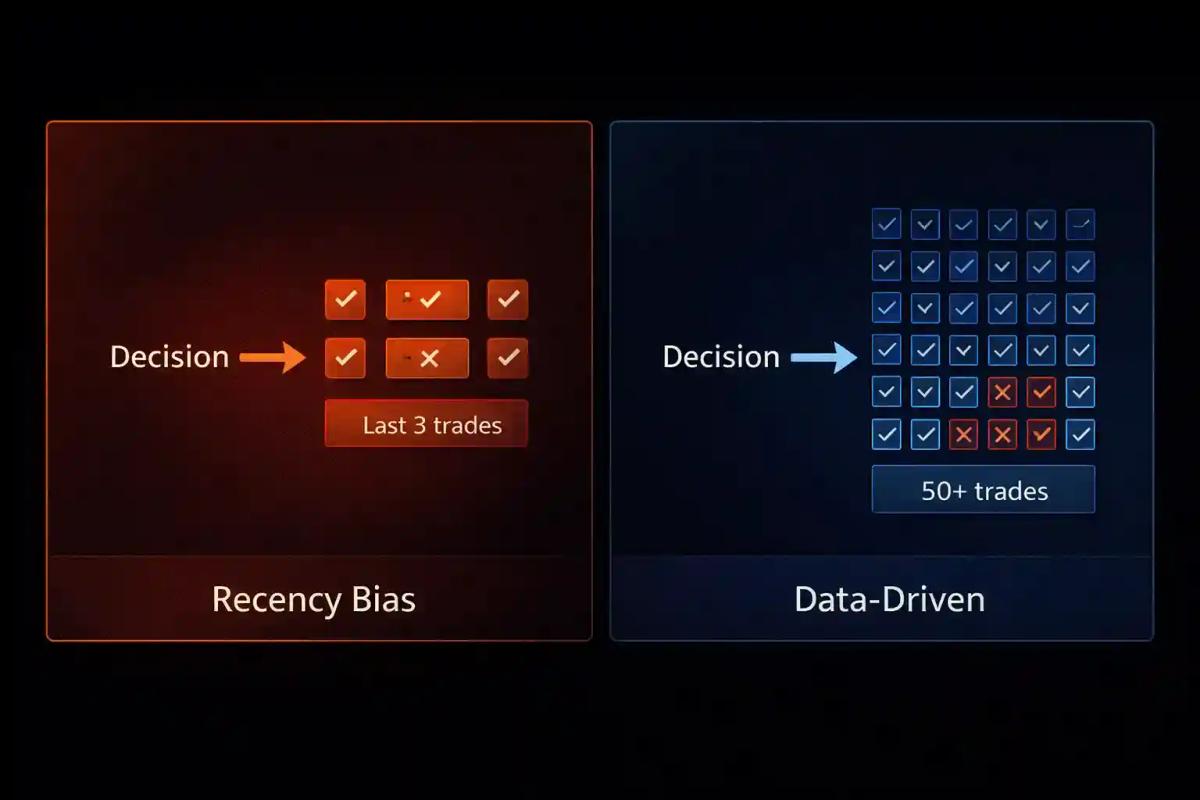
For traders, this plays out in a very specific way. Instead of evaluating a strategy based on hundreds of trades or months of data, your brain zeroes in on what just happened. A string of three losing trades starts to feel like the whole strategy is broken. Two big winners in a row, and suddenly you feel untouchable.
Think of it like judging the weather based only on yesterday. If it rained yesterday, recency bias convinces you it’s going to rain today, regardless of what the seasonal forecast says. In trading, your “seasonal forecast” is your backtested strategy and long-term track record. But recency bias keeps dragging your attention back to yesterday’s rain.
The core problem is that your brain treats it as far more meaningful than it actually is, crowding out the broader picture entirely.
How Recency Bias Differs from Normalcy Bias and Other Cognitive Traps
Recency bias often gets tangled up with other cognitive biases, so it helps to draw clean lines between them.
- Recency bias makes you overweight what just happened. You assume recent results predict what’s coming next.
- Normalcy bias pulls in nearly the opposite direction. It makes you underreact to unusual events because you assume things will stay “normal.” A trader with normalcy bias might ignore early warning signs of a major drawdown because “that’s never happened to me before.”
- Confirmation bias nudges you toward information that supports what you already believe. If you’re bullish, you’ll latch onto every bullish signal and wave away the bearish ones.
All three can live in the same trader at the same time, but they pull in different directions. Recency bias stands out because it disguises itself as adaptability. You think you’re reading the market. In reality, you’re reacting to noise.
So what is it about trading, specifically, that makes this bias so stubborn?
Why Traders Are Especially Vulnerable to Recency Bias
The Role of Short-Term Memory in Trade Decisions
Most people don’t walk around remembering their 200th trade from eight months ago. But you almost certainly remember what happened yesterday, or this morning. That’s how short-term memory works: it’s vivid, emotionally loaded, and instantly accessible.
Trading amplifies this because the feedback loop is relentlessly tight. You make a decision, and the result lands on your screen in minutes, hours, or days. Each outcome arrives with an emotional punch, whether that’s relief, excitement, frustration, or regret. Those emotions get stamped into memory far more deeply than any dry statistic in a spreadsheet ever could.
Compare this to something like real estate investing, where results unfold over years. There’s less emotional charge per decision, so short-term memory has less raw material to distort. In trading, you’re generating fresh emotional data constantly, and your brain can’t help treating the freshest data as the most significant.
How Winning and Losing Streaks Distort Judgment
Streaks make everything worse. After a run of winners, confidence inflates. You start to feel like you’ve “figured it out,” and risk management begins to feel like an unnecessary brake on your momentum. After a losing streak, doubt takes root. The strategy you spent months testing suddenly feels unreliable, and the urge to overhaul everything becomes hard to ignore.
In any system with a genuine edge, streaks are statistically inevitable. A strategy with a 60% win rate will still produce strings of four or five consecutive losses on a regular basis. But recency bias doesn’t care about math. It cares about how you feel right now. And right now, five losses in a row feels like proof that something is broken.
The emotional weight of streaks is precisely what makes strong trading psychology so essential, and so difficult to sustain.
How Recency Bias Shows Up in Your Trading
You might assume you’d notice yourself falling into this trap, but recency bias rarely looks irrational from the inside. Here are the most common ways it quietly takes hold.
Overweighting Recent Results in Strategy Evaluation
You’ve been running a swing trading strategy for six months with solid results. Then you hit two rough weeks. Suddenly you’re Googling new setups, watching YouTube videos on different indicators, and questioning whether your approach ever really worked.
This is recency bias in its most familiar form: letting a small, recent sample override a larger, tested one. Instead of asking “how has this strategy performed over 200 trades?”, you’re asking “how did it perform this week?” Those are fundamentally different questions, and only one of them gives you useful information.
Abandoning a Tested System After a Few Losses
This is where recency bias gets expensive. You don’t just doubt your system; you actually walk away from it. Maybe you switch to a completely different strategy, or you drift into “discretionary” trading, which often just means trading on gut feeling dressed up as flexibility.
Traders who stick with a valid system through normal drawdowns are the ones who capture its long-term edge. Those who bail after a handful of losses lock in the losing streak and never get to ride the recovery. If you’ve ever jumped ship from a strategy only to watch it recover without you, recency bias was likely steering that decision.
Increasing Position Size After Recent Wins
This one is deceptive because it feels like confidence, not bias. You’ve had a strong week, so you bump up your lot size or take on a larger position. You’re “letting winners run,” right?
Not quite. If your position sizing rules say you risk 1% per trade, that number shouldn’t shift based on how your last three trades went. Increasing size after wins (and often shrinking it after losses) is a textbook recency bias pattern. It turns your risk management into an emotional thermostat rather than a disciplined framework.
Recognizing these patterns matters. But what’s the actual damage when you let them run unchecked?
The Real Cost of Letting Recent Results Bias Your Decisions
The cost of recency bias is the slow, cumulative erosion of your edge over time.
When you abandon strategies too early, you never collect enough data to know what actually works. When you inflate position sizes after wins, you set yourself up for outsized losses when the streak inevitably ends. When you cut your risk after losses, you miss the recovery trades that would have brought you back to breakeven or beyond.
Over months and years, this pattern carves out a sawtooth equity curve: sharp gains followed by sharp, emotionally driven losses. The strategy might have a genuine edge, but your execution, filtered through recency bias, erodes it.
There’s also a subtler toll: decision fatigue. Constantly second-guessing your approach, researching alternatives, and reworking your plan drains mental energy that would be better spent on disciplined execution. The traders who perform consistently aren’t the ones with the most sophisticated systems. They’re the ones who can sit with discomfort, follow their rules, and trust a process built on meaningful data rather than recent memory.
So how do you actually build that kind of discipline into your trading?
How to Counteract Recency Bias
No single fix eliminates recency bias entirely. It’s a feature of how your brain works, not a bug you can patch. But you can build systems and habits that blunt its influence on your actual trading decisions.
Building a Decision Framework Before the Trade
The best time to make a trading decision is before the market opens and your emotions are still. A pre-trade decision framework, essentially a set of criteria your setup must meet before you enter, strips away a huge amount of real-time emotional decision-making.
Your framework should include:
- Entry criteria based on your strategy rules (not recent performance)
- Position sizing rules that are fixed or formula-based
- Exit criteria (both stop loss and take profit) defined in advance
- A brief gut check: “Am I taking this trade because it fits my system, or because of how my last few trades went?”
That last question is the recency bias circuit breaker. If you can’t answer that the trade fits your system on its own merits, you step aside.
Using a Trading Journal for Perspective Keeping
A well-maintained trading journal is one of the most effective tools against recency bias, not because of what you write, but because of what you read.
When your last three trades are losses and your confidence is rattled, your journal opens the wider view. You can look back at the last time you hit a similar losing streak and see what happened next.
Perspective keeping, the habit of deliberately widening your view beyond recent events, is a mental discipline that strengthens with practice. Your journal is the tool that makes it tangible. Without one, “think about the big picture” is just vague advice. With one, you have real data to anchor your perspective.
Reviewing Performance Over Meaningful Sample Sizes
One of the simplest rules you can adopt: never evaluate your strategy based on fewer than 30 trades. Ideally, aim for 50 to 100 or more before drawing conclusions about whether something is working.
This sounds obvious on paper, but it’s remarkably hard to follow in the middle of a drawdown. Five losses feel like a crisis. Thirty trades feel like an eternity. But statistical significance doesn’t bend to your feelings. Small samples tell you almost nothing about your edge. Acting on them is like flipping a coin five times, getting three heads, and concluding the coin is rigged.
Discipline around sample sizes is one of the core pillars of sound risk management, and it serves as a direct counterweight to recency bias.
Checklists and Rules-Based Execution
Airline pilots use pre-flight checklists not because they don’t know how to fly, but because stress and routine can cause even experts to skip critical steps. The same logic applies to trading.
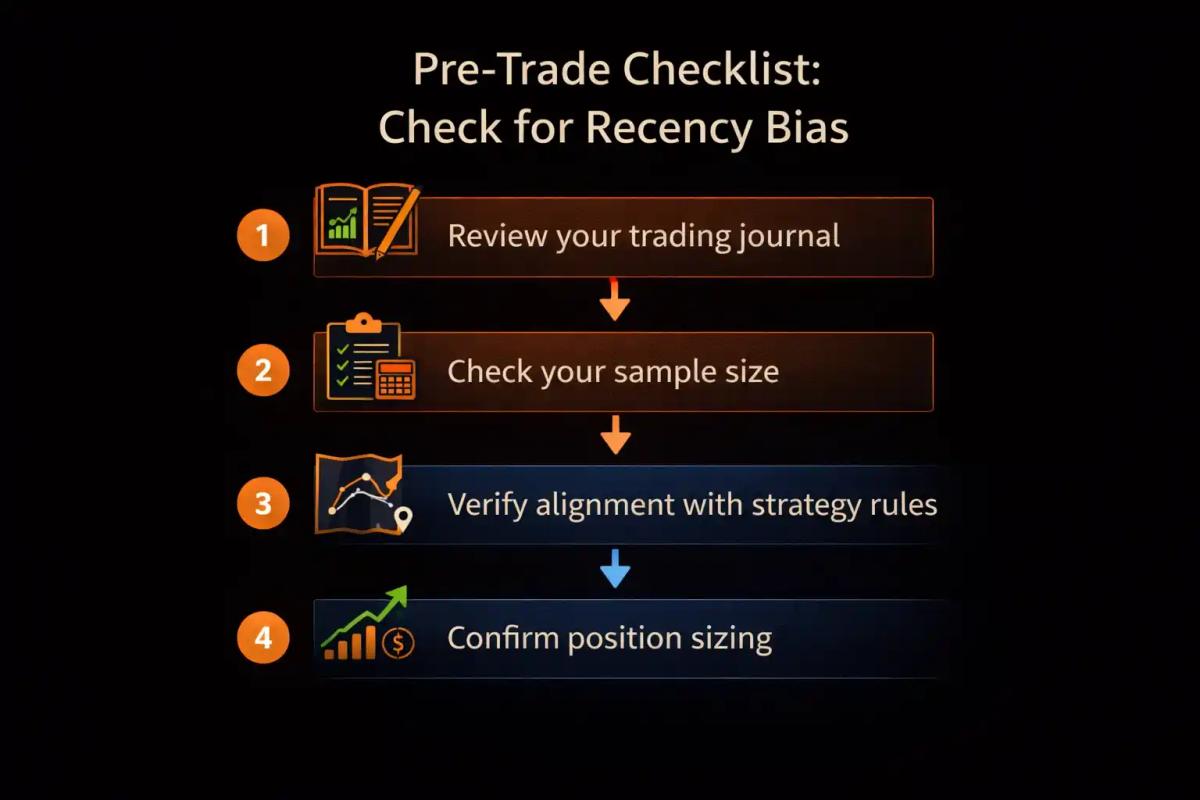
A simple pre-trade checklist might include:
- Does this setup match my documented strategy criteria?
- Is my position size consistent with my risk rules (not shaped by recent P&L)?
- Have I reviewed my journal to confirm I’m not reacting to a recent streak?
- Are my stop loss and take profit levels set before entry?
- Am I trading this because my system says to, or because I “feel” like it?
Consistency is what separates traders who capture their edge over time from those who let recency bias bleed it away.
Frequently Asked Questions
What's the difference between recency bias and loss aversion?
Recency bias is about overweighting recent events regardless of whether they were wins or losses. Loss aversion, on the other hand, is the tendency to feel the pain of a loss more intensely than the pleasure of an equivalent gain. They often reinforce each other (a recent loss hits harder because of loss aversion, then recency bias makes you overreact to it), but they're distinct psychological patterns.
Does recency bias only affect beginner traders?
Not at all. Experienced traders are just as susceptible because the bias is rooted in how human memory and emotion function, not in skill level. The difference is that seasoned traders are more likely to have systems in place (journals, checklists, rules-based frameworks) that limit how much the bias can steer their actual decisions.
How can I tell if I'm making decisions based on recency bias right now?
Ask yourself one question: "Would I make this same decision if my last five trades had gone differently?" If the answer is no, recency bias is likely at play. Other warning signs include a sudden urge to overhaul a strategy you've tested extensively, adjusting position sizes based on recent results, or feeling unusually confident or defeated after a small cluster of trades.
What's the single most effective habit to reduce recency bias?
If you only adopt one habit, make it keeping and regularly reviewing a trading journal. A journal forces you to confront your full track record rather than relying on emotional memory. It transforms "I feel like my strategy isn't working" into "my strategy has a 58% win rate over 150 trades, and this drawdown is within normal parameters." That shift from feeling to data is the most powerful recency bias counterweight available to you.
Can recency bias ever work in a trader's favor?
In rare cases, yes. If market conditions have genuinely shifted (a regime change in volatility, a structural break in correlations), paying close attention to recent data might alert you to something your historical model hasn't captured. But this is the exception, not the rule, and it demands careful analysis rather than gut reaction. The vast majority of the time, recency bias leads you to overreact to noise rather than adapt to signal.
About the authors


Related articles
Analysis Paralysis in Trading: Why You Freeze and How to Fix It
Learn to recognize analysis paralysis in trading, understand its psychological roots, and build a decision-making framework with confident execution.
Anchoring Bias in Trading: How Mental Price Traps Cost You Money
Learn how anchoring bias distorts your trading decisions. Spot mental price traps, break free from fixation on entry prices, and build systems to protect your returns.
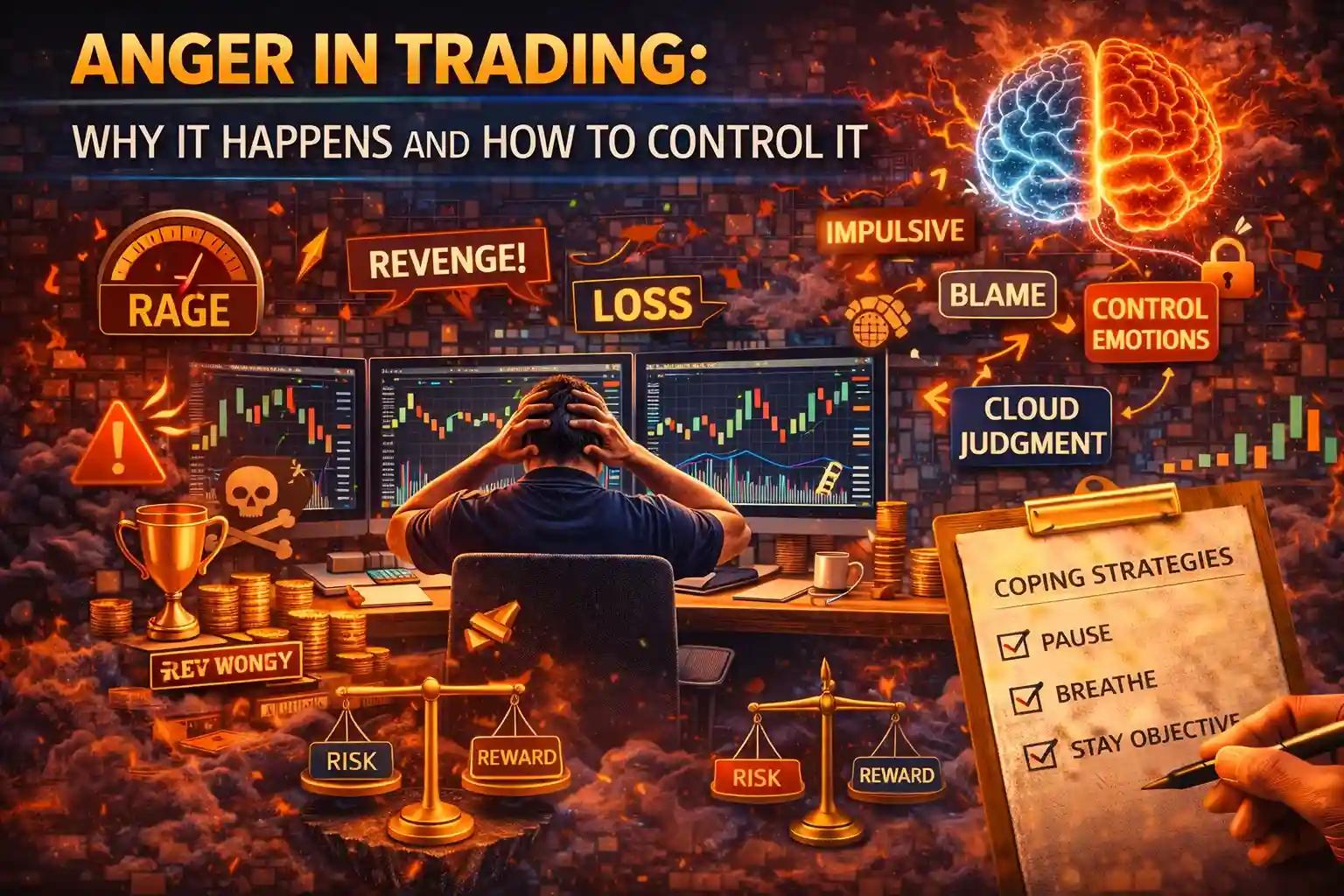
Anger in Trading: Why It Happens and How to Control It
Learn why anger strikes during trading, how it destroys performance through revenge trades and broken rules, and proven techniques to control it.
0 comments