


Regret in Trading: Why It Happens and How to Move Past It
Regret in trading is one of the most common emotional experiences you’ll face in the markets, yet one of the least discussed in any practical way. It’s not a character flaw. It’s not proof you’re too emotional for this game. It’s a deeply wired psychological response, and understanding how it works is the first step toward keeping it from quietly steering your next fifty decisions.
This is a breakdown of what regret actually does inside your trading brain, why it hooks you so effectively, and what you can do to loosen its grip for good.
What Regret in Trading Actually Is
Most traders think regret is just feeling bad about a loss. It’s more specific than that, and recognizing what you’re actually dealing with changes how you respond.
The Psychology Behind Trading Regret
Regret is a counterfactual emotion. It’s powered by comparison: measuring what happened against what you believe could have happened if you’d chosen differently. Your brain constructs an alternate reality where you made the “right” call, then punishes you for living in the version where you didn’t.
In trading, this hits harder than in most areas of life because the feedback is immediate, numerical, and unambiguous. You don’t have to wonder what would have happened. The chart shows you exactly what you missed or what you lost. There’s nowhere to hide, and your brain knows it.
This is why a $200 loss on a trade where you broke your rules can sting worse than a $500 loss on a trade you executed cleanly. Regret isn’t proportional to the dollar amount. It’s proportional to how much you believe the outcome was your fault.
How Regret Differs from Healthy Self-Reflection
Here’s where it gets tricky. Regret feels productive. It disguises itself as self-improvement. You tell yourself you’re “reviewing what went wrong,” but what you’re actually doing is looping on the emotional charge of the outcome without extracting anything useful.
Healthy self-reflection asks: “Was my process sound? What can I adjust going forward?” It’s forward-facing and specific.
Regret asks: “Why didn’t I do the obvious thing?” It’s backward-looking, emotionally loaded, and usually distorted by information you didn’t have at the time.
If your post-trade analysis leaves you feeling informed and adjusted, that’s reflection. If it leaves you feeling heavy, frustrated, or hesitant about your next setup, that’s regret wearing a productive mask. That distinction matters far more than most traders realize.
So what does regret actually look like when it shows up at your desk? It turns out there are two very different flavors, and each one derails your trading in its own way.
The Two Types of Trading Regret
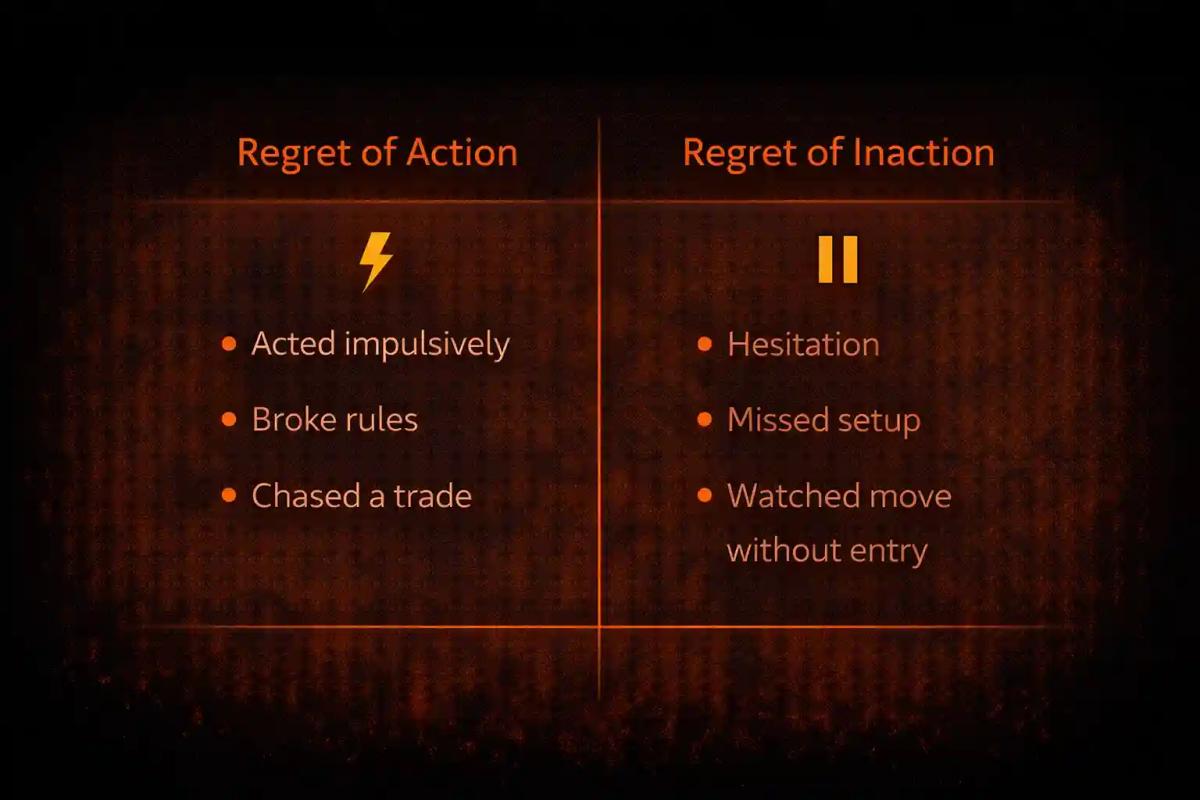
Not all regret is equal. The trade you wish you hadn’t taken and the trade you wish you had are two completely different psychological experiences, and they push your behavior in opposite directions.
Regret of Action (Trades You Took)
This is the regret that comes from doing something you now wish you hadn’t. You entered a position, it moved against you, and now you can’t stop replaying the moment you pulled the trigger.
Common triggers include:
- Breaking your own rules (entering too early, oversizing, ignoring a stop)
- Taking an impulsive trade based on a tip, headline, or gut feeling
- Holding through a planned exit because you hoped for more
Action regret tends to feel sharp and personal. It carries self-blame because you can point to a specific decision and say, “I did that.” The mental replay is vivid because there was a concrete moment of choice you can pinpoint on the chart.
Regret of Inaction (Trades You Missed)
This is the quieter, more corrosive version. You saw the setup. You recognized it. Maybe you even had it on your watchlist. But you didn’t pull the trigger, and now the move has happened without you.
Inaction regret is fueled by:
- Hesitation after a recent loss that shook your confidence
- Overthinking the entry and waiting for “more confirmation”
- Being distracted or away from your screen during a valid setup
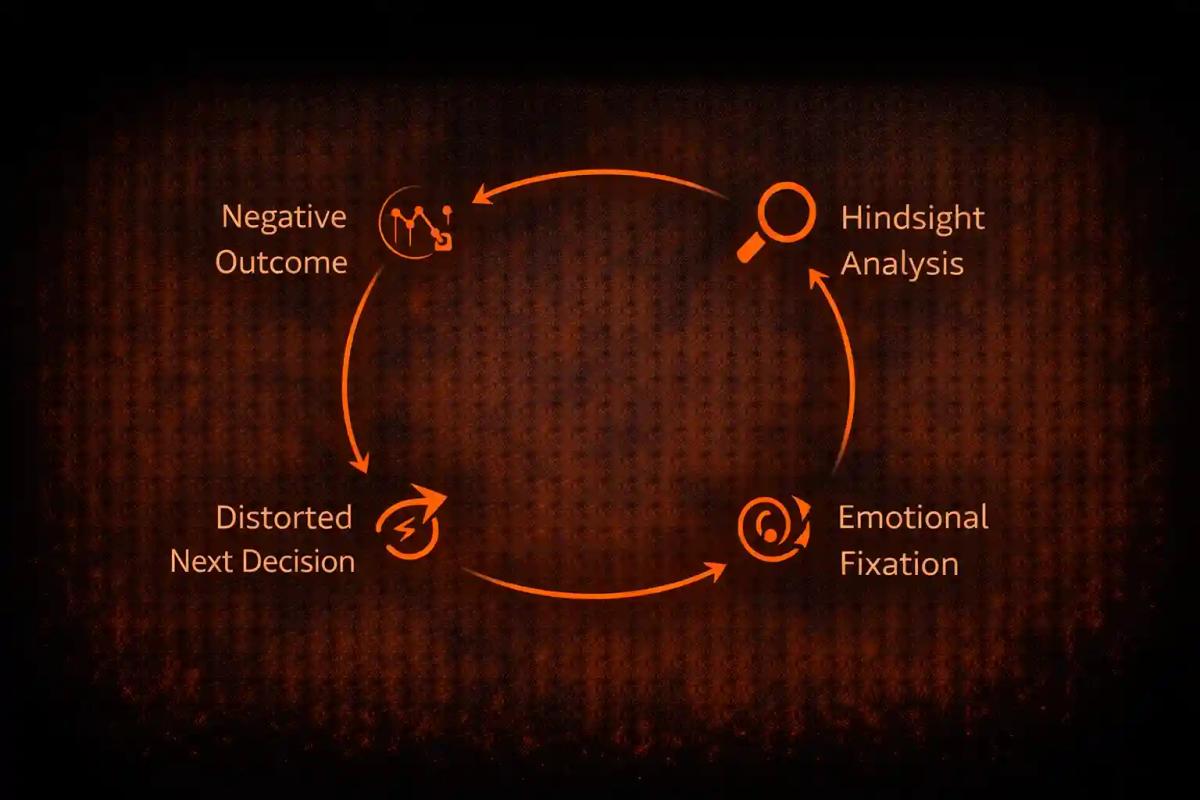
What makes inaction regret particularly dangerous is that it accumulates. One missed trade stings. Three in a row starts to feel like a pattern. And that accumulated frustration often becomes the fuel for the exact impulsive trades that create action regret. It’s a cycle, and once you see it, you’ll recognize it everywhere in your trading history.
But what keeps that cycle spinning? Why can’t you simply acknowledge the miss or the loss and move on? The answer lies in a few specific cognitive traps that your brain walks into almost automatically.
Why Traders Get Trapped in Regret Loops
Regret doesn’t just visit and leave. For many traders, it moves in and redecorates the whole room. Understanding the mental mechanisms that keep you stuck is the only way to interrupt the pattern before it calcifies.
Hindsight Bias and the Illusion of Obviousness
Hindsight bias is your brain’s tendency to look at a past event and conclude it was predictable all along. After a trade goes wrong (or a missed trade goes right), your memory quietly rewrites the story. Suddenly the signals were “obvious.” The warning signs were “right there.”
They weren’t. Or at least, they weren’t nearly as clear in real time as they appear in the rearview mirror. Your brain edits out the ambiguity, the conflicting signals, the genuine uncertainty that existed when you made the decision. What’s left is a clean narrative where you should have known better, a story your mind is remarkably good at telling.
This is one of the most well-documented cognitive biases in behavioral finance, and it’s the single biggest fuel source for trading regret. You’re not regretting a bad decision. You’re regretting a retroactively rewritten version of a decision that looked very different in the moment.
Outcome Bias vs. Process Evaluation
Closely related is outcome bias: the tendency to judge the quality of a decision by its result rather than by the reasoning behind it.
Think of it this way. If you follow your system perfectly and the trade loses, that’s a good decision with a bad outcome. If you break every rule in your playbook and the trade wins, that’s a bad decision with a good outcome. Regret almost always latches onto outcomes rather than process, which means it punishes you for things that were sometimes just the normal cost of probability playing out.
The moment you start evaluating your decisions by whether they made money instead of whether they followed your edge, regret gets a permanent seat at the table.
The Role of FOMO in Amplifying Regret
Fear of missing out doesn’t just cause bad entries. It supercharges regret after the fact. When you miss a move and then watch the market continue without you, FOMO takes the natural sting of inaction regret and amplifies it into something that feels urgent, almost physical.
FOMO-amplified regret is especially dangerous because it creates false time pressure. It whispers that you need to act now to make up for what you missed, which is exactly the emotional state most likely to produce your next regretful trade. The loop tightens with each rotation.
So if regret is this deeply wired and this effectively self-reinforcing, what does it actually do to your trading going forward? The damage is more specific than you might expect.
How Regret Distorts Future Trading Decisions
Regret doesn’t stay in the past. It actively warps how you approach the next trade, and the one after that. Here’s where the real cost shows up.
Revenge Trading as a Regret Response
Revenge trading is regret’s most visible offspring. After a painful loss or a missed opportunity, you feel a pull to get back into the market immediately, not because there’s a valid setup, but because the emotional discomfort of sitting with the regret feels unbearable.
Revenge trades are characterized by larger position sizes, looser criteria for entry, and a fixation on recovering a specific dollar amount. You’re not trading the market anymore. You’re trading against your own feelings. And the outcomes tend to compound the original regret rather than resolve it.
Hesitation and Missed Setups
On the opposite end, regret can make you freeze. After a trade goes badly, your brain flags similar setups as threats rather than opportunities. You see the pattern forming, it matches your criteria, but your finger won’t click. The memory of the last time you took “this kind of trade” holds you in place like an invisible wall.
This hesitation often looks rational from the outside (“I’m being more selective”), but internally it’s driven by emotional avoidance, not improved analysis. The distinction is subtle but critical.
Abandoning a Tested Strategy
Perhaps the most costly long-term consequence is strategy abandonment. A string of losses, even if they fall within normal statistical variance for your system, can trigger enough regret to make you throw out an approach that actually works.
You switch to a new indicator, a new timeframe, a new method, not because you’ve done rigorous backtesting, but because continuing with the old approach feels emotionally intolerable. Discipline erodes quietly, trade by trade, until your process is unrecognizable from what you started with.
The good news? Once you see how regret operates, you can build specific defenses against it. And they’re more practical than you might think.
Practical Strategies for Dealing with Regret
You can’t eliminate regret entirely, and you shouldn’t try to. What you can do is change your relationship with it so it becomes information rather than interference.
Separating Decision Quality from Outcome Quality
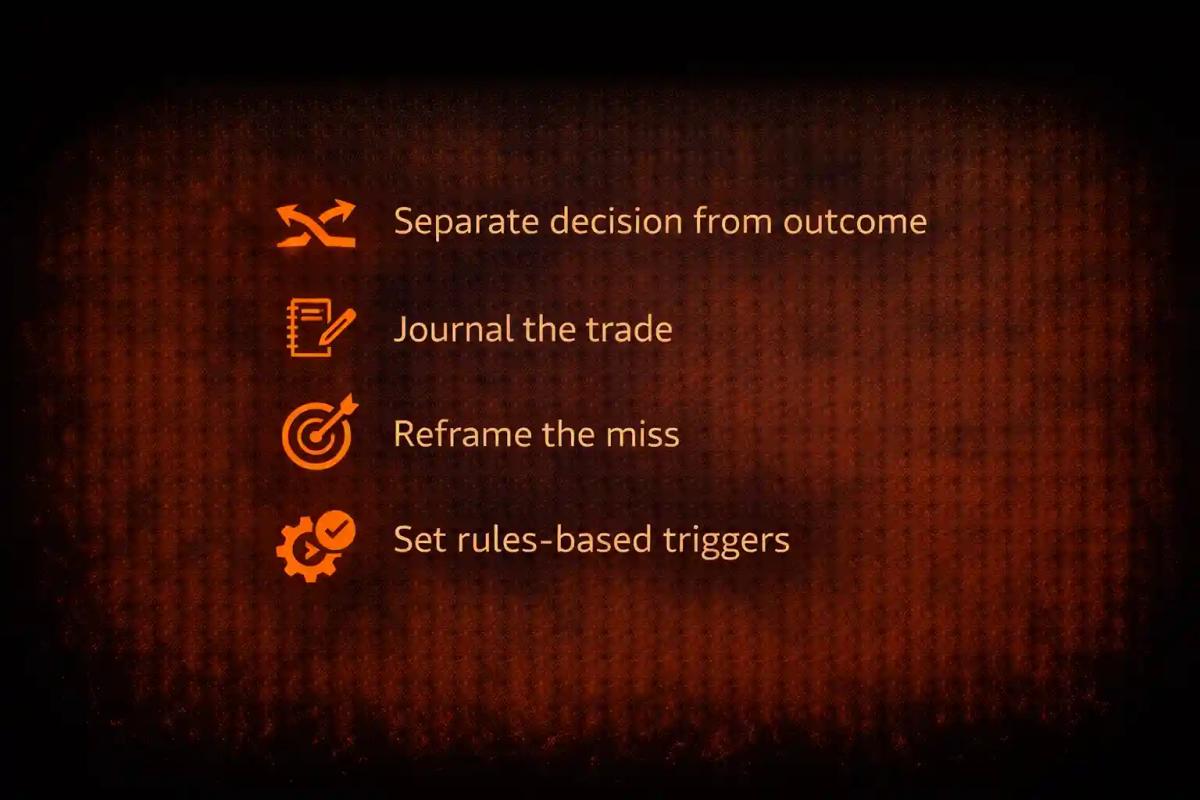
This is the single most powerful mental shift you can make as a trader. Start grading your trades on process, not profit.
After each trade, ask yourself:
- Did I follow my entry criteria?
- Was my position size appropriate?
- Did I manage the trade according to my plan?
- Would I take this same trade again with the same information?
If the answers are yes, the trade was a good trade regardless of the outcome. Losses on good decisions are simply the cost of operating in a probabilistic environment. When you internalize this, regret loses most of its leverage because you stop blaming yourself for things that were never fully in your control.
Using a Trading Journal to Process Regret
A trading journal is the most effective tool for converting regret into usable data. But the key is how you journal, not just that you do it.
For each trade that triggers regret, record:
- What you felt before, during, and after the trade
- What information you had at the time of the decision (not what you know now)
- Whether the decision aligned with your system
- What, if anything, you would genuinely change about the process (not the outcome)
Writing forces your brain out of the emotional loop and into analytical mode. Over time, your journal becomes a factual record that counters hindsight bias directly. When your brain insists “you should have known,” your journal says “here’s what you actually knew, and here’s what you did with it.”
Reframing Missed Opportunities
Missed trades are only painful if you frame them as losses. They’re not. You didn’t lose money on a trade you didn’t take. You maintained your capital and preserved your position to take the next valid setup.
A useful reframe: every missed trade is evidence that you have standards. You didn’t chase. You didn’t force it. That restraint, even when it felt wrong in the moment, is exactly the behavior that keeps you in the game long-term.
Try keeping a separate section in your journal for missed trades. Note what you saw, why you didn’t enter, and what happened afterward. Over time, you’ll notice that many of those “obvious” misses would have actually been mediocre or losing trades. Your memory just doesn’t hold onto those versions as tightly.
Setting Rules-Based Triggers to Reduce Discretionary Regret
The more decisions you leave to real-time discretion, the more surface area you give regret to work with. Every judgment call becomes a potential “what if” later.
Reduce this by defining as many elements of your trading process as possible in advance:
- Entry criteria (specific, observable, non-negotiable)
- Position sizing rules
- Stop-loss and take-profit levels
- Conditions under which you sit out entirely
When you follow a predefined rule and the trade doesn’t work out, regret has nowhere to land. You didn’t make a choice that went wrong. You executed a system. The emotional difference is significant, and it compounds over time.
But even the best strategies work better when they’re built on the right psychological foundation. What does that actually look like in practice?
Building a Regret-Resistant Trading Mindset
Strategies handle individual episodes of regret. A mindset shift changes how vulnerable you are to it in the first place.
Accepting Uncertainty as a Trading Constant
Every trade is a probability, not a certainty. You will have losses. You will miss moves. These are features of trading, not bugs. The moment you genuinely accept that no amount of skill, preparation, or analysis eliminates uncertainty, regret loses its central premise: that you “should have” known the outcome in advance.
Think of it like weather forecasting. A meteorologist who predicts a 70% chance of rain and it stays dry didn’t make a bad forecast. They made an accurate probabilistic assessment that happened to fall in the 30%. Your trades work the same way. The quality of the decision and the quality of the outcome are two separate things.
Focusing on Long-Term Edge Over Single Trades
Regret is almost always focused on individual trades. Your edge plays out over hundreds or thousands. When you zoom out, any single trade, win or loss, taken or missed, becomes a tiny data point in a much larger sample.
Ask yourself: “Will this trade matter to my equity curve in six months?” Almost always, the honest answer is no. What matters is whether you’re consistently executing a strategy with a positive expectancy. Trading psychology isn’t about feeling good on every trade. It’s about maintaining your process across enough trades for the math to work in your favor.
When to Seek Professional Support
There’s a line between normal trading regret and something deeper. If you find that regret is persistent, if it’s affecting your sleep, your mood outside of trading, your relationships, or your ability to function normally, that’s not a trading problem anymore. That’s a mental health concern that deserves professional attention.
A therapist experienced in performance psychology or cognitive behavioral approaches can help you address thought patterns that go beyond what any trading journal or reframing technique can handle. There’s no weakness in recognizing that. Some of the most disciplined traders in the world work with performance coaches or psychologists as part of their routine.
This article is educational content, not clinical advice. If trading-related distress is significantly impacting your daily life, please consult a qualified mental health professional.
Frequently Asked Questions
Is regret a normal part of trading, or does it mean something is wrong with me?
Regret is completely normal and nearly universal among traders, regardless of experience level. It's a natural response to making decisions under uncertainty where outcomes are immediately visible. It only becomes a concern when it's persistent enough to interfere with your decision-making or your wellbeing outside of trading.
What's the difference between regret and a constructive trade review?
Constructive trade review is forward-looking and process-focused. It asks what you can adjust next time. Regret is backward-looking and outcome-focused. It fixates on what you should have done differently based on information you didn't have at the time. If your review leaves you feeling heavier and more hesitant rather than more informed, you've likely crossed from review territory into regret.
How do I stop mentally replaying a specific bad trade?
Write it down in your trading journal with full detail, including what you knew at the time, what you felt, and what you'd change about your process (not the outcome). This externalizes the loop. Your brain tends to replay unresolved experiences, and journaling signals that the event has been processed and catalogued. The replay won't vanish overnight, but the intensity and frequency will decrease noticeably.
Should I journal trades I missed, or only trades I actually took?
Journal both. Missed trades carry their own emotional weight, and recording them creates a factual counterbalance to your memory's tendency to only remember the ones that would have been winners. Over time, your missed trade log will reveal that many of those "obvious" opportunities were far more ambiguous than you remember them being.
How does regret lead to revenge trading?
Regret creates emotional discomfort that feels like it demands immediate resolution. Revenge trading is the attempt to "undo" that feeling by jumping back into the market and recovering the loss or capturing the missed move. It's not driven by analysis or edge. It's driven by emotional urgency, which is why revenge trades tend to be oversized, poorly planned, and often result in additional losses that deepen the original regret.
When should I consider getting professional help for trading-related regret?
If regret consistently disrupts your sleep, bleeds into your mood and relationships outside of trading, or creates anxiety that makes it difficult to execute your strategy over weeks or months, it's worth speaking with a mental health professional. Look for someone experienced in performance psychology or cognitive behavioral approaches. Persistent emotional distress is not something you should try to "trade through."
Do experienced, professional traders still feel regret?
Yes. Experience doesn't eliminate regret. It changes your relationship with it. Experienced traders tend to recognize regret faster, process it through structured habits like journaling and process-based evaluation, and prevent it from leaking into their next decision. The feeling still shows up. They've just built reliable systems to keep it from taking the wheel.
About the authors


Related articles
Analysis Paralysis in Trading: Why You Freeze and How to Fix It
Learn to recognize analysis paralysis in trading, understand its psychological roots, and build a decision-making framework with confident execution.
Anchoring Bias in Trading: How Mental Price Traps Cost You Money
Learn how anchoring bias distorts your trading decisions. Spot mental price traps, break free from fixation on entry prices, and build systems to protect your returns.
Anger in Trading: Why It Happens and How to Control It
Learn why anger strikes during trading, how it destroys performance through revenge trades and broken rules, and proven techniques to control it.
0 comments