


Self-Awareness for Traders: Know Yourself to Trade Better
Self-awareness for traders isn’t some soft, feel-good concept. It’s the foundational skill that determines whether your strategy actually works in your hands or just looks good in a backtest. This guide will help you identify your trading personality, run an honest self-assessment, and start turning self-knowledge into a genuine performance edge.
This article is for educational purposes only and does not constitute financial or psychological advice. If you’re experiencing serious emotional or psychological difficulties related to trading, please consult a qualified professional.
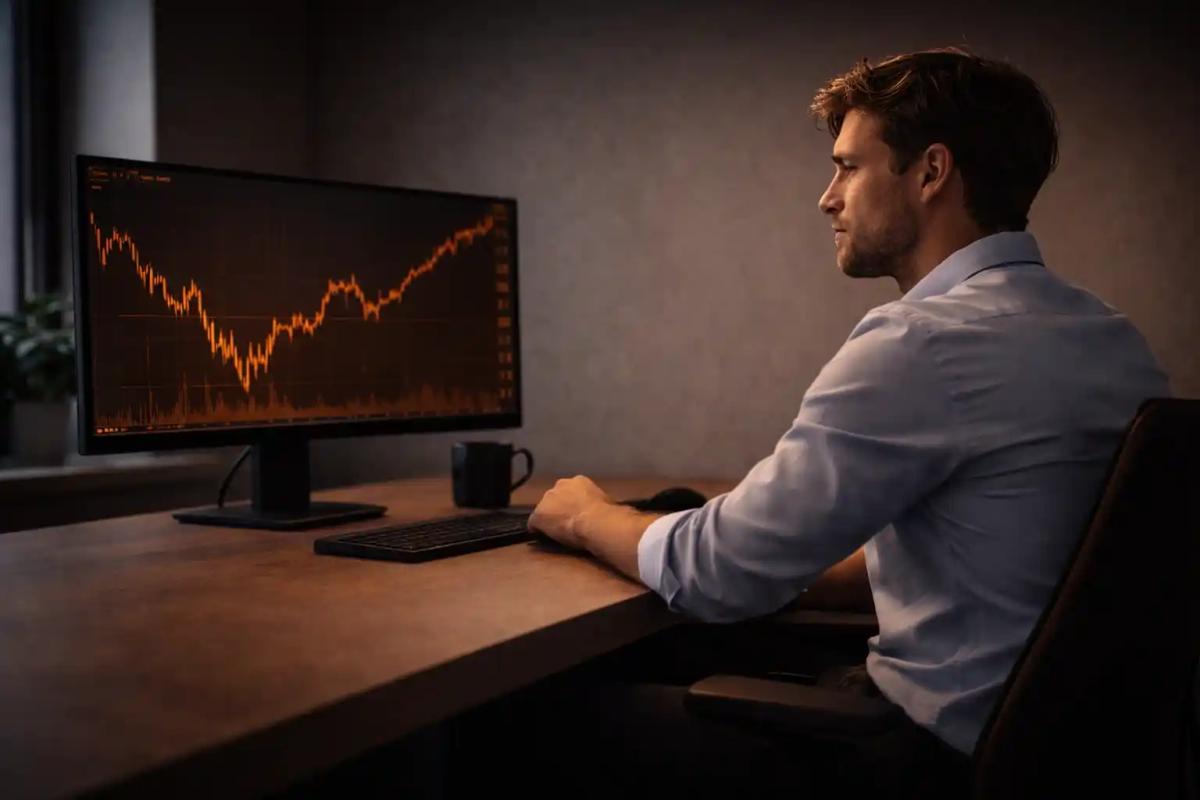
What Self-Awareness Actually Means in Trading
Most traders hear “self-awareness” and immediately think it means controlling their emotions. That’s part of it, but it barely scratches the surface.
Beyond “Control Your Emotions”
“Just don’t be emotional” is about as useful as telling someone with a flat tire to “just drive better.” Emotions are data. Self-awareness in trading means understanding why you react the way you do, what triggers those reactions, and how those patterns consistently show up in your decisions.
Think about the difference between saying “I panicked and sold too early” and understanding “I tend to exit winning trades prematurely because I have a deep fear of giving back gains, likely rooted in an early experience where I watched a profitable trade turn into a significant loss.” The first is an observation. The second is self-awareness, and it gives you something you can actually work with.
True trading self-awareness means recognizing your default patterns around risk, patience, decision speed, and confidence, then understanding how those patterns help or hurt you under specific market conditions.
The Gap Between Knowing and Doing
Here’s where it gets tricky. Most traders already know they have weaknesses. You probably know you overtrade, or hold losers too long, or skip your stop losses. Knowing isn’t the problem.
The real gap sits between intellectual knowledge and behavioral change. You can know that revenge trading is destructive and still do it ten minutes after a bad loss. Self-awareness bridges that gap by making unconscious patterns conscious before you act on them, not after. It becomes the early warning system that gives you a chance to choose differently.
So if self-awareness is this valuable, why do so few traders actually invest time in developing it?
Why Most Traders Skip Self-Assessment
The trading world has a blind spot, and it isn’t a technical one. It’s the widespread belief that finding the right strategy matters more than understanding the person executing it.
The Rush to Strategy
When you’re new to trading, the pull toward strategy is magnetic. You want setups, entries, exits, indicators. That’s tangible. That’s measurable. Self-assessment, by comparison, feels abstract and painfully slow.
So most traders spend months (or years) cycling through strategies, blaming each one for not delivering, when the real issue is a mismatch between the strategy and their psychological wiring. A highly impatient person forcing themselves into position trading is like a sprinter training for a marathon. Not impossible, but you’re fighting yourself every single step.
Ego and Blind Spots
There’s another reason traders avoid self-assessment: it stings. Nobody enjoys discovering that their “conviction” is actually stubbornness, or that their “risk tolerance” is really just an inability to accept being wrong.
Ego protects us from truths we’re not ready to hear. In trading, that protection carries a financial cost. The traders who tend to make the fastest progress are the ones willing to sit with the discomfort of honest self-evaluation, even when what they find isn’t flattering.
So what does an honest look at your trading personality actually involve? Let’s break it down.
Identifying Your Trading Personality
Your trading personality isn’t a single trait. It’s a combination of tendencies across several dimensions, and understanding where you fall on each one is the first step toward aligning your approach with who you actually are.
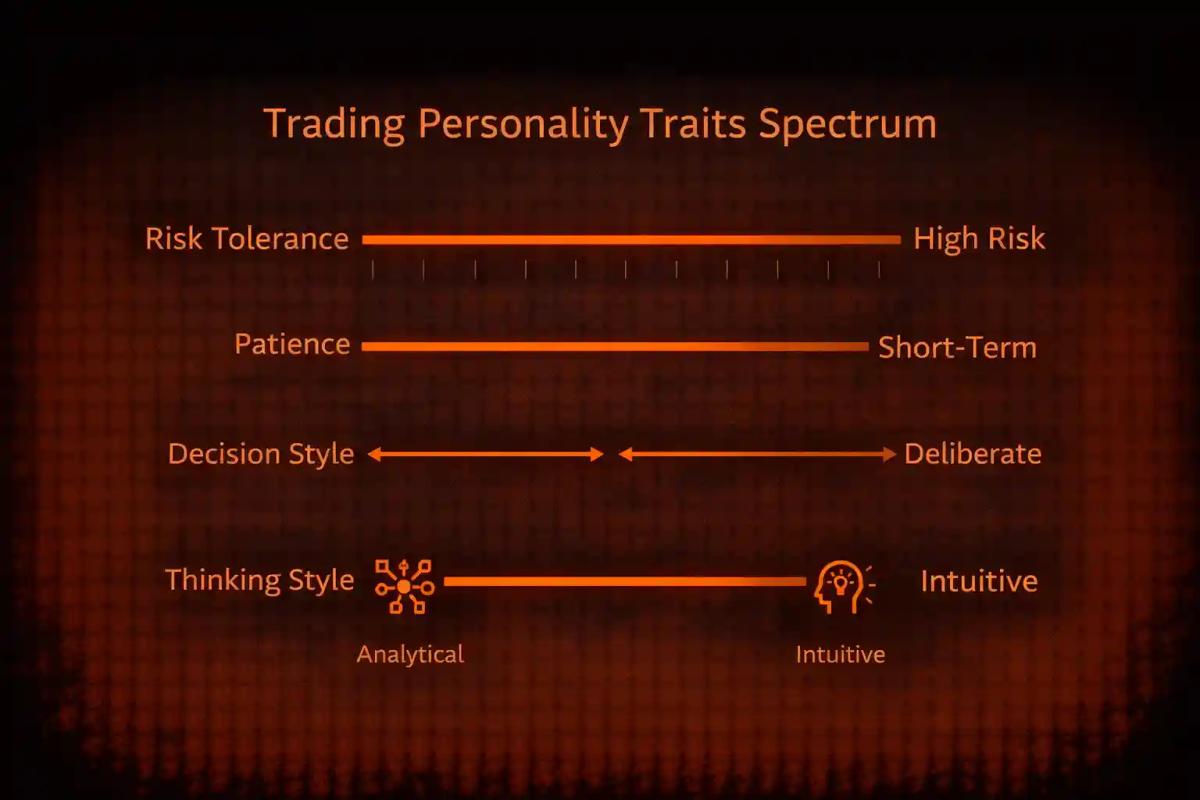
Risk Tolerance vs. Risk Capacity
These two concepts sound similar but are fundamentally different. Confusing them is one of the most common mistakes traders make.
Risk tolerance is psychological. It’s how much uncertainty and potential loss you can handle emotionally before your judgment starts to crack. Some people can watch a position drop 5% and feel nothing. Others start sweating at 1%.
Risk capacity is financial. It’s how much you can actually afford to lose without it affecting your life, your ability to keep trading, or your financial obligations.
Problems surface when these two are misaligned. A trader with high risk tolerance but low risk capacity might take oversized positions they can’t afford to lose. A trader with high capacity but low tolerance might trade too small and never see meaningful returns. Knowing where you sit on both scales is essential for setting position sizes you can live with, financially and emotionally.
Decision-Making Style Under Pressure
When a trade moves against you quickly, what’s your instinct? Do you freeze and wait for more information? Act immediately on gut feeling? Start searching for reasons the trade might still work out?
Your decision-making style under pressure reveals a lot about which strategies will feel natural. Fast, intuitive decision-makers often gravitate toward scalping or short-term day trading. More deliberate, analytical thinkers tend to thrive with swing or position trading, where there’s time to process information before committing.
Neither style is inherently better. But trading against your natural wiring creates constant friction that drains your energy and chips away at your performance over time.
Time Horizon and Patience Profile
Be honest with yourself here. Can you hold a trade for weeks without checking it constantly? Or does anything longer than a few hours make you restless?
Your patience profile isn’t just a preference. It’s a core part of your personality that affects everything from which timeframes you trade to how you handle drawdowns. A trader with low patience who forces themselves into long-term positions will almost certainly exit too early, cutting winners short and undermining whatever edge their strategy had.
Understanding these traits is one thing. But how do they translate into concrete strengths and weaknesses at the trading desk?
Mapping Your Personal Strengths and Weaknesses
Every personality trait that helps you in one area of trading can hurt you in another. The goal isn’t to eliminate weaknesses entirely. It’s to know what they are so you can build systems around them.
Strengths That Translate to Trading Edge
Consider a trader who is naturally patient and analytical. In swing trading, that’s a genuine advantage. They can wait for high-probability setups, avoid overtrading, and ride winners without panicking at every pullback.
Or take someone who’s highly disciplined in other areas of life, maybe they exercise consistently or manage their time well. That same discipline translates directly into following a trading plan, honoring stop losses, and sticking to position-sizing rules.
Your existing strengths are trading assets. The key is identifying them clearly and choosing a style that lets you lean into them rather than neutralize them.
Weaknesses That Become Costly Patterns
On the flip side, a trader who’s fiercely competitive might struggle to accept losses, turning small losers into catastrophic ones because “being wrong” feels intolerable. Someone who’s naturally optimistic might develop a blind spot for risk, always expecting the best-case scenario and brushing past warning signs.
Here are some patterns worth examining closely:
- Perfectionism often leads to analysis paralysis, where you miss good trades because no setup is ever “perfect enough”
- Impulsiveness shows up as overtrading, chasing entries, and deviating from your plan after a big win or loss
- People-pleasing tendencies might make you overly influenced by other traders’ opinions, fintwit, or chat room calls
- Stubbornness frequently manifests as refusing to cut losses or insisting a thesis is right despite mounting contrary evidence
The point isn’t to “fix” your personality. It’s to build enough awareness that these tendencies don’t hijack your trading unconsciously.
How to Run a Self-Assessment as a Trader
Self-awareness isn’t a one-time exercise. It’s an ongoing practice. But you need somewhere to start, and the most effective tool is one you’ve probably heard about but might not be using correctly.
The Trading Journal as a Mirror
A trading journal that only records entries, exits, and P&L is a ledger, not a self-assessment tool. To use your journal as a genuine mirror, you need to track what’s happening inside you alongside what’s happening on the chart.
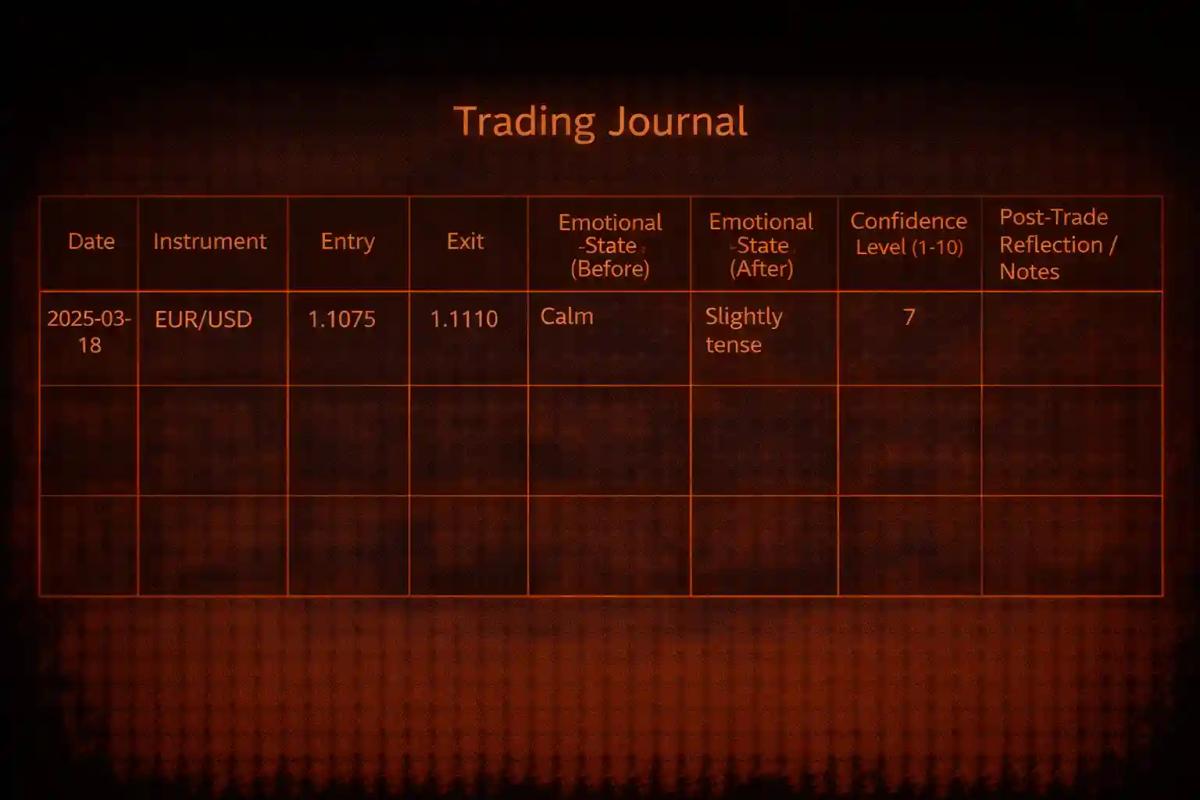
For every trade, consider logging:
- Your emotional state before entering (calm, anxious, excited, bored, frustrated)
- Your confidence level on a 1-10 scale
- Whether the trade followed your plan or was a deviation
- Your emotional state after exiting
- What, if anything, you’d do differently
Over time, this data reveals patterns no chart can show you. You might discover you make your worst trades on Mondays, or after a string of winners, or when you’re running on four hours of sleep. That’s the kind of insight that actually moves the needle on performance.
If you don’t already have a system for this, our guide on keeping a trading journal walks through the process step by step.
Reviewing Trades for Behavioral Patterns
Set a weekly review session where you look at your journal not for P&L, but for behavioral patterns. You’re hunting for recurring themes.
Ask yourself questions like:
- Which types of trades do I consistently execute well?
- Where do I most often deviate from my plan?
- What emotional state precedes my worst trades?
- Am I sizing positions based on analysis, or based on how I feel about a trade?
- Do I trade differently after a win streak versus a loss streak?
The answers won’t always be comfortable, but they’ll be actionable. Pattern recognition is a skill traders already value in markets. Turning it inward is simply applying the same analytical lens to yourself.
Questions to Ask Yourself After Every Session
Building self-awareness into your daily routine doesn’t require hours of introspection. A few focused questions after each session can do the heavy lifting.
Try these as a starting framework:
- Did I follow my plan today? If not, what pulled me off track?
- What was my strongest decision today, and what drove it?
- What was my weakest decision, and what was I feeling at the time?
- Is there anything I’m avoiding looking at honestly?
That last question matters most. The things you don’t want to examine are usually exactly the things you need to examine.
With a clearer picture of your patterns in hand, the next question becomes practical: what do you actually do with this self-knowledge?
Matching Self-Knowledge to Your Trading Style
Self-awareness without application is just navel-gazing. The real payoff comes when you use what you’ve learned about yourself to choose, or refine, a trading style that fits your wiring.
Personality Traits and Strategy Fit
Different trading styles demand different psychological profiles. Here’s a general mapping to help you assess fit:
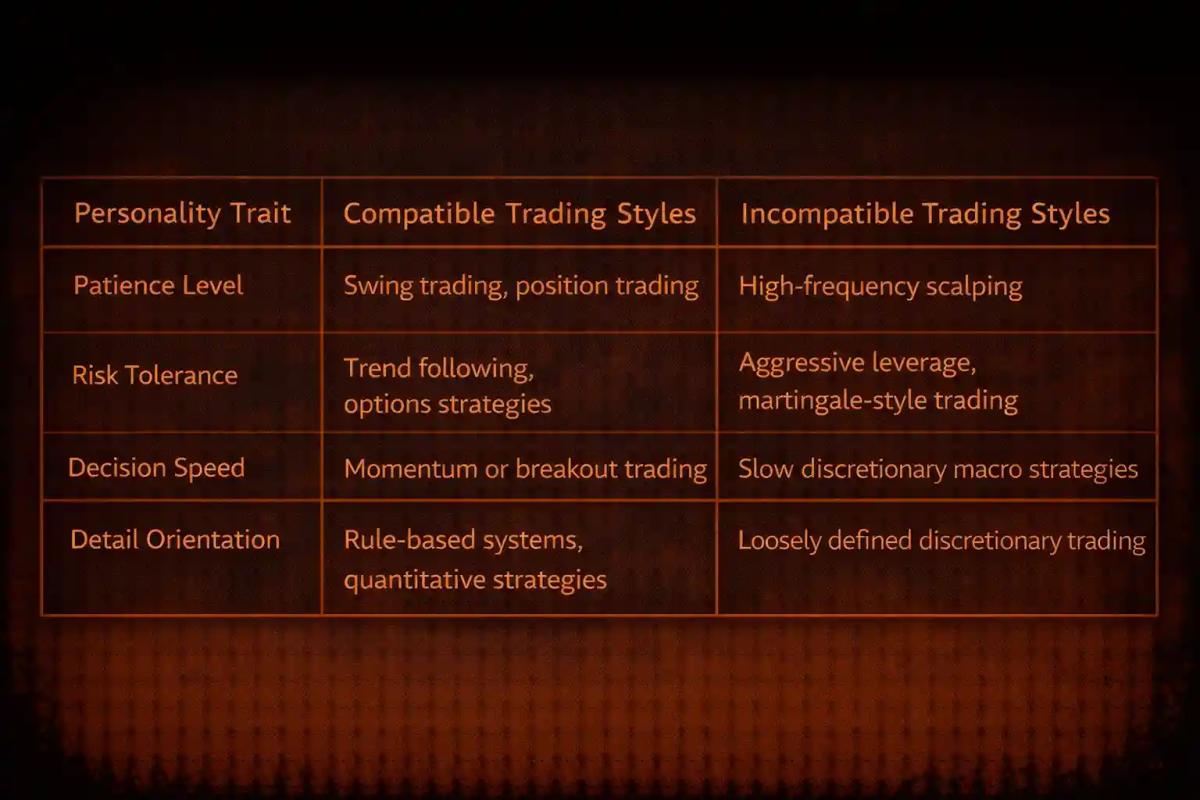
This isn’t about putting yourself in a box. It’s about recognizing that choosing a trading style that works with your natural tendencies removes a major source of friction from your trading.
When to Adapt vs. When to Accept Your Wiring
This is where nuance matters. Some tendencies can, and should, be developed. If you’re impulsive, building a pre-trade checklist can slow you down enough to make better decisions. That’s productive adaptation.
But some traits run deep. If you genuinely cannot sit in a trade for more than a day without it consuming your thoughts, forcing yourself into position trading might create more problems than it solves. In that case, acceptance (finding a style that works with your shorter attention span) is the smarter move.
The wisdom lies in knowing which category a given trait falls into for you. And that knowledge comes from, you guessed it, sustained self-awareness practice.
Building a Self-Awareness Practice
Self-awareness isn’t a box you check once. It’s a habit you build, and like any habit, it works best when it’s structured and consistent.
Daily and Weekly Reflection Habits
Keep your daily practice simple enough that you’ll actually do it. A five-minute post-session journal entry beats a 30-minute review you skip three days out of five.
A practical weekly structure might look like:
- Daily (2-5 minutes): Quick journal entry covering emotional state, plan adherence, and one key takeaway
- Weekly (15-20 minutes): Review the week’s entries for behavioral patterns. Note any recurring emotional states or decision types
- Monthly (30 minutes): Zoom out. Are you seeing improvement in specific areas? Are new patterns emerging? Does your current trading style still match what you know about yourself?
Tracking Emotional States Alongside Performance
One powerful technique is to overlay your emotional data with your performance data. Even a simple spreadsheet where you track your self-rated emotional state alongside trade outcomes will do the job.
After a month or two, the correlations become visible. You might find that your highest-confidence trades actually underperform (a telltale sign of overconfidence bias), or that trades taken in a neutral emotional state consistently outperform those taken when you’re excited or anxious.
This kind of data-driven self-awareness is what separates traders who think they know themselves from traders who actually do. And it’s the foundation that supports everything else in trading psychology.
Frequently Asked Questions
How can you tell if you lack self-awareness as a trader?
The biggest tell is repeating the same mistakes without understanding why. If you find yourself saying "I knew I shouldn't have done that" after trades regularly, but keep doing it anyway, there's a gap between your intellectual understanding and your actual self-awareness. Consistently blaming external factors (the market, your broker, "manipulation") for losses that stem from your own decisions is another strong indicator.
Are personality tests useful for traders?
They can be a helpful starting point, but don't treat them as gospel. Frameworks like the Big Five personality traits can give you a rough map of your tendencies around risk, patience, and decision-making. That said, no personality test has been scientifically validated specifically for trading performance, so use them as conversation starters for self-reflection rather than definitive answers.
How long does it take to develop meaningful self-awareness in trading?
There's no fixed timeline, but most traders who journal consistently and review honestly start noticing meaningful patterns within four to eight weeks. Developing the habit of self-awareness, where it becomes automatic rather than forced, typically takes several months of deliberate practice. It's an ongoing process, not a destination.
What's the relationship between self-awareness and trading discipline?
Self-awareness is the foundation that makes discipline sustainable. Without understanding why you break your rules, willpower alone will eventually fail. When you know your specific triggers (boredom, fear of missing out, revenge after a loss), you can build targeted systems to address them rather than relying on vague "be more disciplined" advice.
Can your trading personality change over time?
Yes, to a degree. Your core tendencies are relatively stable, but your reactions to those tendencies can evolve significantly with experience and deliberate practice. A naturally impulsive person probably won't become endlessly patient, but they can learn to recognize their impulsive urges and create decision buffers that prevent those urges from driving their trades.
How does self-awareness differ from trading psychology as a whole?
Self-awareness is one component of trading psychology, but it's arguably the most foundational. Trading psychology as a broader field covers emotional regulation, cognitive biases, performance optimization, and mental resilience. Self-awareness is the prerequisite that makes all of those other areas addressable. You can't manage a bias you haven't identified.
What are the most common blind spots traders have about themselves?
Overconfidence after winning streaks sits near the top of the list. Many traders also carry blind spots around confirmation bias (seeking information that supports their existing view) and loss aversion (holding losing trades far too long while cutting winners short). Another frequently overlooked blind spot is failing to recognize how external factors like sleep quality, stress, or personal life events directly shape trading decisions.
About the authors


Related articles
Analysis Paralysis in Trading: Why You Freeze and How to Fix It
Learn to recognize analysis paralysis in trading, understand its psychological roots, and build a decision-making framework with confident execution.
Anchoring Bias in Trading: How Mental Price Traps Cost You Money
Learn how anchoring bias distorts your trading decisions. Spot mental price traps, break free from fixation on entry prices, and build systems to protect your returns.
Anger in Trading: Why It Happens and How to Control It
Learn why anger strikes during trading, how it destroys performance through revenge trades and broken rules, and proven techniques to control it.
0 comments