


Trading Stress Management: A Practical Guide for Traders
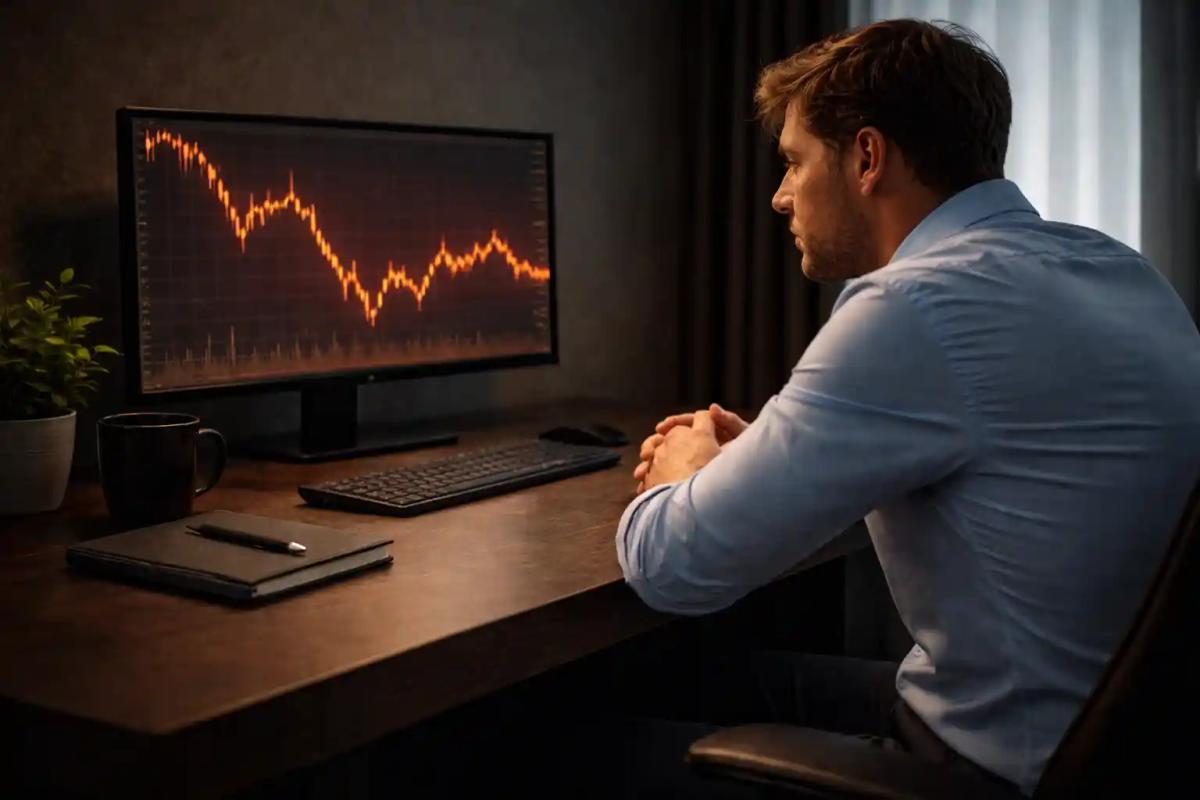
You already know trading is stressful. You don’t need another article telling you to “just relax” or “trust the process.” What you need are concrete techniques you can use before you sit down at your desk, while price action is moving against you, and after you’ve closed out a session that left you drained.
That’s what this guide delivers. Trading stress management isn’t about eliminating pressure. That’s not possible, and anyone who tells you otherwise is selling something. It’s about building a repeatable system for handling pressure so it stops bleeding into your decisions, your health, and your relationships.
This content is educational, not medical or psychological advice. If you’re experiencing persistent mental health difficulties, please consult a qualified professional.
Let’s get into it.
Why Trading Is One of the Most Stressful Performance Activities
Most people outside of trading have no idea what it actually feels like to risk real money on a decision you made in seconds, then watch the outcome unfold in real time with your financial future attached to it. Trading sits alongside surgery, elite athletics, and emergency response in terms of cognitive and emotional load. But there’s one critical difference: the scoreboard never stops updating.
The Unique Psychological Load of Financial Risk
Consider what makes trading psychologically distinct from other high-performance fields. A surgeon operates within a known protocol. An athlete competes against a visible opponent with defined rules. As a trader, you’re making probabilistic bets against a market that gives you zero feedback on whether your reasoning is sound until after you’ve committed capital.
That uncertainty is the core stressor. Your income isn’t guaranteed by a salary. Your results on any given day, week, or month are partially outside your control no matter how sound your process is. And unlike most professions, your mistakes cost you money immediately and visibly.
This creates a psychological environment where your brain is constantly toggling between analysis, risk assessment, and emotional regulation, often all at once. The mental load isn’t just about the trades themselves. It’s the accumulation of hundreds of micro-decisions under uncertainty, day after day.
How Stress Physically Affects Trading Decisions
When you watch price spike against your position, your brain triggers the same cortisol and adrenaline response as a physical threat. Your body doesn’t distinguish between a charging animal and a rapidly expanding loss. The fight-or-flight system activates, and here’s where it gets dangerous for traders: that system was designed for physical survival, not for nuanced financial decisions.
Cortisol narrows your attention. That’s great if you need to run from danger, but terrible if you need to assess whether a drawdown is within normal parameters. Adrenaline pushes you toward action, which is why so many traders revenge-trade or move stops impulsively during stress spikes. Your prefrontal cortex, the part of your brain responsible for planning and rational analysis, literally receives less blood flow when your stress response is fully activated.
The result? You become a worse trader precisely when the stakes feel highest. Understanding this isn’t just interesting biology. It’s the foundation for every technique in this guide.
So how do you know when stress has crossed from normal pressure into something actively hurting your trading?
Recognizing the Warning Signs of Trading Stress
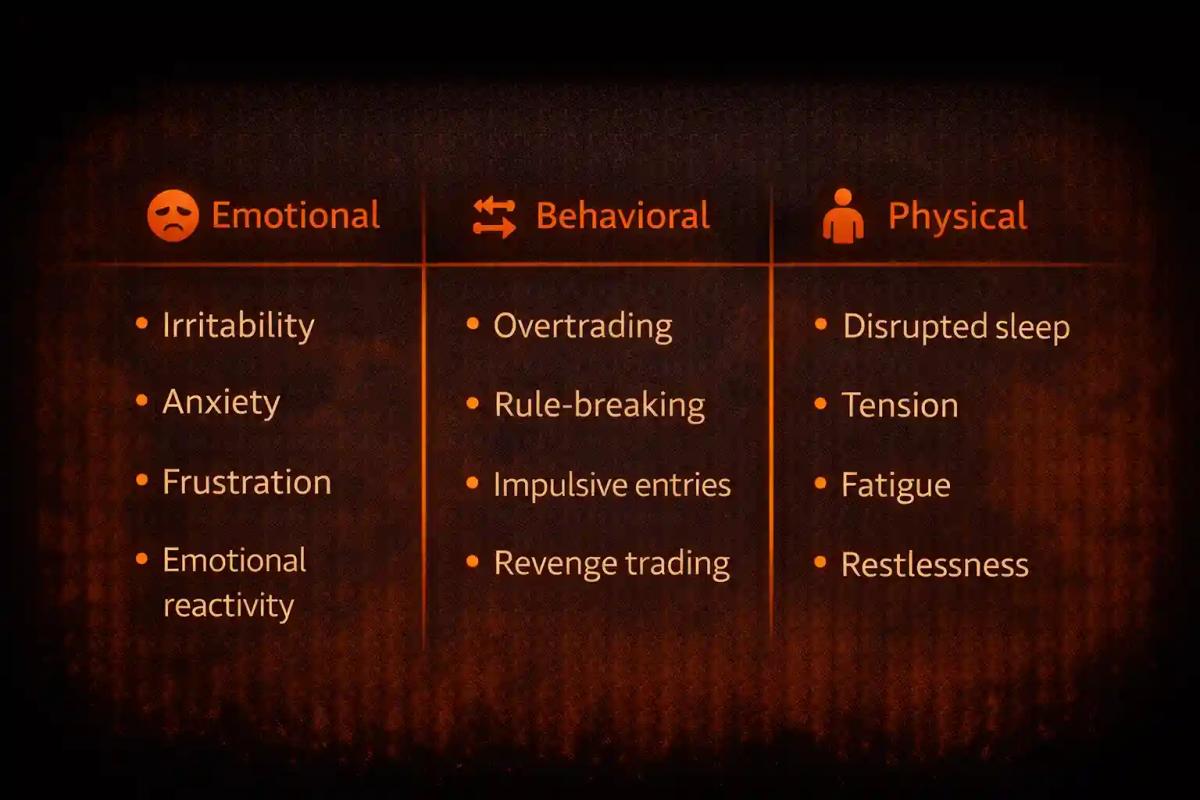
Most traders don’t recognize they’re stressed until they’ve already made a costly mistake because of it. Stress doesn’t announce itself with a pop-up notification. It creeps in gradually, and your brain is remarkably good at normalizing it. Spotting the early signals is the first real skill in trading stress management.
Emotional Indicators
These are the feelings that shift beneath the surface before you even realize your decision-making is compromised:
- Irritability that seems disproportionate: snapping at small things unrelated to trading, feeling agitated by normal market noise you’d usually ignore
- Dread before sessions: a heavy, anxious feeling when you think about sitting down to trade, especially on Sunday evenings or pre-market mornings
- Emotional flatness: feeling numb or detached from results, which might look like discipline but is often a shutdown response
- Obsessive replay: inability to stop mentally re-running trades, especially losses, hours after your session ends
Behavioral Indicators
Stress shows up in what you do, often before you’re consciously aware of what you feel:
- Overtrading: taking setups you’d normally skip, increasing frequency without a strategic reason
- Revenge trading: immediately re-entering after a loss to “make it back”
- Avoidance: skipping your journal, not reviewing trades, avoiding your P&L
- Rule-breaking: widening stops, oversizing positions, or abandoning your plan mid-session
- Checking charts obsessively outside of trading hours
Physical Indicators
Your body keeps the score, even when your mind tries to push through:
- Disrupted sleep: difficulty falling asleep, waking up at 3 AM thinking about positions or the next session
- Tension patterns: jaw clenching, tight shoulders, headaches that build through the trading day
- Digestive issues: stomach discomfort, appetite changes, nausea before high-stakes sessions
- Fatigue: exhaustion that sleep doesn’t fix, the kind that makes even a winning day feel draining
If you’re reading these lists and nodding, that’s not a sign of weakness. It’s a sign you’re a normal human being doing something genuinely difficult. The question isn’t whether you’ll experience these signals. It’s what you do when they show up.
And the best thing you can do? Start managing stress before the session even begins.
Pre-Session Stress Reduction Techniques
The thirty minutes before your trading session sets the emotional tone for everything that follows. Walk in already activated, and you’re starting at a disadvantage. The goal is to arrive at your desk in a state of calm alertness, where your rational brain is fully online.
Structured Morning Routines for Traders
A morning routine for traders isn’t about productivity hacking or Instagram-worthy rituals. It’s about creating a buffer between the chaos of daily life and the demands of the market. Here’s what actually works:
- Wake up with enough margin. If your session starts at market open, rushing straight from bed to charts means you’re already trading in a reactive state. Give yourself at least 30-60 minutes.
- Move your body first. Even ten minutes of walking, stretching, or light exercise brings your nervous system into a balanced state. This isn’t optional wellness fluff. It directly lowers baseline cortisol.
- Limit pre-market information overload. Scrolling Twitter, reading five different analysts’ takes, and watching financial news simultaneously doesn’t prepare you. It fragments your attention and seeds anxiety.
- Eat something stable. Blood sugar crashes during a session amplify emotional reactivity. A balanced meal or snack before trading is a genuine performance tool.
Pre-Market Mental Preparation
Once your body is in a good state, prepare your mind specifically for trading:
- Review your trading plan: not your watchlist, your plan. What are your rules today? What setups are you looking for? What’s your maximum risk?
- Set a daily loss limit: knowing your walk-away point before the session removes an enormous amount of in-session decision stress
- Do a five-minute breathing exercise: box breathing (inhale for 4 counts, hold for 4, exhale for 4, hold for 4) is used by military personnel and elite athletes for exactly this purpose. It directly downregulates your stress response.
- Name your current emotional state: simply saying “I feel anxious about yesterday’s loss” or “I feel overconfident after last week” brings your prefrontal cortex online and reduces emotional reactivity
These aren’t rituals for the sake of routine. Each one puts you in a measurably better state for decision-making.
But what happens when stress hits mid-session, when the market is moving and you can feel your body tightening?
Managing Stress During Live Trading
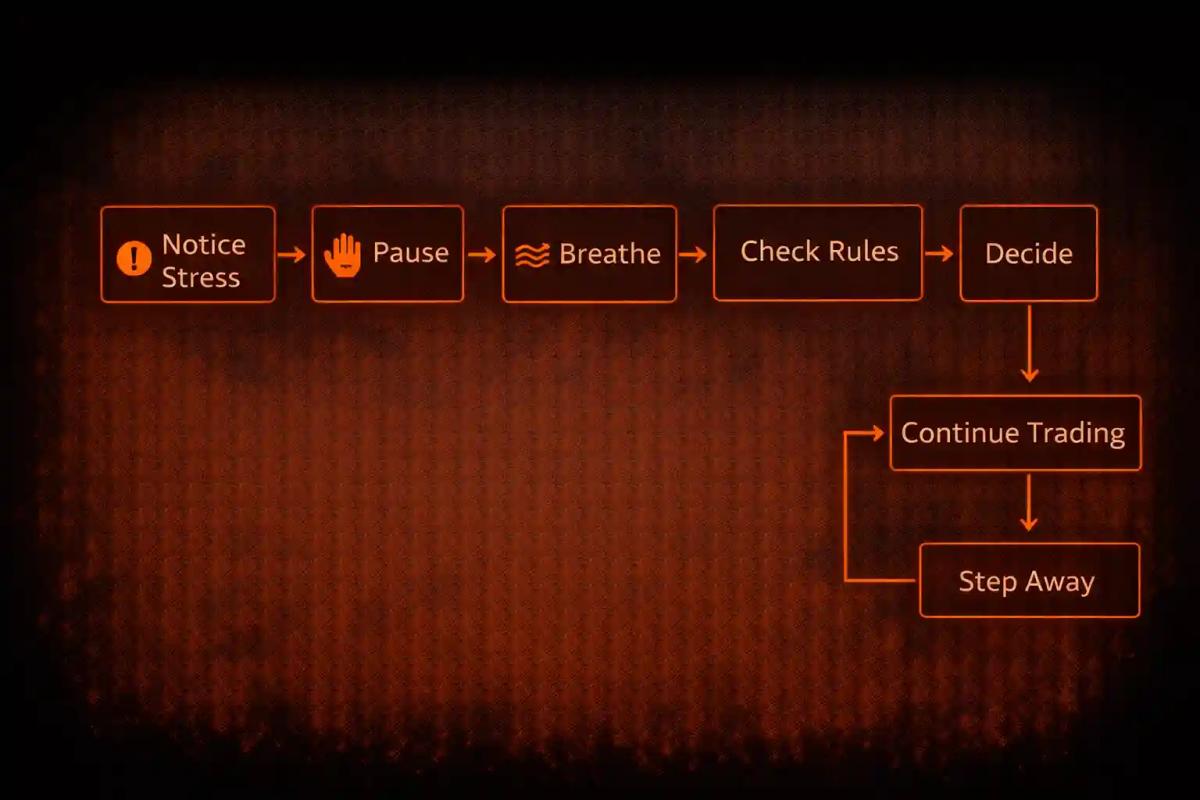
This is where most generic stress advice falls apart. Telling a trader to “take a deep breath” while they’re watching a position move against them with real money on the line is like telling a pilot to meditate during turbulence. The techniques need to be fast, practical, and executable without stepping away from your setup.
Breathing and Grounding Techniques at the Desk
When you feel stress spiking mid-session, your first job is to interrupt the physiological cascade before it hijacks your decision-making:
- Physiological sigh: two quick inhales through the nose followed by a long exhale through the mouth. This is the fastest known method to downregulate your nervous system in real time. It takes about 10 seconds.
- 5-4-3-2-1 grounding: identify 5 things you can see, 4 you can touch, 3 you can hear, 2 you can smell, 1 you can taste. This pulls your brain out of the threat-loop and back into the present moment.
- Hands on desk: physically pressing your palms flat on your desk and feeling the surface gives your nervous system a concrete anchor. Simple, but surprisingly effective when your mind is spinning.
These aren’t relaxation techniques. They’re pattern-interrupt tools that buy you the 30-60 seconds your prefrontal cortex needs to come back online.
Using Rules-Based Trading to Remove Emotional Load
Here’s something that often gets overlooked in stress management conversations: the single best in-session stress reduction tool is a clear, pre-defined trading plan.
When your entry criteria, [position sizing](internal link: risk management content), stop placement, and exit rules are defined before the session, each decision becomes a yes-or-no check against your plan rather than a fresh emotional evaluation. That’s the difference between “should I hold this?” (stressful, ambiguous) and “does this still meet my criteria?” (clear, binary).
If you find yourself constantly stressed during live trading, it’s worth asking honestly: is the stress coming from the market, or from the fact that you’re making it up as you go? A solid [risk management framework](internal link: risk management content) doesn’t just protect your capital. It protects your nervous system.
When to Step Away from the Screen
Stepping away is one of the most underrated risk management techniques you can develop. Here are the non-negotiable moments:
- You’ve hit your pre-set daily loss limit
- You’ve taken a revenge trade (or feel the urge building)
- You can’t articulate why you’re in a trade
- Your body is showing clear stress signals (racing heart, tunnel vision, shallow breathing)
- You’ve been staring at screens for more than 2-3 hours without a break
When you step away, step away fully. Close the charts. Leave the room. Even five minutes of walking or looking at a distant point resets your visual and mental focus.
The session ends eventually. But the work of managing stress doesn’t stop when you close your platform.
Post-Session Recovery and Stress Coping Techniques
What you do in the hour after your trading session determines how much of that day’s stress you carry into tomorrow. Most traders completely ignore this window, and it’s one of the biggest reasons trading stress quietly accumulates into burnout over weeks and months.
Journaling as a Decompression Tool
A trading journal is one of the most effective decompression tools available to you.
Writing about your session (what happened, what you felt, what you did well, what you’d change) externalizes the emotional content that would otherwise stay trapped in mental replay loops. Research on expressive writing consistently shows that putting stressful experiences into words reduces their emotional intensity.
Your post-session journal doesn’t need to be elaborate. Three simple prompts are enough:
- What was my [emotional state](internal link: trading psychology content) today, and how did it shift during the session?
- Did I follow my plan? If not, where and why did I deviate?
- What’s one thing I’ll carry forward from today?
The key is consistency, not length. Five minutes of honest journaling beats thirty minutes of avoidance.
Physical Activity and Screen Detachment
After hours of concentrated screen time, your body and eyes need a deliberate reset. Physical activity after trading serves a dual purpose: it metabolizes the stress hormones produced during the session, and it creates a clear psychological boundary between “trading time” and “the rest of your life.”
This doesn’t require a gym session (though that works fine). A 20-minute walk, some bodyweight exercises, or even yard work can do the job. The critical element is screen detachment. Jumping from trading screens straight to social media or news keeps your nervous system locked in the same activated state.
Reviewing Losses Without Self-Destruction
Losing trades need review. They don’t need a funeral.
There’s a real difference between constructive loss review (“I entered early, the setup wasn’t fully formed, I’ll wait for confirmation next time”) and destructive rumination (“I’m terrible at this, I always mess up, I’ll never be consistent”). The first sharpens your trading. The second just compounds your stress.
One practical technique: when reviewing a loss, focus exclusively on the process, not the outcome. Ask “did I follow my rules?” rather than “why did I lose money?” If you followed your rules and still lost, that’s probability doing its thing. If you broke your rules, the lesson is about discipline, not about the market being unfair.
The way you talk to yourself about losses shapes whether trading stress stays manageable or spirals into something more corrosive.
Burnout Prevention for Active Traders
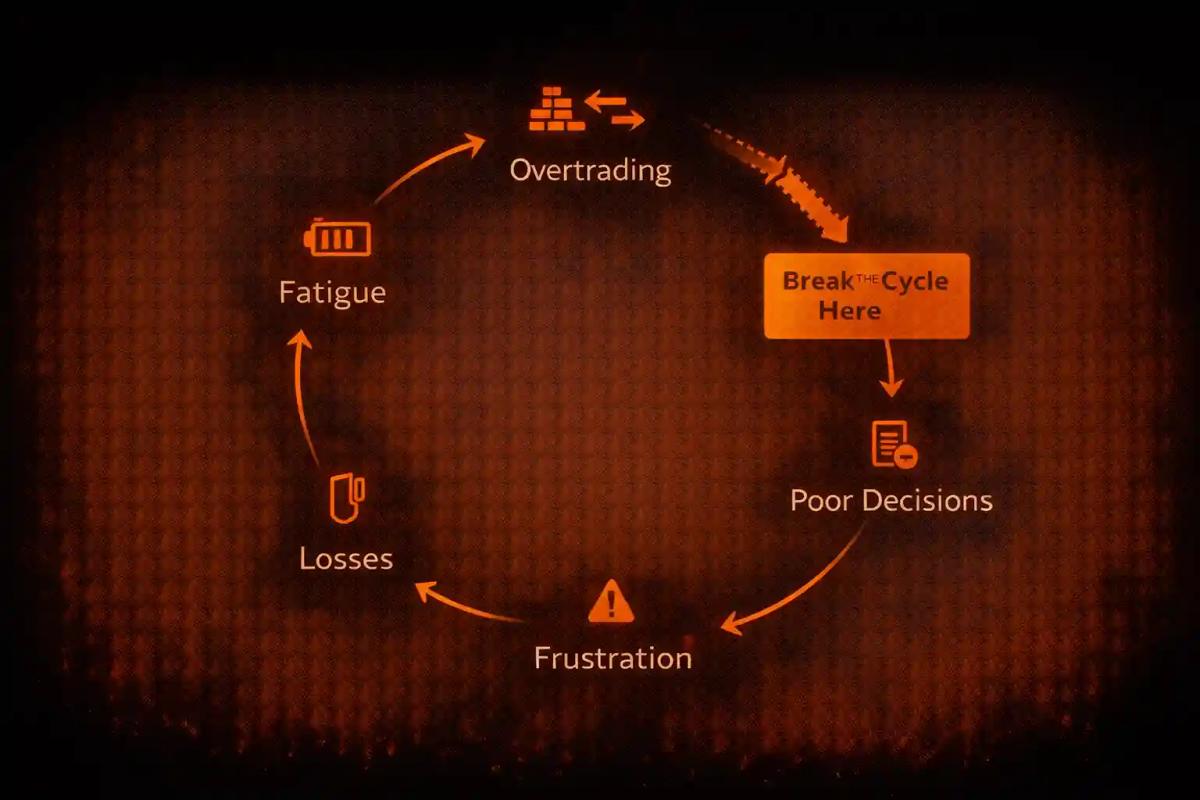
Burnout isn’t just “a lot of stress.” It’s a fundamentally different state, one marked by emotional exhaustion, detachment, and a loss of motivation that doesn’t bounce back after a good night’s sleep. If regular trading stress is like muscle soreness after a hard workout, burnout is a stress fracture. You can’t push through it without making it worse.
Scheduling Breaks and Trading Holidays
Professional athletes have off-seasons. Surgeons have scheduled days off. Traders? Many trade every single session, week after week, month after month, as if taking a day off somehow means they’re not serious.
That thinking is backwards. Scheduled breaks are performance tools:
- Daily: define a hard stop time for your trading session, not just a daily loss limit
- Weekly: take at least one full day with zero chart time
- Monthly: consider one week per month with reduced trading or pure review and education focus
- Quarterly: a genuine break of several days to a week where you fully disconnect
The market will be there when you come back. Your mental health might not be, if you never step away.
Separating Identity from P&L
One of the most dangerous psychological traps in trading is fusing your self-worth with your results. When “I had a bad trading week” becomes “I am a failure,” you’ve crossed a line that turns every loss into a personal attack on your identity.
You are not your P&L. Your value as a person is not determined by your last trade. This sounds obvious written on a screen, but in the moment, after your third consecutive red day, it doesn’t feel obvious at all.
Practical ways to maintain that separation: keep interests and relationships outside of trading active, avoid introducing yourself primarily as “a trader,” and notice when your mood for the entire day is being dictated by a single session’s results.
Building a Support System
Trading is isolating by nature. Most traders work alone, and most people in their lives don’t understand what they do or why it’s stressful. That isolation amplifies every other stress factor.
Building a support system means finding people who get it:
- Trading communities or groups (with healthy, non-toxic cultures)
- A trading partner or accountability buddy
- Friends or family members you can talk to honestly, even if they don’t understand the specifics
- A therapist or performance coach who works with traders or high-performance professionals
You don’t have to do this alone. Trying to is one of the fastest paths to burnout.
What if the stress you’re feeling isn’t just about managing your emotions better, though? What if it’s telling you something important about your trading itself?
When Stress Signals a Bigger Problem
Not all trading stress is created equal, and sometimes the right response isn’t a breathing exercise. Sometimes stress is your brain’s legitimate alarm system telling you that something in your process is broken.
Stress from Poor Risk Management vs. Psychological Stress
This distinction matters more than most traders realize. If you’re stressed because you’re risking too much per trade, trading without stops, or sizing positions beyond what your account can handle, the fix isn’t meditation. The fix is fixing your risk management.
Ask yourself honestly:
- Would I feel this stressed if my position size were half as large?
- Am I stressed because the market is moving, or because a normal move could seriously damage my account?
- Is my stress proportional to the actual risk, or is it amplified by poor planning?
If your stress disappears when you reduce size, your problem is structural. No amount of journaling will fix an overleveraged account.
Recognizing When Professional Help Is Needed
There’s a line between normal trading stress and something that calls for professional support. Here are signals that it’s time to talk to a qualified mental health professional:
- Trading stress has spread into persistent anxiety or depression that affects your life outside of trading
- You’re using substances (alcohol, drugs, even excessive caffeine) to cope with trading-related feelings
- You’ve had thoughts of self-harm related to trading losses
- You’re experiencing panic attacks before or during sessions
- Your sleep has been consistently disrupted for more than two weeks
- You feel unable to stop trading even when you know you should (compulsive trading patterns)
Seeking professional help is not a sign that you’re not cut out for trading. It’s a sign that you’re taking your performance and well-being seriously. Many elite performers across every field work with mental health professionals. Trading is no different.
Building Your Personal Trading Stress Management Plan
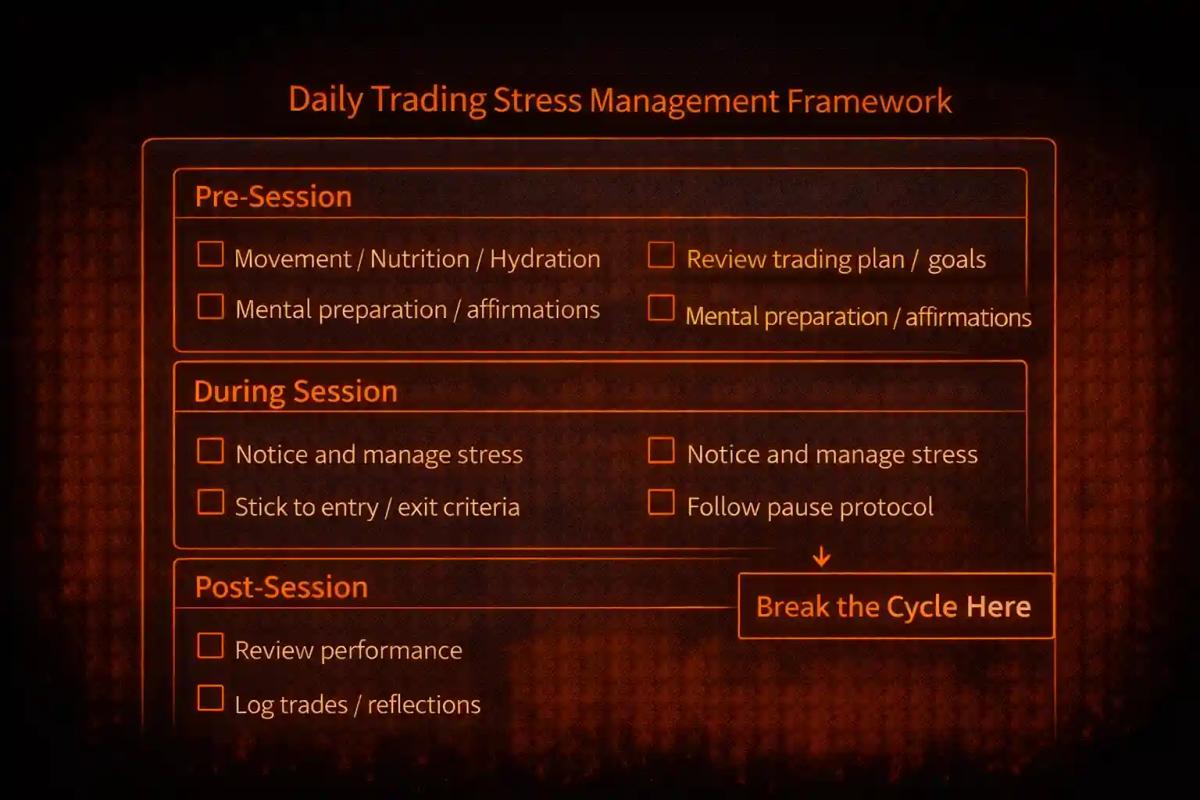
Everything in this guide is useful as information. It becomes powerful when you turn it into a personal, written plan that you actually follow. Here’s how to build yours.
Daily Framework Template
Structure your trading day around three stress management checkpoints:
Pre-Session (30-60 minutes before trading):
- Physical: movement, nutrition, hydration
- Mental: review plan, set loss limits, breathing exercise
- Emotional: name your current state, check for carry-over stress from yesterday
During Session:
- Have your stress response protocol visible (notice, pause, breathe, check rules, decide)
- Set timer reminders to check in with yourself every 60-90 minutes
- Know your hard stop triggers (daily loss limit, revenge trade urge, physical stress signals)
Post-Session (within 1 hour of closing):
- Journal: emotional state, plan adherence, one takeaway
- Physical reset: movement, screen detachment
- Constructive loss review (if applicable)
- Deliberate transition to non-trading life
Weekly Check-In Structure
Once a week, step back and look at the bigger picture. Spend 15-20 minutes on these questions:
- What was my overall stress level this week, on a 1-10 scale?
- Did I follow my daily stress management plan consistently?
- Were there days I should have stepped away but didn’t?
- Am I showing any early burnout signals?
- What’s one adjustment I’ll make to my plan for next week?
This weekly check-in acts as your early warning system. It catches patterns that daily awareness misses. Over time, it also gives you a record so you can see whether your stress management is genuinely improving or just holding steady.
Trading stress management isn’t a one-time fix. It’s an ongoing practice, much like improving your technical analysis or refining your strategy. The traders who last in this business aren’t the ones who feel no stress. They’re the ones who’ve built systems to handle it.
Start with one technique from each phase. Practice it for a week. Add another. Build the habit. Your future trading self will thank you.
Frequently Asked Questions
Is trading stress normal, or is it a sign something is wrong with my trading?
Trading stress is completely normal and expected. You're making financial decisions under uncertainty with real money at risk, which is inherently stressful. However, if your stress is persistent, overwhelming, or clearly tied to poor risk management (like oversizing positions), it may be signaling a structural problem in your approach that needs addressing beyond stress management techniques alone.
What's the single fastest technique to calm down during a live trade?
The physiological sigh: two quick inhales through your nose followed by one long exhale through your mouth. It takes roughly 10 seconds and is the fastest evidence-backed method to downregulate your nervous system in real time. It works because the extended exhale activates your parasympathetic nervous system, slowing your heart rate and reducing the cortisol spike that impairs decision-making.
How do I tell the difference between trading stress and actual burnout?
Regular trading stress is situational. It spikes during difficult sessions and recovers with rest and good habits. Burnout is a state of chronic emotional exhaustion where rest doesn't restore you, motivation disappears, and you feel detached or cynical about trading even on good days. If a weekend off doesn't noticeably improve how you feel, and the pattern has lasted weeks rather than days, you're likely moving into burnout territory.
Can stress management techniques actually improve my trading results?
Stress management doesn't directly generate profitable trades, but it removes a significant source of poor decisions. Revenge trading, impulsive entries, moving stops, and overtrading are all stress-driven behaviors that erode edge over time. By keeping your prefrontal cortex online during sessions, you're more likely to execute your plan consistently, and consistent execution is where real results come from.
How often should I take breaks from trading to prevent burnout?
At minimum, take one full day per week completely away from charts and trading content. Beyond that, consider reducing intensity for one week per month (lighter size, fewer setups, more review), and taking a genuine multi-day break at least once per quarter. The specific schedule matters less than the consistency. Sporadic long breaks are less effective than regular, planned recovery time built into your routine.
Does physical exercise specifically help with trading-related stress?
Yes, and it works through multiple pathways. Exercise metabolizes cortisol and adrenaline (the stress hormones your body produces during sessions), improves sleep quality, enhances cognitive function, and creates a clear psychological boundary between trading and the rest of your day. You don't need intense workouts. Even 20-30 minutes of walking after a session can make a noticeable difference in how you feel and how well you recover.
When should I consider seeking professional help for trading stress?
Consider professional help if trading stress has become persistent anxiety or depression that follows you outside of trading hours, if you're relying on substances to cope, if your sleep has been disrupted for more than two weeks, if you notice compulsive trading patterns you can't control, or if you're experiencing panic attacks. A therapist or psychologist with experience in performance psychology can provide tools that go beyond what self-management alone can offer.
About the authors


Related articles
Analysis Paralysis in Trading: Why You Freeze and How to Fix It
Learn to recognize analysis paralysis in trading, understand its psychological roots, and build a decision-making framework with confident execution.
Anchoring Bias in Trading: How Mental Price Traps Cost You Money
Learn how anchoring bias distorts your trading decisions. Spot mental price traps, break free from fixation on entry prices, and build systems to protect your returns.
Anger in Trading: Why It Happens and How to Control It
Learn why anger strikes during trading, how it destroys performance through revenge trades and broken rules, and proven techniques to control it.
0 comments