


Trading Temptation: How to Recognize and Resist Impulsive Trades
You know the feeling: the chart is moving, your finger hovers over the buy button, and something inside you screams to get in right now, even though nothing about the setup matches your plan. That pull is trading temptation. And if left unchecked, it will bleed your account dry one impulsive decision at a time.
This guide breaks down what trading temptation is and how you can catch yourself before making a trade you’ll regret. You’ll walk away with a framework for identifying your personal triggers and concrete techniques to interrupt them in real time.
This content is for educational purposes only and does not constitute financial advice. Trading involves substantial risk of loss.
What Is Trading Temptation
Definition and Core Characteristics
Trading temptation is the urge to enter, exit, or modify a trade based on emotional impulse rather than your established criteria. It’s that moment when you feel compelled to act immediately, when waiting feels physically uncomfortable, when your reasoning brain takes a back seat to something more primal.
The characteristics tend to show up the same way across traders:
- A sense of urgency that feels disproportionate to the actual situation
- Rationalizations that appear logical but wouldn’t survive calm scrutiny
- Physical sensations like tension, restlessness, or a racing heartbeat
- A narrowing of focus where contradicting information simply disappears
Some of the most technically skilled traders struggle with it precisely because their knowledge hands them more sophisticated ways to rationalize impulsive decisions.
How Temptation Differs from Calculated Risk
Not every strong conviction is temptation, and not every sudden opportunity is a trap. The difference lies in the process.
Calculated risk follows your pre-established rules. You identified the setup in advance, your position size fits your risk parameters, and you can articulate why this trade makes sense without referencing how you feel in the moment. The trade might still lose, but the decision-making process was sound.
Temptation hijacks that process. You find yourself bending rules, making exceptions, discovering reasons to act that conveniently appeared only after you felt the urge. If you’re working backward from a desire to trade to find justification for it, you’re experiencing temptation.
Common Types of Trading Temptation
FOMO Temptation
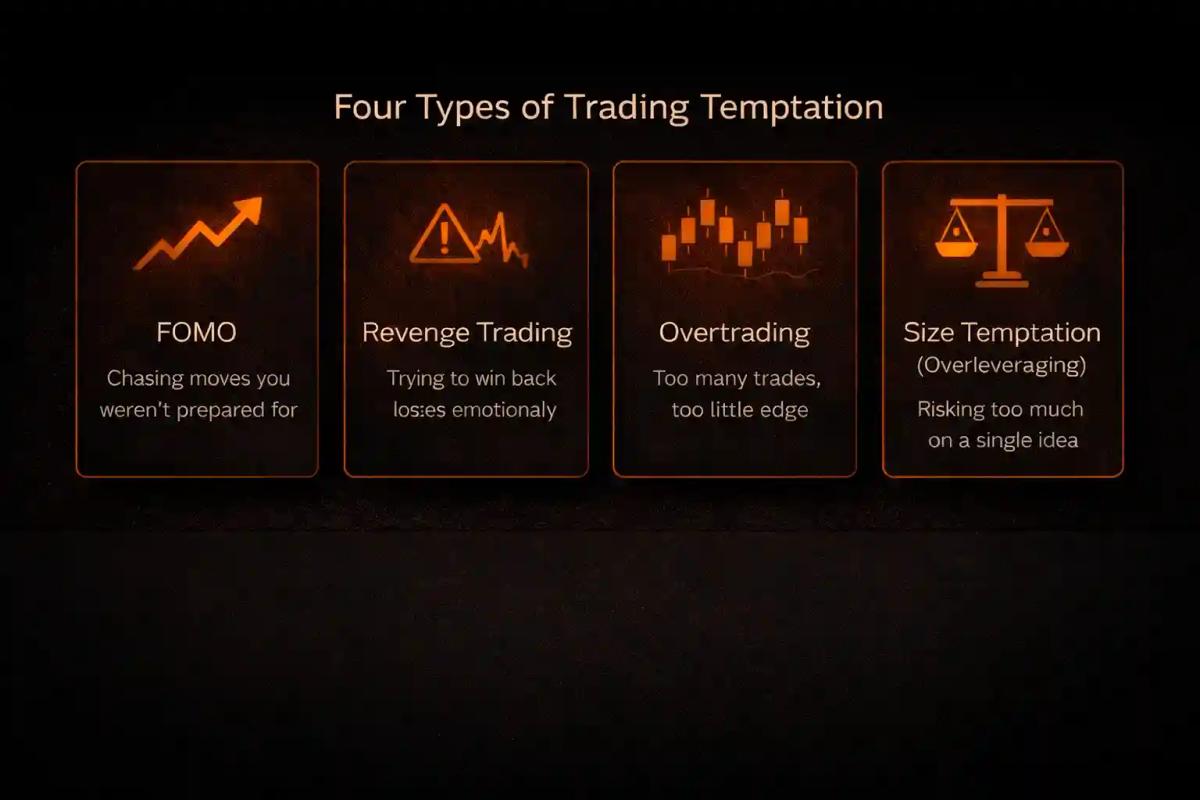
Fear of missing out might be the most universal form. You see a move happening (a stock breaking out, a currency pair spiking, crypto pumping) and every second you’re not in feels like money slipping through your fingers.
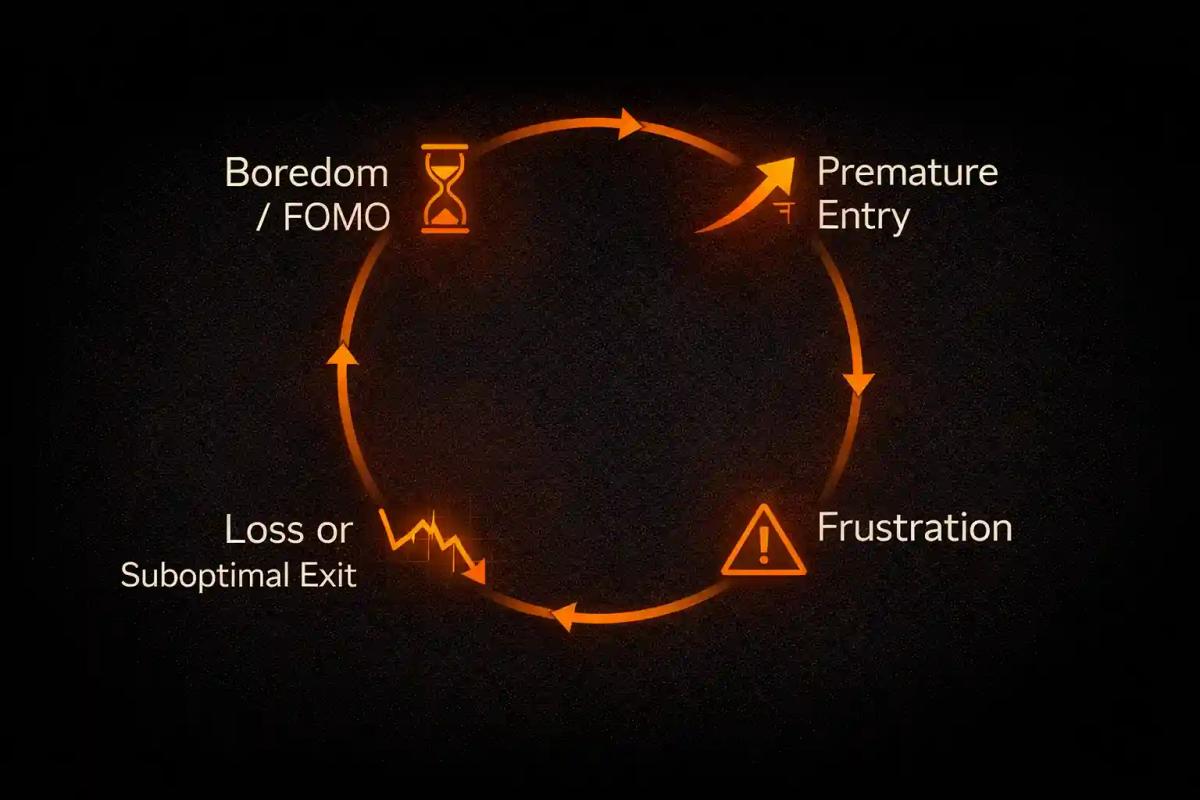
FOMO speaks in a specific voice: “This is the one. If I don’t get in now, I’ll miss the whole move. I can always get out if it reverses.” By the time FOMO grabs you, you’re usually late. You’re seeing the move because it already happened. Entering now often means buying at the worst possible moment while early sellers prepare to take profits.
FOMO doesn’t care about your entry criteria or risk-reward ratios. It only cares about not being left behind.
Revenge Trading Temptation
A losing trade that stopped you out right before reversing in your direction feels like a personal insult. Revenge trading is the urge to immediately get back in and “recover” what the market “took” from you.
This form frames trading as a battle you’re losing, where the only acceptable response is to fight harder. You might increase your position size to make back the loss faster, or jump into something new without proper analysis because sitting on the sidelines feels like admitting defeat.
Revenge trading almost always compounds the damage. Trading angry means trading blind.
Overtrading Temptation
Sometimes the temptation is about trading itself. Overtrading is the compulsion to always have a position open, to constantly be doing something.
This one disguises itself as diligence. You tell yourself you’re staying engaged. But quality setups don’t appear every hour or even every day. Trading out of restlessness rather than opportunity means paying spreads and commissions to satisfy an emotional itch.
Size Temptation (Overleveraging)
You’ve found a great setup. Everything aligns with your plan. The temptation here is to maximize it: to push your position size beyond normal parameters because this one feels like a sure thing.
Size temptation whispers that your standard risk is leaving money on the table. It conveniently forgets that even excellent setups fail regularly, and that one oversized loss can wipe out weeks of disciplined gains. Position sizing rules exist precisely because certainty doesn’t exist in trading.
Why Traders Give In to Temptation
Psychological Triggers
Your brain evolved to keep you alive in environments where quick decisions about immediate threats mattered more than probabilistic thinking over hundreds of iterations. Several psychological mechanisms work against you:
- Loss aversion makes losses feel roughly twice as painful as equivalent gains feel good, creating irrational urgency to avoid or recover from losses.
- Recency bias causes recent events to loom larger than they should. A few winners can make you feel invincible; a few losers can make you desperate.
- Confirmation bias helps you find evidence for whatever you already want to do. Once temptation sets in, your brain becomes remarkably creative at justifying it.
- The dopamine loop means the anticipation of reward can feel better than the reward itself. Placing a trade delivers a neurochemical hit regardless of outcome.
None of this makes you weak or flawed. It makes you human. Awareness of these mechanisms becomes your first line of defense.
Environmental and Situational Factors
Your surroundings heavily influence your vulnerability. Traders are more likely to make impulsive decisions when:
- Sleep-deprived or physically fatigued
- Trading during volatile news events without a predetermined plan
- Watching positions tick by tick instead of at defined intervals
- Under financial pressure that raises the emotional stakes
- Surrounded by social media or chat rooms hyping specific moves
The environment you trade in isn’t neutral. It either supports your discipline or quietly undermines it.
How to Recognize Temptation in Real Time
Physical and Emotional Warning Signs
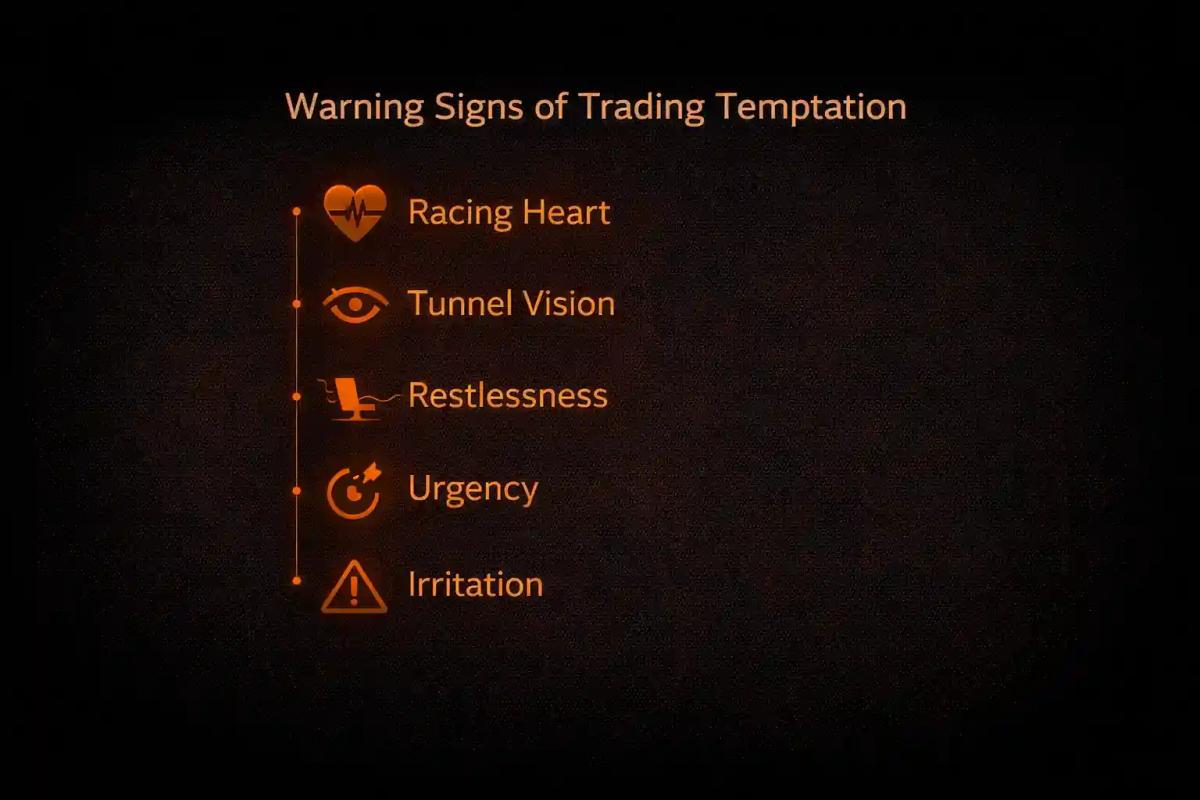
Your body often knows you’re experiencing temptation before your conscious mind admits it. Learn to read these signals:
- Racing heartbeat or shallow breathing when looking at a potential trade
- Physical restlessness: inability to sit still, tapping, clenching
- Tightness in your chest or stomach that feels like urgency
- Tunnel vision where you’re fixated on one chart or one number
- Irritation when something delays your ability to place the trade
Emotionally, temptation often arrives as a kind of certainty that shouldn’t exist. When you feel absolutely sure about an outcome, or when the idea of not trading feels intolerable, those sensations are worth heeding as warnings.
Behavioral Patterns That Indicate Temptation
Beyond physical sensations, certain behaviors signal temptation has taken hold:
- Checking charts repeatedly at irregular intervals
- Calculating potential profits before entering a trade
- Searching for confirming opinions online
- Reducing or ignoring your normal analysis process
- Making mental exceptions to your trading rules
- Feeling annoyed by conflicting information
Temptation makes you impatient, overconfident, and selectively blind. If you notice yourself rushing through your checklist or rationalizing why this time is different, pause.
Practical Techniques for Resisting Bad Trades
Pre-Trade Checklists
A written checklist completed before every trade creates a physical barrier between impulse and action. Your checklist should include:
- Does this setup match my written trading plan criteria?
- Have I identified my entry, stop loss, and target before looking at current price?
- Is my position size within my standard risk parameters?
- Can I articulate why this trade makes sense without referencing how I feel?
- Would I take this trade if I had just woken up calm and rested?
The checklist works because temptation hates friction. It wants immediate action. Anything that slows you down gives your rational mind time to catch up.
Cooling-Off Rules
Implement mandatory delays between identifying a potential trade and executing it. Depending on your timeframe:
- Wait 5–10 minutes before entering any trade that wasn’t planned the night before
- Step away from the screen for a set period after any loss
- Set a rule that you can’t trade for 24 hours after violating any of your other rules
Cooling-off periods don’t prevent good trades. Those will still be there after a short delay. What they prevent is acting on pure impulse.
Environment and Routine Adjustments
Redesign your trading environment to reduce temptation triggers:
- Remove or limit access to social media during trading hours
- Set specific times for chart review rather than constant monitoring
- Trade in a dedicated space that supports focus
- Keep a visible reminder of your rules and recent lessons
- Consider using alerts rather than watching price action live
Your discipline is a finite resource. Don’t waste it fighting temptations you could sidestep entirely through smarter design.
Building Long-Term Discipline Against Temptation
Journaling and Self-Review
A trading journal is your primary tool for understanding your personal temptation patterns. After each session, document:
- Any trades you took outside your plan
- Moments you felt tempted but didn’t act
- What you were feeling physically and emotionally during key decisions
- What environmental factors were present
Over time, your journal reveals patterns invisible to memory alone. You might discover you’re most vulnerable on Fridays, or after winning streaks, or when a specific asset moves without you. That self-knowledge becomes your roadmap for building targeted defenses.
Accountability Systems
Discipline gets easier when you’re not relying solely on willpower. Consider:
- Sharing your trading rules with a trusted friend or fellow trader
- Joining a community focused on process over profits
- Reviewing your journal with someone who will notice patterns you miss
- Committing publicly to specific rules so the social cost of breaking them rises
Accountability doesn’t mean seeking approval for trades. It means creating external checkpoints that reinforce your internal standards.
When Temptation Wins: How to Recover
Post-Trade Analysis After Impulsive Decisions
When you make an impulsive trade, your first job is preventing the damage from spreading. Before doing anything else, document exactly what happened while it’s fresh:
- What triggered the temptation?
- What warning signs did you ignore?
- Which rule or checklist item did you skip or rationalize?
- How did you feel at the moment you placed the trade?
This analysis is about converting a loss into data. Every impulsive trade you understand thoroughly is one you’re less likely to repeat.
Preventing Spiral Behavior
The most dangerous moment comes right after an impulsive trade, especially if it loses. This is when revenge trading and size temptation hit their peak. You need predetermined circuit breakers:
- A hard rule to stop trading for the day (or longer) after any impulsive trade
- A loss limit that forces you away from the screen regardless of circumstances
- A cool-down ritual: a walk, a conversation, anything that physically separates you from the trading environment
Spirals happen when one bad decision creates the emotional conditions for another. Your job is to break that chain before it starts. The trade already happened. Your only remaining choice is whether you’ll let it define the rest of your session.
Trading temptation never fully disappears. It’s part of operating in markets that move fast and reward quick action. But the traders who survive long-term are the ones who’ve built systems to interrupt it, recover from it, and learn from every time it wins.

About the authors

Related articles
Analysis Paralysis in Trading: Why You Freeze and How to Fix It
Learn to recognize analysis paralysis in trading, understand its psychological roots, and build a decision-making framework with confident execution.
Anchoring Bias in Trading: How Mental Price Traps Cost You Money
Learn how anchoring bias distorts your trading decisions. Spot mental price traps, break free from fixation on entry prices, and build systems to protect your returns.
Anger in Trading: Why It Happens and How to Control It
Learn why anger strikes during trading, how it destroys performance through revenge trades and broken rules, and proven techniques to control it.
0 comments