


Markets move in cycles. Prices rise, fall, and rise again. Patterns that have repeated throughout financial history.
Two terms dominate discussions of these cycles: bull markets and bear markets. Understanding what these terms mean, how to recognize each phase, and what they imply for trading and investing decisions forms a foundational part of financial literacy.
This guide explains the characteristics of bull and bear markets, examines their historical patterns, and explores how traders and investors approach each environment. The information presented here is educational and does not constitute financial advice. Readers should consult qualified professionals before making investment decisions.

What Is a Bull Market?
A bull market refers to a sustained period during which asset prices rise or are expected to rise. The term most commonly applies to stock markets but can describe any asset class: bonds, real estate, commodities, or cryptocurrencies.
Defining Characteristics of Bull Markets
The widely accepted threshold for a bull market is a rise of 20% or more from recent lows in a broad market index such as the S&P 500 or Dow Jones Industrial Average. That said, the percentage alone doesn’t capture the full picture.
Bull markets share several recognizable characteristics. Prices trend upward over an extended period, with higher highs and higher lows forming on price charts. Investor confidence builds as positive economic news reinforces optimistic expectations. Trading volume often increases as more participants enter the market, and corporate earnings generally improve alongside broader economic expansion.
Sentiment tends toward optimism during these periods. Fear of missing out can drive buying activity, and risk appetite grows as participants become more willing to invest in growth-oriented or speculative assets. Economic conditions frequently include low unemployment, rising gross domestic product, and accommodative monetary policy, though none of these factors guarantee a bull market will continue.
How Long Do Bull Markets Last?
Historical data shows that bull markets in U.S. equities have lasted anywhere from a few months to over a decade. The bull market that began in March 2009 following the global financial crisis extended until February 2020: nearly eleven years, making it one of the longest on record.
On average, bull markets have historically lasted longer than bear markets. This asymmetry reflects the general long-term upward trend of equity markets. Individual bull markets can end abruptly due to economic shocks, policy changes, or shifts in investor sentiment that few anticipated.
What Is a Bear Market?
A bear market represents a sustained period of declining asset prices, typically defined as a drop of 20% or more from recent highs. Bear markets signal widespread pessimism and often coincide with economic contractions or recessions.
Defining Characteristics of Bear Markets
Bear markets share recognizable patterns. Prices establish lower highs and lower lows over time. Investor confidence erodes as negative news accumulates, and selling pressure intensifies as participants seek to limit losses or exit positions entirely.
Risk aversion dominates during these periods. Capital often flows from equities into perceived safe havens: government bonds, gold, or cash. Volatility typically increases as uncertainty grows, and trading volume may spike during sharp selloffs. Corporate earnings often decline, and economic indicators frequently deteriorate: rising unemployment, contracting output, weakening consumer confidence.
The psychology differs markedly from bull phases. Fear replaces greed as the dominant emotion. Pessimism can become self-reinforcing: falling prices prompt further selling, which drives prices lower still.
How Long Do Bear Markets Last?
Bear markets have historically been shorter than bull markets, though they can feel longer to those experiencing them. The emotional weight of losses distorts perception. The average bear market in U.S. equities has lasted roughly 9 to 16 months, though individual instances vary widely.
Some bear markets resolve quickly. The COVID-19-induced bear market of 2020 saw the S&P 500 fall over 30% in approximately one month before recovering rapidly. Others, such as the bear market following the 2008 financial crisis, took longer to reach their troughs and required years before previous highs were reclaimed.
Bull vs Bear Market: Key Differences
Understanding the distinctions between bull and bear markets helps you contextualize market conditions and calibrate your expectations.
Price Movement and Trends
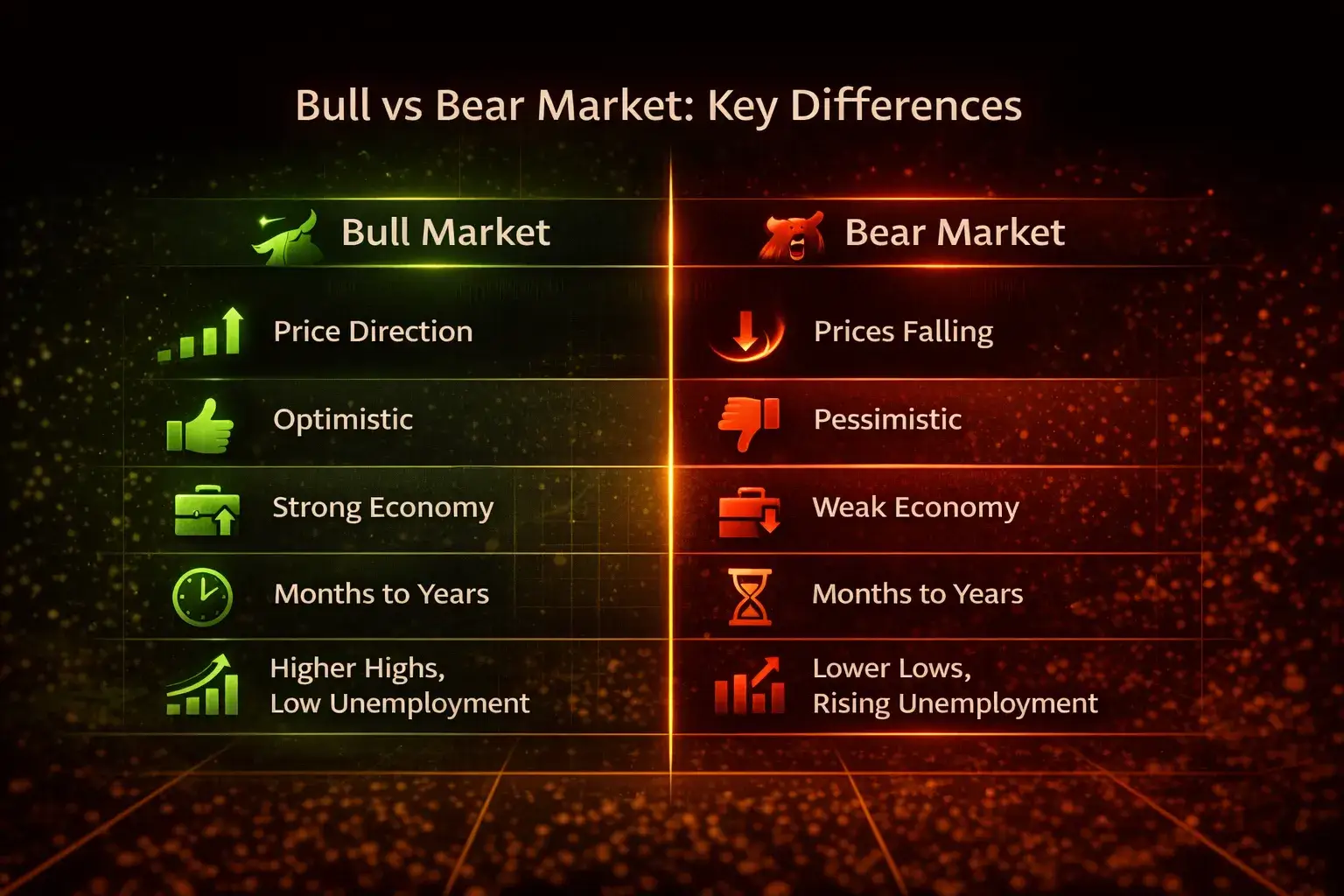
The most apparent difference lies in price direction. Bull markets feature sustained upward movement with the primary trend pointing higher. Bear markets exhibit the opposite: prices decline over time, and rallies typically fail to exceed previous highs.
Volatility also differs between phases. While both market types can experience sharp moves, bear markets often see more dramatic single-day swings as fear-driven selling creates rapid price drops. Bull markets tend toward steadier, more gradual appreciation, though corrections of 10% or more can occur within broader uptrends.
Investor Sentiment and Behavior
Sentiment diverges dramatically. Bull markets cultivate optimism, confidence, and increased risk tolerance. Investors may hold positions longer, add to winning trades, and explore higher-risk opportunities. The prevailing attitude often assumes prices will continue rising, sometimes beyond what fundamentals support.
Bear markets foster pessimism, caution, and defensive positioning. Investors may reduce equity exposure, increase cash holdings, and prioritize capital preservation over growth. Fear of further losses can prompt selling even when prices have already fallen substantially.
In both cases, it’s essential to have a proper exit strategy to avoid emotions taking over your decision-making.
Economic Indicators
Bull and bear markets often align with different economic conditions, though the relationship is imperfect. Bull markets frequently coincide with economic expansion: rising GDP, low unemployment, strong consumer spending, healthy corporate earnings.
Bear markets often accompany economic weakness or recession. Declining GDP, rising unemployment, reduced consumer confidence, and falling corporate profits tend to appear during prolonged downturns. Markets sometimes anticipate economic changes, however, meaning bear markets can begin before recessions officially start or end before economic recovery is fully underway.
Historical Examples of Bull and Bear Markets
Examining past market cycles provides context for understanding how bull and bear phases unfold in practice.
Notable Bull Markets
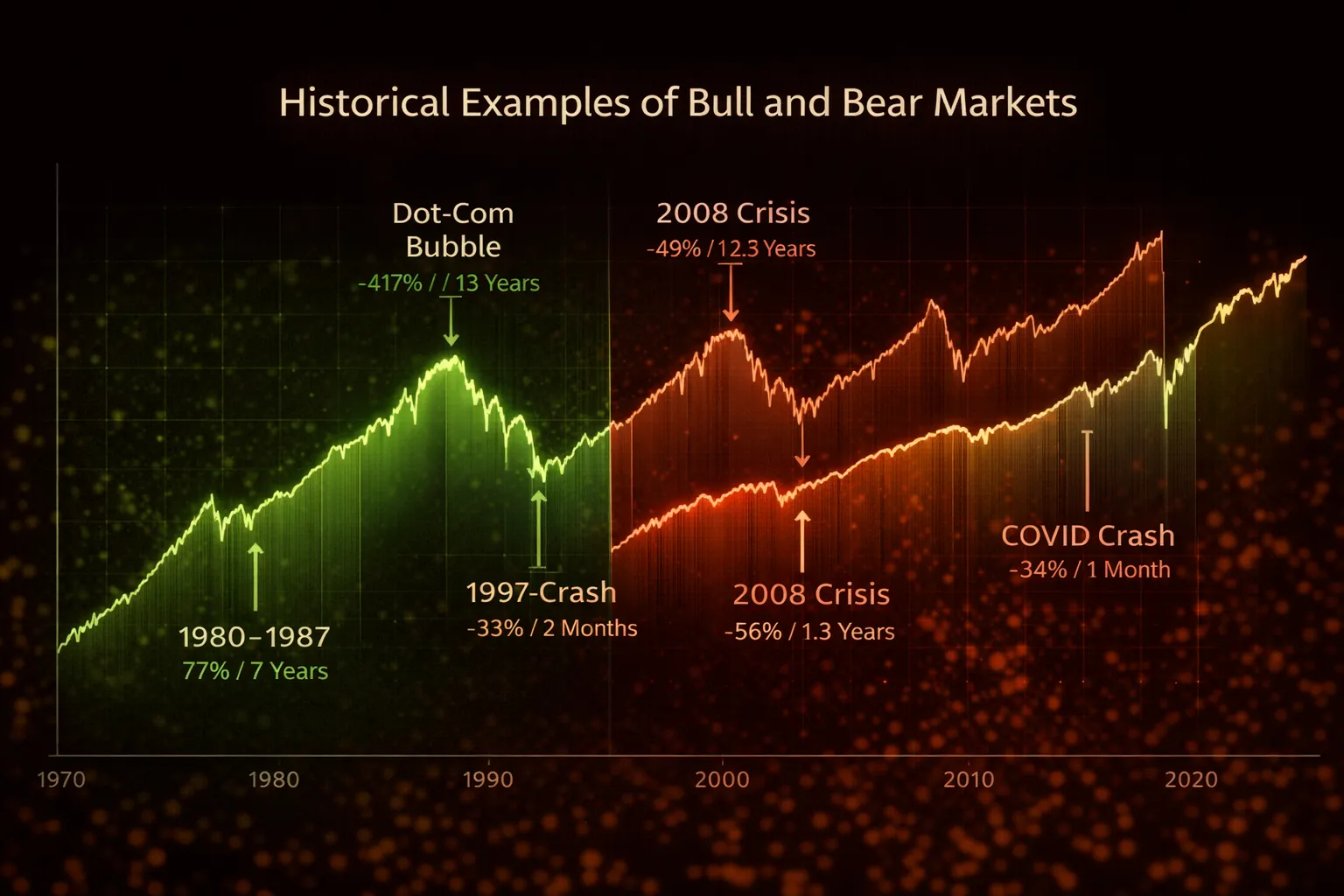
The post-World War II era produced one of the most significant bull markets in U.S. history. From 1949 to 1956, the Dow Jones Industrial Average roughly tripled as the American economy expanded and consumer prosperity grew.
The 1990s technology boom created another memorable bull market. Fueled by enthusiasm for internet companies and technological innovation, the S&P 500 gained over 400% from 1990 to early 2000 before the dot-com bubble burst.
The bull market beginning in March 2009 stands out for its duration. Following the depths of the global financial crisis, U.S. equities embarked on an extended climb that lasted nearly eleven years. The S&P 500 rose approximately 400% during this period, supported by low interest rates, quantitative easing, and eventual economic recovery.
Notable Bear Markets
The crash of 1929 and subsequent bear market remains the most severe in U.S. history. The Dow Jones Industrial Average lost approximately 89% of its value from its 1929 peak to its 1932 trough, coinciding with the Great Depression.
The dot-com crash of 2000–2002 hit technology-heavy indices particularly hard. The Nasdaq Composite fell approximately 78% from its peak as the speculative excesses of the late 1990s unwound.
The 2008 financial crisis triggered a bear market that saw the S&P 500 decline over 50% from its 2007 high. The collapse of major financial institutions and the freezing of credit markets created widespread panic before government interventions helped stabilize the system.
The COVID-19 bear market of 2020 was notable for its speed. The S&P 500 fell over 30% in roughly one month as pandemic fears gripped markets. The subsequent recovery proved equally rapid, with indices reclaiming their losses within months.
How to Identify Market Cycles
Recognizing the current market phase can help you set appropriate expectations and accurately read the market for better decision-making.
Technical Indicators
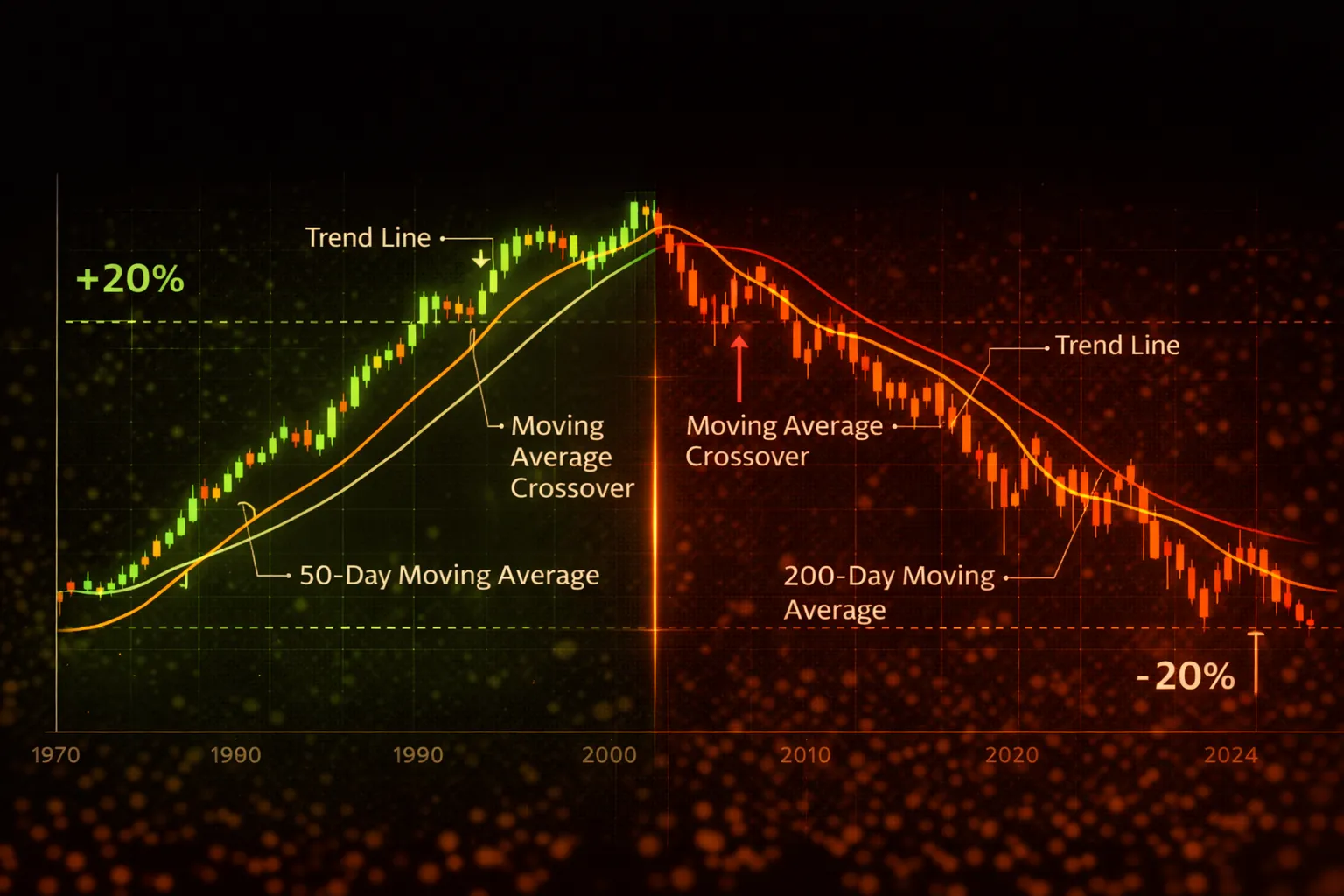
Technical analysis offers several tools for assessing market conditions. Moving averages help identify the prevailing trend. When prices trade above long-term moving averages such as the 200-day moving average, this often indicates bullish conditions. Prices persistently below this average may suggest bearish conditions.
Moving average crossovers provide additional signals. When a shorter-term moving average crosses above a longer-term average, this “golden cross” pattern is often interpreted as bullish. The opposite “death cross” pattern, where the shorter average falls below the longer, is frequently viewed as bearish.
Trend line analysis involves drawing lines connecting successive highs or lows. An upward-sloping trend line of higher lows suggests a bull market; a downward-sloping line of lower highs indicates bearish conditions. Breaking established trend lines can signal potential phase changes.
The 20% threshold serves as a common reference point. A rise of 20% from a recent trough often marks the technical beginning of a new bull market, while a 20% decline from a peak typically defines entry into a bear market. These thresholds are conventions rather than hard rules.
Fundamental Signals
Fundamental analysis examines underlying economic and corporate data. Indicators such as GDP growth, unemployment rates, inflation figures, and consumer confidence readings provide context for market conditions. Sustained improvement across multiple indicators often supports bull markets; deterioration may signal bear market risk.
Corporate earnings represent another consideration. Rising earnings across broad market indices generally support higher stock prices and bull market conditions. Declining earnings, particularly when widespread across sectors, often accompany bear markets.
Monetary policy influences market conditions significantly. Accommodative policies with low interest rates tend to support asset prices. Tightening policies aimed at controlling inflation can create headwinds for equities, though the relationship isn’t mechanical.
Trading Strategies for Bull and Bear Markets
Different market environments call for different approaches. The strategies outlined here represent general educational concepts rather than specific recommendations.
Approaches During Bull Markets
During bull markets, many investors adopt growth-oriented positioning. This may involve maintaining higher allocations to equities, focusing on sectors that historically perform well during economic expansion, or holding positions for longer periods to capture upward trends.
Buy-and-hold strategies often perform well during sustained bull markets, as attempting to time short-term fluctuations can result in missing significant gains. Some investors use market pullbacks as opportunities to add to positions at lower prices.
Diversification remains relevant even in rising markets. While enthusiasm may focus on the strongest-performing areas, maintaining exposure across different asset classes and sectors provides a buffer if conditions change unexpectedly.
Approaches During Bear Markets
Bear markets present different considerations, especially regarding risk management. Some investors reduce equity exposure and increase allocations to less volatile assets such as bonds or cash equivalents. This defensive positioning aims to preserve capital during declining markets.
Dollar-cost averaging (investing fixed amounts at regular intervals regardless of price) continues to work during bear markets. This approach results in purchasing more shares at lower prices, which can improve average cost basis if markets eventually recover.
Some traders and investors view bear markets as opportunities to acquire assets at discounted prices. This approach requires sufficient capital reserves and the willingness to tolerate further declines before any recovery materializes.
Maintaining perspective helps during difficult market periods. Bear markets, while painful, have historically been followed by recoveries. The timing and magnitude of any recovery remains uncertain, however, and individual circumstances vary considerably.
Common Misconceptions About Bull and Bear Markets
Several misunderstandings persist regarding market cycles.
One common misconception holds that bull or bear markets can be reliably predicted in advance. Various indicators may suggest increased probability of market transitions, but precise timing consistently eludes even professional forecasters.
Another misconception assumes bear markets always coincide exactly with recessions. While correlation exists, markets often move in anticipation of economic changes. Bear markets can begin before recessions are officially declared and can end before economic conditions fully improve.
Some believe diversification becomes unnecessary during strong bull markets. Concentrated positions in outperforming areas can suffer disproportionate losses when conditions shift, however. Maintaining appropriate diversification and properly researched strategies (rather than just hoping the bull market will continue) helps manage risk across different environments.
The idea that any single strategy works in all conditions represents another misconception. Approaches that succeed during bull markets may struggle during bear phases, and vice versa. Adapting to changing conditions while maintaining core investment principles tends to serve investors better than rigid adherence to any single method.
Frequently Asked Questions


Comments