


Overconfidence in trading is one of the most dangerous psychological traps you can fall into, precisely because it disguises itself as skill. It feels like progress, but left unchecked, it quietly rewires your decision-making until you’re taking risks you would never have accepted when you started.
This guide breaks down what overconfidence bias actually is, why your brain is wired to fall for it, how to recognize it in your own behavior, and what you can do to manage it without losing the conviction you need to trade well.
This article is for educational and informational purposes only. Nothing here constitutes financial advice. Trading involves significant risk, and you should always consult a qualified professional before making financial decisions.

What Is Overconfidence Bias in Trading?
Every trader needs confidence to pull the trigger. But there’s a point where confidence stops being an asset and starts becoming a liability. Most traders don’t notice when they cross that line.
Overconfidence bias is a well-documented cognitive bias in behavioral finance. It means you systematically overestimate the accuracy of your own knowledge, the quality of your predictions, or your ability to control outcomes. In trading, this translates to believing you know more about where a market is heading than you actually do.
The Psychology Behind Overconfidence
Your brain is built for survival, pattern recognition, and conserving mental energy. When you experience success, your brain files that away as evidence of competence. Win a few trades in a row, and your subconscious starts whispering that you’ve cracked the code.
This is rooted in what psychologists call the “illusion of control”: the tendency to believe you have influence over outcomes that are largely driven by external, unpredictable forces. In a market environment where randomness plays a significant role, this illusion can be devastating. You start attributing wins to your brilliance rather than acknowledging favorable conditions, timing, or plain luck.
The Dunning-Kruger effect is relevant here too. Early in your trading journey, limited experience can actually inflate your sense of competence because you don’t yet know enough to recognize what you don’t know. The less you understand about market complexity, the simpler it appears.
How Overconfidence Differs from Healthy Confidence
This distinction matters more than most traders realize. Healthy, calibrated confidence means you trust your process, your preparation, and your risk management while still accepting that any individual trade can go against you. It’s rooted in evidence: a tested strategy, a documented edge, and consistent review.
Overconfidence, by contrast, is rooted in feeling. It skips the evidence and jumps straight to certainty. A confident trader says, “My system has a 60% win rate over 200 trades, so I’ll trust the next setup.” An overconfident trader says, “I just know this one is going to work.”
The difference is whether your confidence is anchored to data or to emotion. And that difference will show up directly in your results over time.
Why Traders Become Overconfident
Nobody wakes up and decides to become reckless. Overconfidence creeps in through specific, predictable doors. Understanding those entry points is the first step to guarding against them.
Winning Streaks and the Illusion of Skill
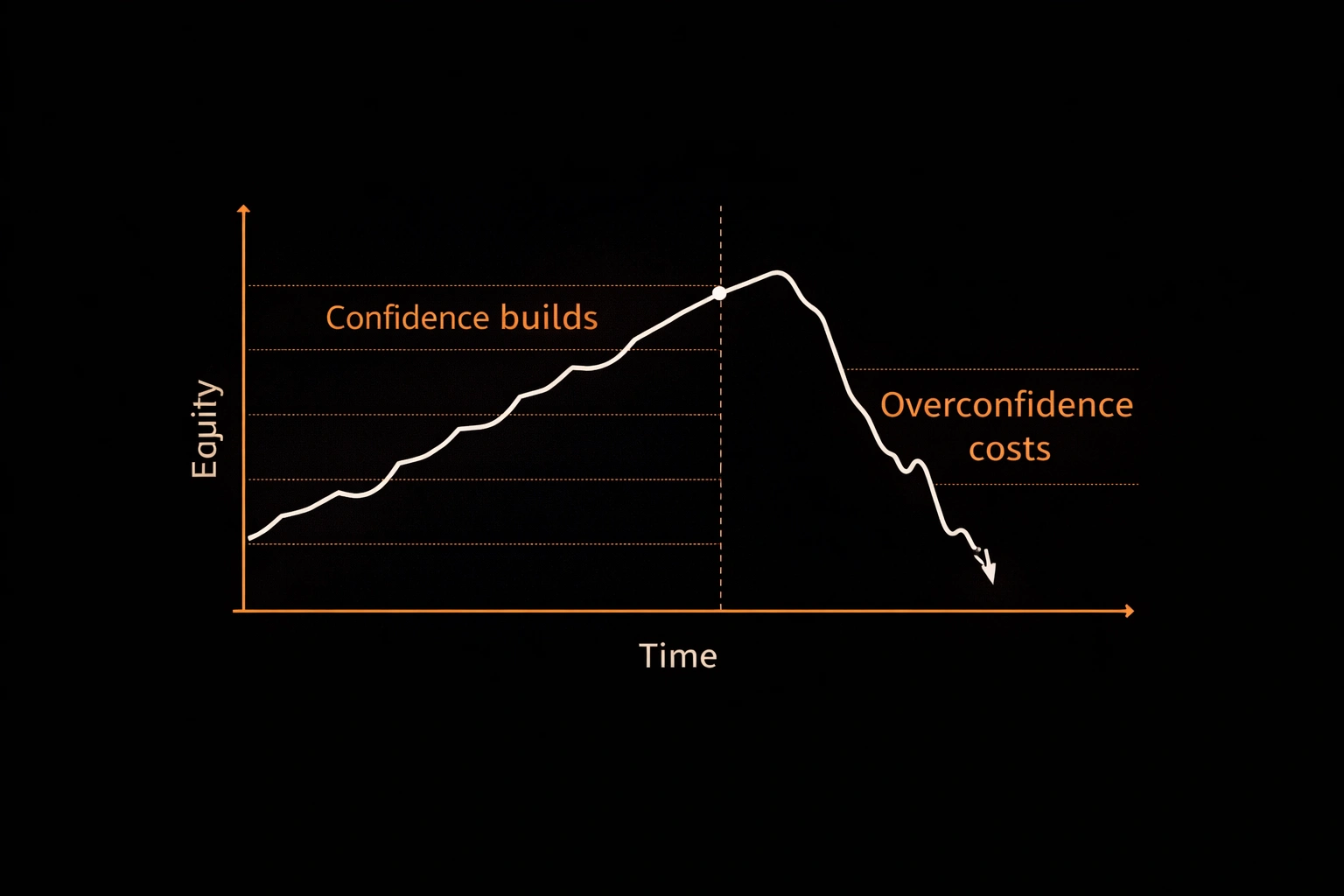
Nothing breeds overconfidence faster than a run of green trades. After five, six, seven winners in a row, the narrative shifts in your head. It stops being “my strategy worked in favorable conditions” and becomes “I’m good at this.”
The problem? Short-term results in trading are a terrible measure of skill. Markets move in regimes. A strategy that works beautifully in a trending environment can fall apart in a range-bound market. Your winning streak might have everything to do with market conditions aligning with your approach, and very little to do with superior judgment.
Think of it like a driver who hasn’t had an accident in ten years. That track record might reflect excellent driving skills, or it might reflect mostly quiet roads in good weather. The moment conditions change, the gap between perceived skill and actual skill becomes painfully clear.
Confirmation Bias as a Fuel Source
Overconfidence recruits confirmation bias as an ally. Once you believe you’re on a hot streak or that you’ve developed an intuitive read on the market, you start unconsciously filtering information. You notice the data that supports your thesis. You dismiss the signals that contradict it.
This creates a feedback loop: overconfidence makes you seek confirming evidence, and confirming evidence deepens your overconfidence. Before long, you’re building a case for what you already believe.
The Role of Social Media and Trading Communities
Social media amplifies overconfidence in ways that are hard to overstate. Your feed is full of screenshots showing massive gains, traders calling exact tops and bottoms, and communities celebrating aggressive plays. What you almost never see is the full picture: the losses, the blown accounts, the survivorship bias baked into every “success story” that reaches your timeline.
When you’re surrounded by people who appear to be winning effortlessly, it distorts your sense of what’s normal and what’s achievable. You start sizing up, trading more aggressively, or abandoning your rules because it looks like everyone else is making money faster than you.
But how do you know when this shift has already happened in your own trading?
Warning Signs You Are an Overconfident Trader
Overconfidence rarely announces itself. It shows up in your behavior before it shows up in your P&L. Here are four concrete warning signs worth watching for.

Increasing Position Sizes Without a Plan
One of the earliest and most reliable signals of overconfidence is position size creep. You start risking 1% per trade as planned. Then, after a few wins, you bump it to 2%. Then 3%. Not because your strategy or risk management rules changed, but because you feel like you can handle it.
Planned, systematic increases in position size based on account growth and strategy performance? Perfectly reasonable. Impulsive increases based on how confident you feel? That’s overconfidence doing what it does best.
Ignoring Stop-Losses or Risk Rules
You set a stop-loss before entering a trade. The price moves against you and approaches your stop. But instead of honoring it, you move it further out, or remove it entirely, because “you know” the trade will come back. This is one of the most destructive manifestations of overconfidence, and it accounts for some of the largest single-trade losses retail traders experience.
Your risk rules exist precisely for the moments when your judgment feels strongest. If you’re only following them when you’re uncertain, they aren’t really rules at all.
Trading Outside Your Strategy or Setup Criteria
Your strategy says you trade breakouts on the 4-hour chart with specific confluence requirements. But after a winning streak, you start taking trades on the 15-minute chart “because the setup looked good.” You enter markets you haven’t studied. You take setups that don’t meet your criteria because your gut tells you to.
Every time you deviate from your defined edge, you’re gambling with the illusion of skill as your only justification.
Dismissing Losses as Anomalies
When a confident trader takes a loss, they review it. When an overconfident trader takes a loss, they explain it away. “That was just a stop hunt.” “The market was manipulated.” “It would have worked if not for that news event.”
If you find yourself narrating away every loss rather than examining it, overconfidence is driving the story. Losses are data. Treating them as noise keeps you from learning the lessons they carry.
So what happens when these behaviors compound over time?
How Overconfidence Destroys Trading Accounts
The damage from overconfidence is a process: a slow erosion of capital that accelerates until recovery becomes nearly impossible.
Compounding Losses Through Excessive Risk
When you’re overconfident, you take bigger positions. Bigger positions mean bigger losses when trades go wrong. And because overconfidence also makes you less likely to cut losses quickly, those bigger positions stay open longer, bleeding more capital than they should.
Here’s the mathematical reality that overconfident traders ignore: a 10% drawdown requires an 11% gain to recover. A 50% drawdown requires a 100% gain. The deeper the hole, the harder and longer the climb back. Overconfidence is the shovel that digs it faster.
The Drawdown Spiral
This is where the real danger lives. After a string of overconfidence-driven losses, many traders double down. The logic (which isn’t logical at all) goes something like this: “I know I’m good at this. These losses are a fluke. I need to trade bigger to make it back.”
This is the drawdown spiral in motion. Overconfidence causes losses. Losses create urgency, which in turn fuels even more overconfident behavior. And the account shrinks further with each cycle. Breaking this loop requires more than willpower. It requires structure.
How to Manage Overconfidence Without Killing Your Edge
Here’s the good news: you don’t have to eliminate confidence to fix this problem. The goal is calibration, matching your confidence level to actual evidence rather than feelings. And the best way to do that is through systems that keep you honest.
The Trading Journal as a Reality Check
If you’re not keeping a trading journal, you’re relying entirely on memory and emotion to evaluate your performance. Memory, as it turns out, is notoriously biased toward confirming what you already believe about yourself.
A good trading journal forces you to record:
- Your entry and exit reasoning (not just price levels)
- Whether the trade met your setup criteria
- Your emotional state before, during, and after the trade
- What the outcome actually was versus what you expected
Over time, this creates a factual record that either supports your confidence or reveals uncomfortable gaps. It’s much harder to maintain the illusion of skill when your own data shows that your last eight “gut feeling” trades all lost money.
Rule-Based Systems and Checklists
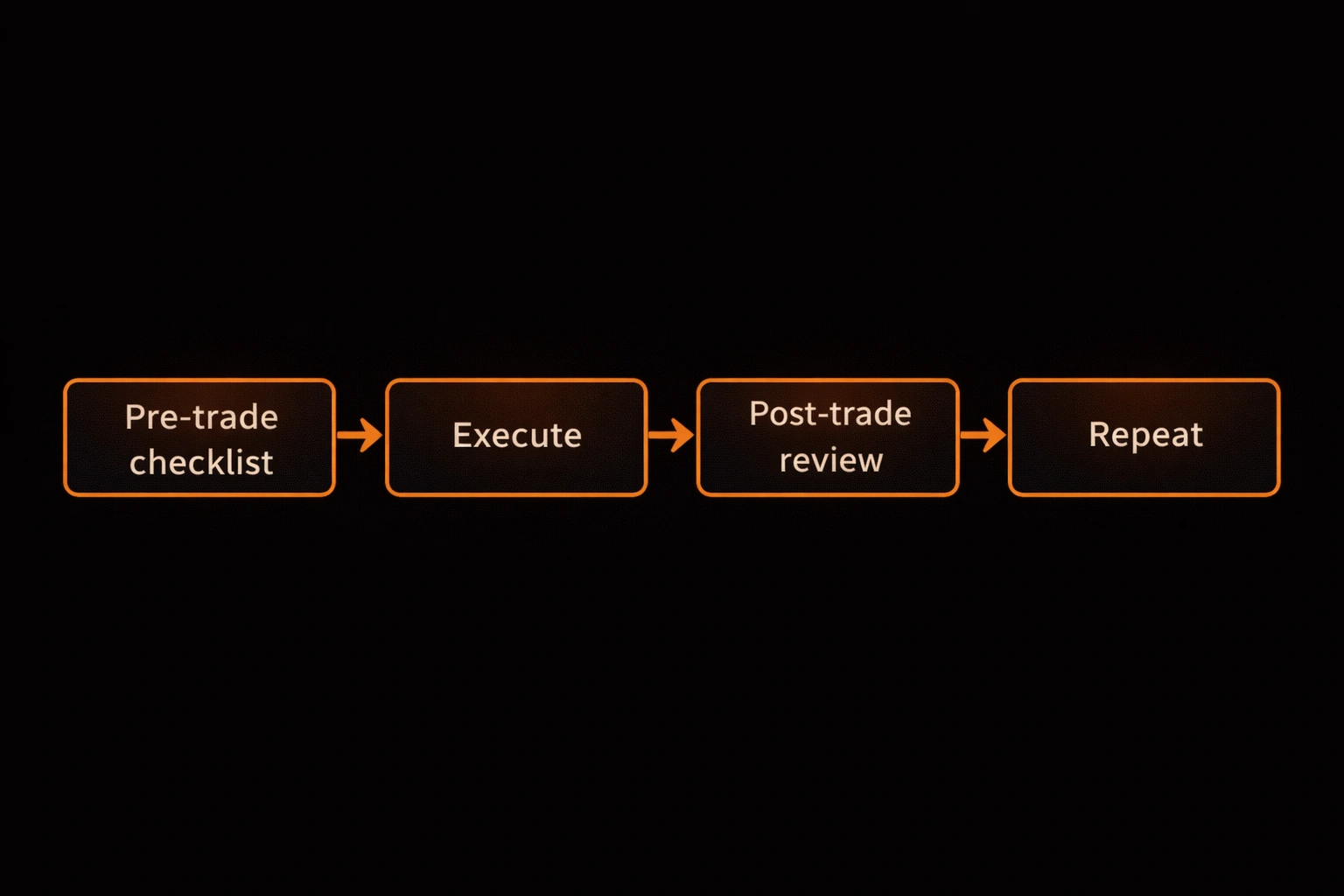
The most effective defense against overconfidence is removing discretion from the moments where it does the most damage. A pre-trade checklist that you must complete before entering any position creates a friction point between impulse and action.
Your checklist might include:
- Does this trade meet my specific setup criteria?
- Is my position sizing consistent with my risk rules?
- Have I placed my stop-loss before entry?
- Am I trading this because of my system, or because of how I feel?
- Have I checked for upcoming news events that could affect this trade?
If you can’t answer all five questions satisfactorily, you don’t take the trade. Simple. Not easy, but simple.
Pre-Trade and Post-Trade Routines
Routines anchor your behavior to process rather than emotion. A pre-trade routine might involve reviewing your journal, checking your recent win rate, and confirming that your current position sizing aligns with your rules. This takes five minutes, and it’s often the difference between a disciplined trade and a reckless one.
Post-trade routines are equally important. After closing a trade, win or loss, take a few minutes to record what happened, why, and whether you followed your plan. This is the mechanism that keeps your self-assessment grounded in reality rather than narrative.
The Value of Accountability Structures
Trading alone makes overconfidence easier to sustain because there’s nobody to challenge your assumptions. Accountability structures, whether that’s a trading partner, a mentor, a structured community, or even the rule-based framework of a prop firm environment, add an external check on your behavior.
Funded account programs and prop trading setups, for example, typically enforce maximum drawdown limits, daily loss caps, and position sizing constraints. These external guardrails don’t care how confident you feel. They enforce discipline mechanically, which is exactly what overconfidence undermines.
You don’t need to trade within a prop firm to benefit from this principle. You can create your own rules and share them with someone who will hold you to them. The point is to build a system where overconfidence runs into a wall before it reaches your capital.
Building Calibrated Confidence as a Trader
Overconfidence isn’t the opposite of good trading. It’s a distortion of something you actually need. The goal isn’t to trade scared or second-guess every decision. It’s to build what researchers in behavioral finance call “calibrated confidence”: a level of self-assurance that accurately reflects your actual edge.
Calibrated confidence looks like this:
- You trust your strategy because you’ve tested and reviewed it, not because it “feels right”
- You accept that individual trade outcomes are uncertain, even when your analysis is solid
- You adjust your conviction based on new data, not based on your ego
- You treat losses as information, not insults
- You let your risk management rules override your feelings every time
Building this kind of confidence is slower than the false version. It requires patience, honest self-reflection, and a willingness to sit with uncertainty. But it’s also the kind of confidence that compounds over a career, rather than the kind that blows up an account in a single month.
Trading psychology is the infrastructure that everything else is built on. And managing overconfidence is one of the most concrete, measurable improvements you can make in your trading.
Frequently Asked Questions


Comments