


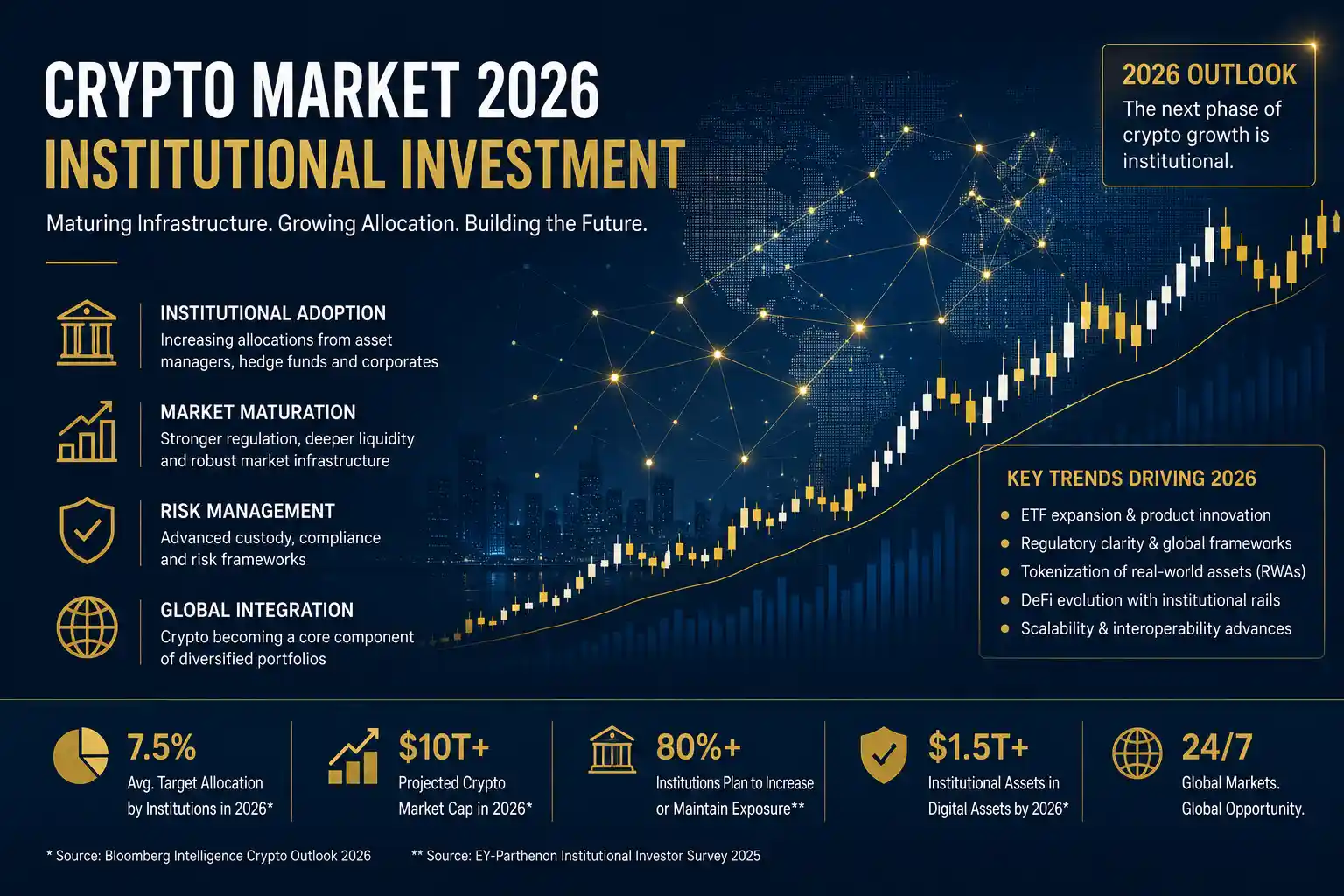
The crypto market in 2026 is structurally different from anything that came before it. This article maps those shifts: the signals, mechanisms, and actors that informed investors are actually tracking right now.
If your mental model was built on 2020-2021 cycle behavior, most of it doesn’t hold. Here is what has changed, what has not, and what deserves your attention.
Why 2026 Marks a Structural Inflection Point
The crypto market spent most of its history being defined by what it lacked: institutional infrastructure, regulatory frameworks, and the kind of market depth that serious allocators require before committing capital. In 2026, those absences are no longer accurate as a description, though they are not fully resolved either.
Two developments, more than any others, explain the shift.
The ETF Effect: From Retail Speculation to Institutional Allocation
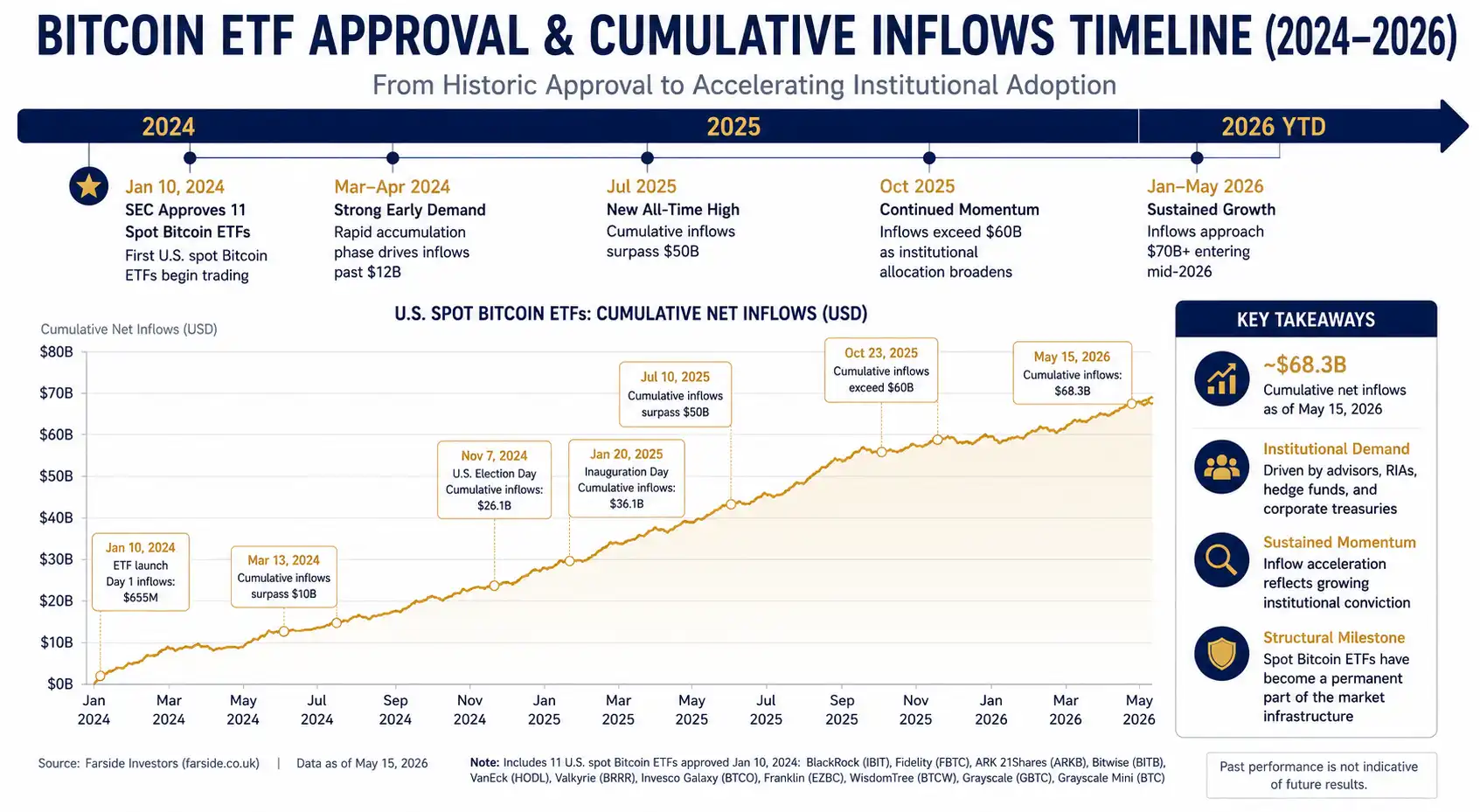
The approval of spot Bitcoin ETFs in the United States in January 2024 was a structural event. It created a regulated, familiar access point for institutions that had previously been excluded by mandate, liability, or operational friction. Pension funds, registered investment advisers, and wealth management platforms that could not custody Bitcoin directly could now access exposure through instruments they already know how to hold.
The inflow trajectory since approval has not been linear, and it rarely is with new instruments. The cumulative picture, however, has shifted the composition of Bitcoin holders in ways that had no precedent in prior cycles. This is no longer a market driven purely by retail momentum. The bid structure is fundamentally different.
Regulatory Clarity Is No Longer a Future Promise
For years, regulatory clarity functioned as something between a wish and a marketing phrase. By 2026, it has become a concrete, if still incomplete, reality in several major jurisdictions.
In the European Union, the Markets in Crypto-Assets regulation (MiCA) is in force, covering issuance, trading, and service provision for most crypto-asset categories. This has materially changed how European institutional allocators approach the asset class because compliance pathways now exist.
In the United States, the picture has shifted considerably. The SEC and CFTC spent years contesting jurisdictional boundaries over crypto assets, but that dynamic has changed materially in 2026. The two agencies launched Project Crypto as a joint initiative to harmonize federal oversight, then signed a formal Memorandum of Understanding committing to coordinated supervision and an end to duplicative enforcement actions. A subsequent joint interpretive release clarified how federal securities law applies to crypto asset categories. Legislative clarity at the federal level remains partial, but the interagency direction is now clearly set.
Stablecoin regulation deserves a brief mention. In the US, the GENIUS Act was signed into law in July 2025, establishing the first federal regulatory framework for payment stablecoins, with implementing regulations currently in progress. In the EU, MiCA’s stablecoin provisions for asset-referenced tokens and e-money tokens have been in application since June 2024.
The rules of the game are more legible than they were. Reading the signals they generate is where most investors, even experienced ones, are still developing their literacy.
The Signals That Matter Now
The signals that matter in 2026 are more sophisticated than price charts, and they are increasingly accessible to non-institutional investors who know where to look.
Bitcoin ETF Flows: Reading the Institutional Appetite
ETF flow data has become one of the cleaner institutional sentiment proxies available. When authorized participants are consistently creating new ETF shares, it indicates demand is outpacing available supply in secondary markets. Sustained redemption pressure signals the opposite. Neither is a directional trade signal on its own, but as part of a broader read on market structure, ETF flows tell you something that price alone cannot.
What to track:
- Daily net flows across the major US spot Bitcoin ETF products (aggregated, not individual issuers)
- Cumulative inflow trends over rolling 30 and 90-day windows
- AUM concentration: how much of total ETF assets are held in the largest products, and whether that concentration is growing or dispersing
These figures are publicly reported and updated daily. Several financial data providers and on-chain analytics platforms aggregate them in dashboards that require no institutional access to use.
On-Chain Metrics That Institutional Desks Monitor
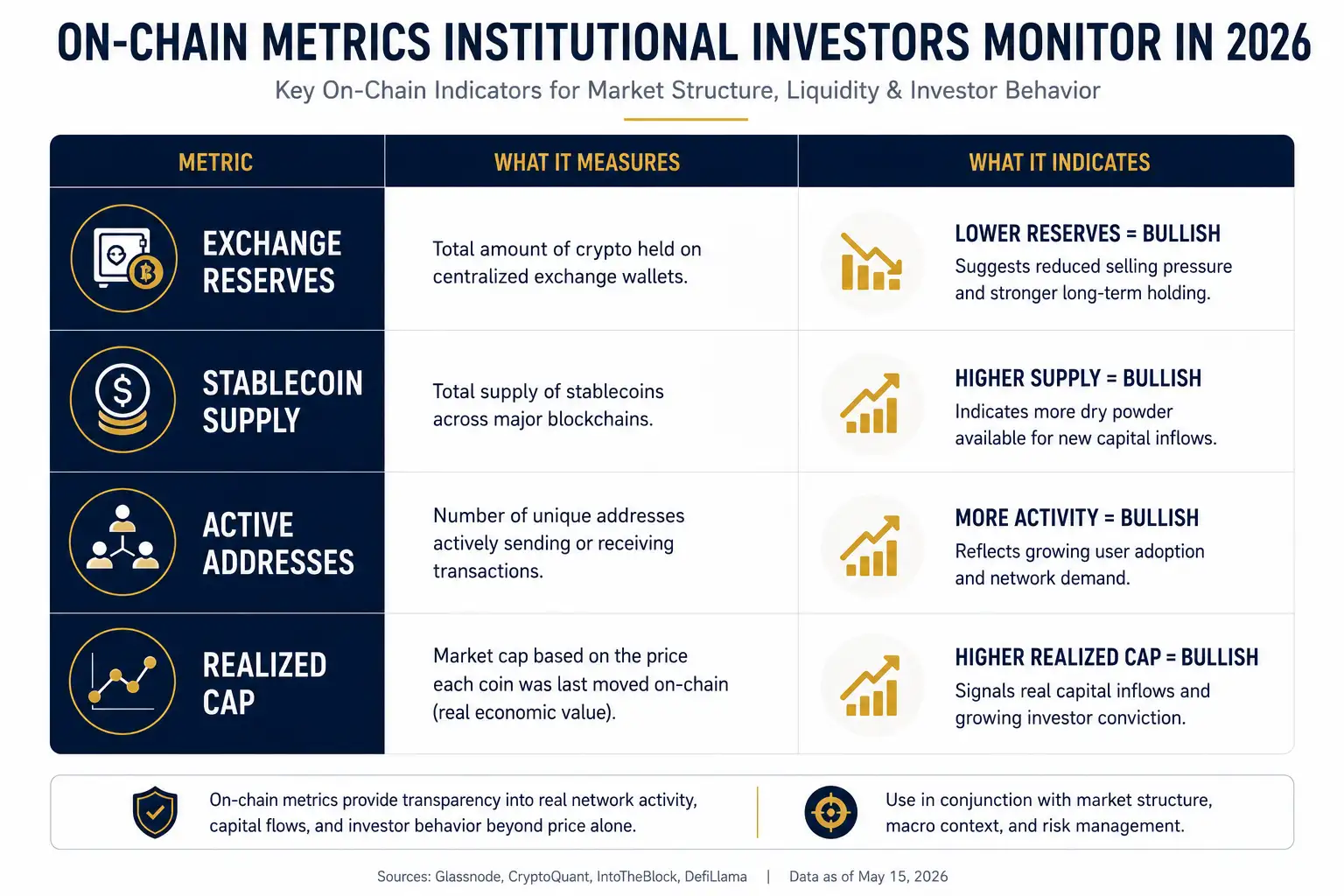
On-chain data is blockchain’s native transparency turned into an analytical layer. Because every transaction settles on a public ledger, patterns become visible that simply do not exist in traditional markets. Here is what matters to serious allocators:
- Exchange reserves: The amount of Bitcoin or other assets held in wallets associated with trading exchanges. Declining reserves historically correlate with holders moving assets to self-custody, which can indicate reduced near-term selling intent. Rising reserves suggest the opposite.
- Stablecoin supply: The total value of dollar-pegged stablecoins circulating on-chain functions as a rough proxy for dry powder, meaning capital sitting on the sidelines in crypto-native form and available to deploy into other assets.
- Active addresses: A measure of network usage. Sustained growth in active addresses reflects genuine adoption; sharp spikes followed by drops are more often speculative activity than structural demand.
- Realized cap: Unlike market cap, which multiplies current price by total supply, realized cap values each coin at the price it last moved on-chain. It gives a picture of aggregate cost basis across the market, useful for understanding where holders stand relative to profit or loss.
Liquidity, Correlations, and Macro Sensitivity
One of the cleaner markers of market maturation is liquidity depth. In prior cycles, Bitcoin spreads on major exchanges were wide enough that large orders moved prices noticeably. By 2026, market depth on the most liquid pairs has improved substantially, making the asset class more accessible to larger allocators without the slippage costs that previously deterred them.
The macro correlation picture is more complicated. Bitcoin’s correlation with risk assets, particularly US equities, has fluctuated across different market regimes. During periods of broad risk-off sentiment, crypto has often sold alongside equities. During periods of dollar weakness or inflation concern, it has at times behaved differently. The correlation is regime-dependent rather than structural, and a simple narrative here is always an oversimplification.
What has changed is that macro desks are actively modeling this. Crypto is now a variable in risk models at major institutions, not a rounding error.
Understanding who is participating in these markets, and what their entry does to market behavior, is the next thing worth examining.
Institutional Crypto Adoption: What It Actually Looks Like
Institutional adoption gets used so often it has nearly lost meaning. Here is what it actually refers to in 2026, concretely.
Who Is Entering and Through What Vehicles
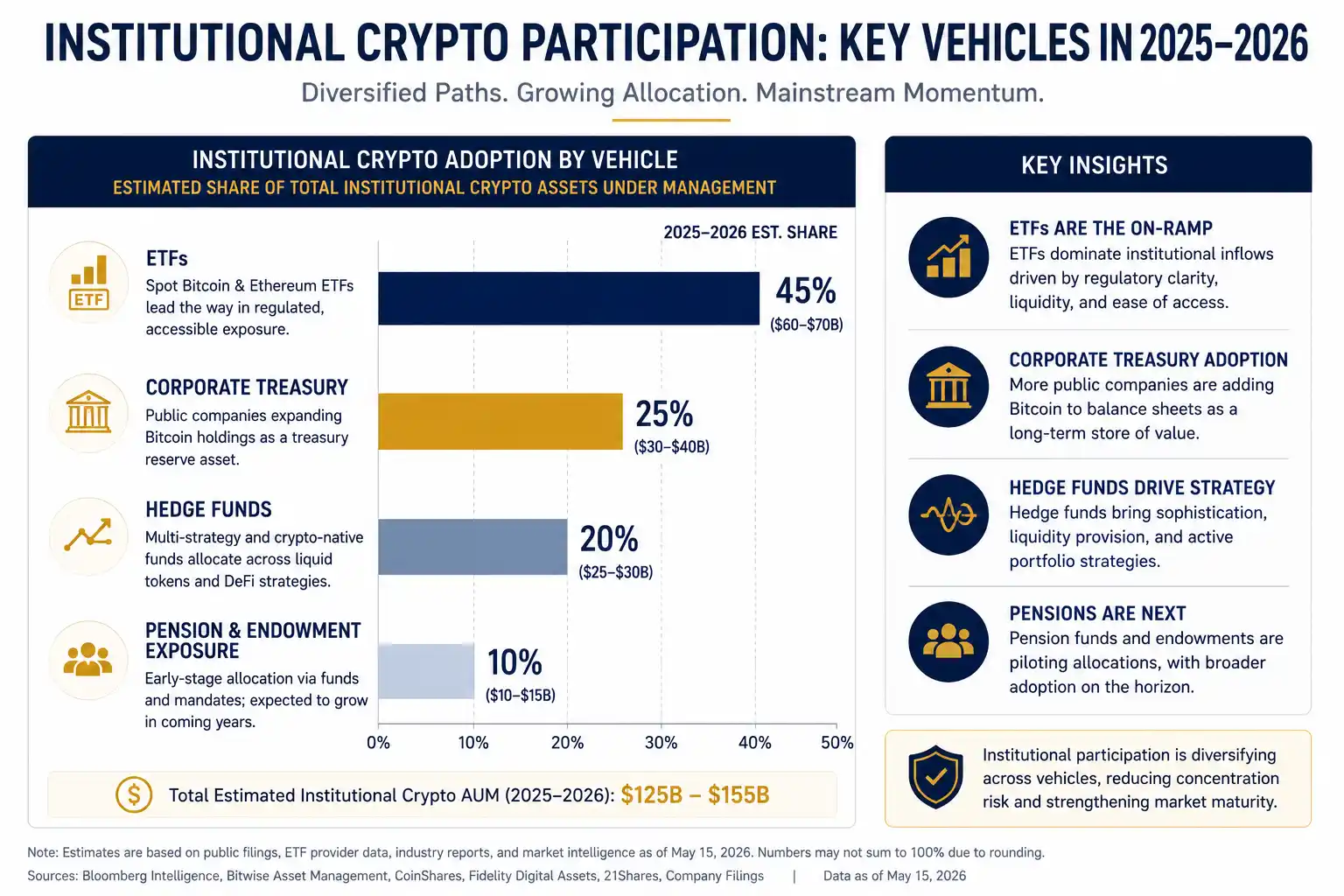
The institutional landscape in crypto is not monolithic. Different types of institutions have entered through different mechanisms, with different levels of exposure and different mandates:
- Asset managers and wealth platforms: Primarily through spot ETFs in the US and regulated exchange-traded products in Europe. BlackRock’s iShares Bitcoin Trust became the reference product for this cohort, but the broader suite of US spot ETF issuers has created competitive access across price points and structures.
- Corporate treasuries: A smaller cohort of publicly listed companies has continued allocating a portion of treasury reserves to Bitcoin, following the approach that attracted attention in the 2020-2021 cycle. While most CFOs remain unconvinced of the case, it is no longer unusual.
- Hedge funds: Both dedicated crypto funds and traditional multi-strategy funds have built positions through a mix of spot, derivatives, and structured products. The derivatives infrastructure, including regulated futures, options, and structured notes, has matured enough to support sophisticated hedged positions.
- Pension and endowment exposure: This is the most nascent category. Some pension funds with diversified alternatives mandates have gained indirect exposure through fund-of-funds structures or allocations to crypto-focused managers. Direct pension allocation to crypto ETFs remains limited in most jurisdictions, though the regulatory pathway now exists in several.
What Institutional Entry Changes About Market Behavior
Institutional participation changes market dynamics in ways that are observable but not always intuitive.
Volatility has reduced relative to prior cycles, not disappeared but reduced. The presence of large allocators with longer time horizons and risk management constraints creates a different bid structure than a market dominated by retail momentum. Institutional sellers also tend to use more sophisticated execution, which dampens some of the sharp, liquidity-driven price swings that characterized earlier markets.
What it does not change: institutional allocators can be wrong, can face redemption pressure, and can sell quickly when mandates or risk parameters require it. The 2022 drawdown happened with institutional participation present. Market maturity does not mean market stability, and that distinction matters.
For context on managing exposure in markets with this profile, MonkeyTrade’s content on risk management in volatile assets is worth reading alongside this.
With a clearer picture of who is participating and why, the more pressing question is where the money is actually going.
Cryptocurrency Investment Trends in 2026
Beyond Bitcoin: Ethereum, Layer 2s, and Emerging Asset Classes
Bitcoin dominates the institutional entry story, but it is not the only asset class drawing informed capital. Ethereum occupies a distinct position as the foundational layer for most of the decentralized finance (DeFi) ecosystem, smart contract activity, and tokenized real-world asset infrastructure. The approval of spot Ethereum ETFs in the US extended regulated access to this asset class as well.
Layer 2 networks are scaling solutions built on top of Ethereum that process transactions more efficiently and at lower cost. They have matured considerably, and institutional interest has begun to extend beyond token speculation toward the utility of the underlying infrastructure. Financial applications built on Layer 2 networks have moved from experimental to operational across a range of contexts.
The broader altcoin and emerging token market remains mostly outside the institutional allocation story. Concentration in Bitcoin and Ethereum dominates institutional exposure, and this is likely to remain true as long as regulatory frameworks continue to treat those two assets differently from the broader token landscape.
How Retail Investors Are Repositioning
The retail investor’s relationship with crypto in 2026 reflects a recalibration after the cycle extremes of 2021-2022. Several patterns are worth noting:
- Multi-asset crypto exposure: More retail investors are holding a basket rather than concentrating in a single asset. Accessible ETF and index products have facilitated this shift.
- Longer holding periods: Data on realized cap and exchange reserve trends suggests a cohort of holders with longer time horizons than the 2021 cycle implied, though this can change quickly.
- DeFi’s institutional interface: Some retail participants who engaged directly with DeFi protocols during the 2020-2021 period are now using more structured products that offer similar exposure with reduced operational risk. Direct protocol access has not gone away, but it is no longer the only path.
Repositioning trends tell you where the market has been. The more useful question is what a rational investor should be watching going forward.
What a Rational Investor Should Be Tracking
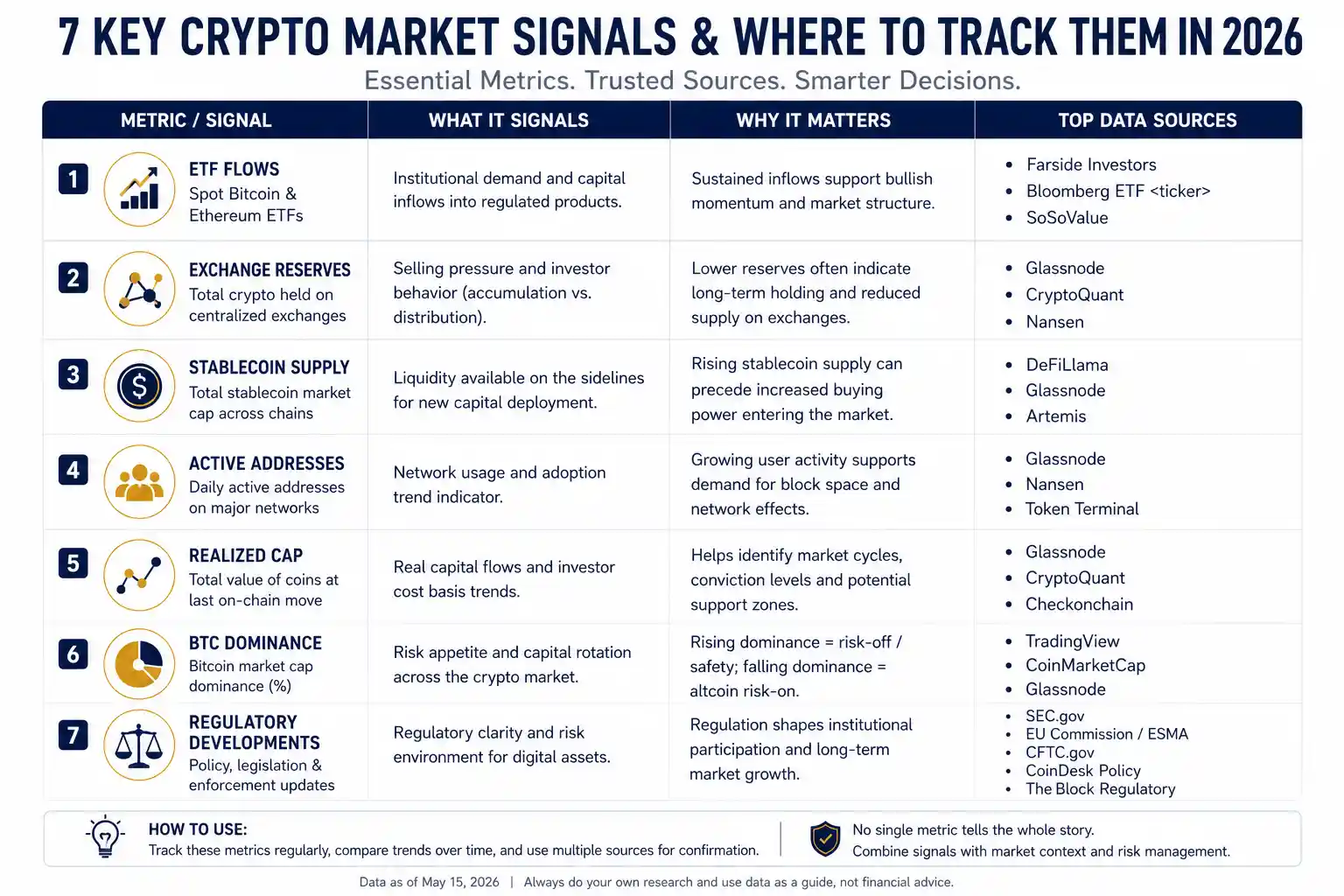
Key Metrics and Data Sources
Here is a structured set of what warrants consistent attention:
Metric / Signal | What It Tells You | Where to Find It |
Bitcoin ETF daily net flows | Institutional demand direction | Public ETF issuer disclosures, financial data platforms |
Exchange reserve trends | Near-term selling pressure / accumulation | On-chain analytics providers (Glassnode, CryptoQuant category) |
Stablecoin supply changes | Available dry powder on-chain | On-chain dashboards, DeFi data aggregators |
Active address growth | Network adoption vs. speculation | On-chain analytics providers |
Macro risk indicators | Correlation context (DXY, yields, risk sentiment) | Standard financial data terminals and platforms |
Regulatory announcement tracking | Framework developments in US, EU, key jurisdictions | SEC, ESMA, and MiCA implementation updates |
Realized cap trends | Aggregate cost basis and holder positioning | On-chain analytics providers |
Most of these are available through free or low-cost platforms.
Risk Considerations That Have Not Gone Away
- Concentration risk: A meaningful portion of Bitcoin and other assets remains concentrated in a small number of wallets and entities. Large position unwinds create outsized market impact.
- Custody and counterparty risk: Holding crypto through regulated products such as ETFs eliminates direct custody risk for that portion of your exposure, but institutional failures, as 2022 demonstrated, can transmit across the ecosystem in non-obvious ways.
- Regulatory reversal risk: The regulatory progress made in the US and EU is real but not permanent. Political change, a significant market event, or a high-profile failure in a regulated product could shift the policy environment materially. Treating current frameworks as settled would be a mistake.
- Liquidity risk in stress: Improved market depth in normal conditions does not mean adequate liquidity in stress conditions. Historical drawdowns in crypto have featured bid-side evaporation that caught even experienced participants off-guard.
- Correlation risk in drawdowns: The asset class has shown a tendency to correlate with equities precisely when diversification would be most valuable. This pattern warrants serious weight in any portfolio construction discussion.
Frequently Asked Questions


Comments