


This article is educational only and does not constitute financial advice. Prop firm rules vary by provider. Always read your specific firm’s documentation before trading.
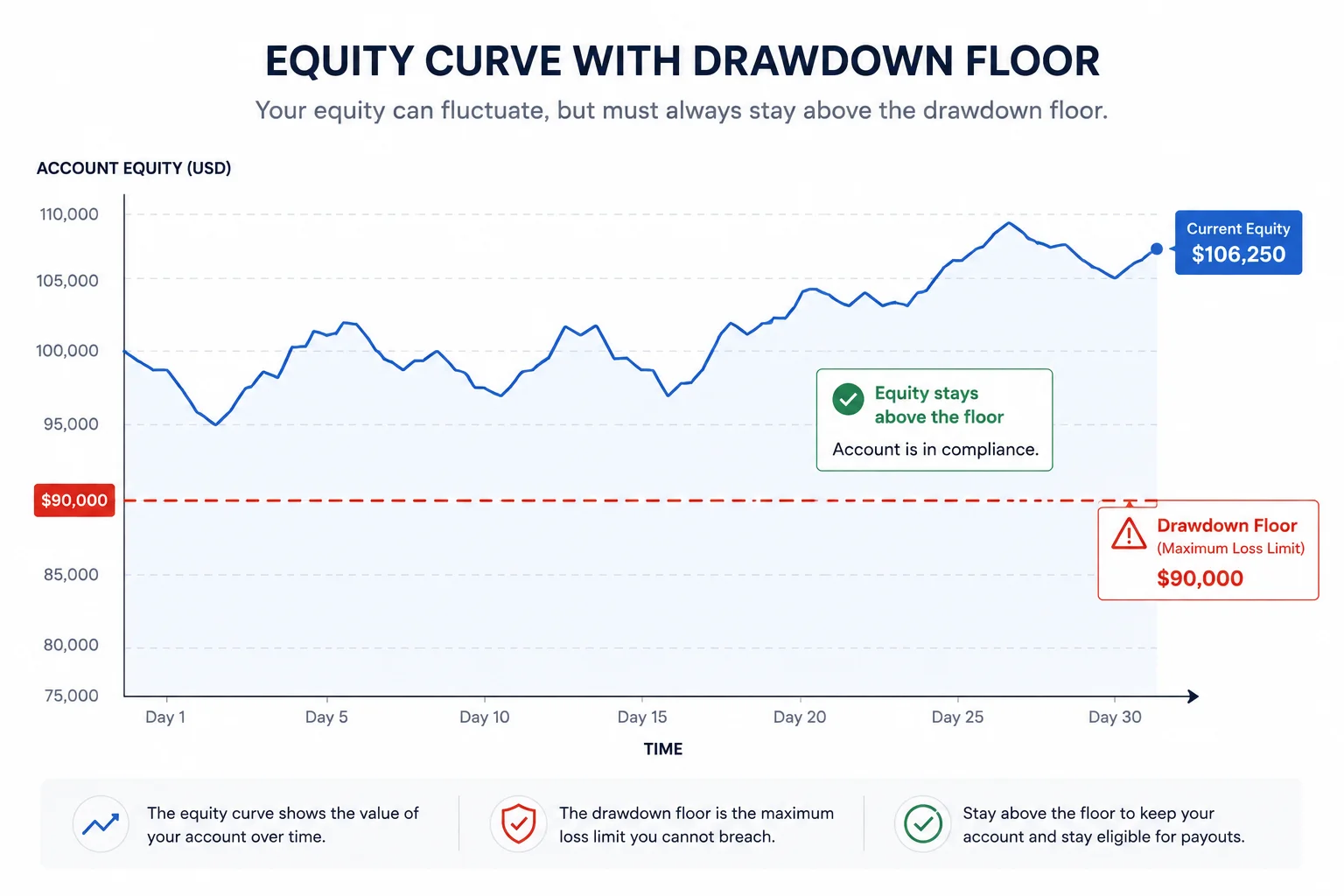
Prop firm drawdown management is the single most important operational skill for anyone trading a funded account. You can have a profitable strategy, solid entries, and a decent win rate, and still lose the account because of how you sized positions or misunderstood how your drawdown limit actually works.
This guide gives you a practical, repeatable framework for calculating your real risk buffer, sizing positions correctly for prop firm constraints, and managing your daily exposure without strangling your trading. The result is a system that makes account preservation feel structured and deliberate, not anxious and reactive.
What Drawdown Limits Actually Mean for Your Trading (Not Just the Rules)
Most traders read the drawdown rules once during the challenge, pass, and then trade the funded account the same way they traded the evaluation. That gap between rule awareness and operational understanding is where funded accounts go to die.
Your drawdown limit defines the absolute floor your account equity cannot touch. The number is fixed in your agreement. What varies (and what matters enormously to how you trade) is how that floor is calculated and when.
Static Drawdown vs. Trailing Drawdown: The Distinction That Ends Accounts
These two rule types behave very differently, and confusing them under live conditions is one of the most common ways funded traders lose accounts they worked hard to earn.
Static drawdown sets a fixed floor from your starting balance. If you start with $100,000 and the static drawdown limit is 10%, your floor is $90,000, permanently. Your account can grow to $130,000 and the floor stays at $90,000. More room as you grow.
Trailing drawdown works differently. The floor moves upward as your account equity grows. Start at $100,000 with a 10% trailing drawdown, peak at $105,000, and your floor trails up to $94,500. From there, it locks in at the highest point reached and stays there.
Here is what that looks like side by side:
Scenario | Starting Balance | Peak Equity | Drawdown Floor | Room Remaining |
Static (10%) | $100,000 | $105,000 | $90,000 | $15,000 |
Trailing (10%) | $100,000 | $105,000 | $94,500 | $10,500 |
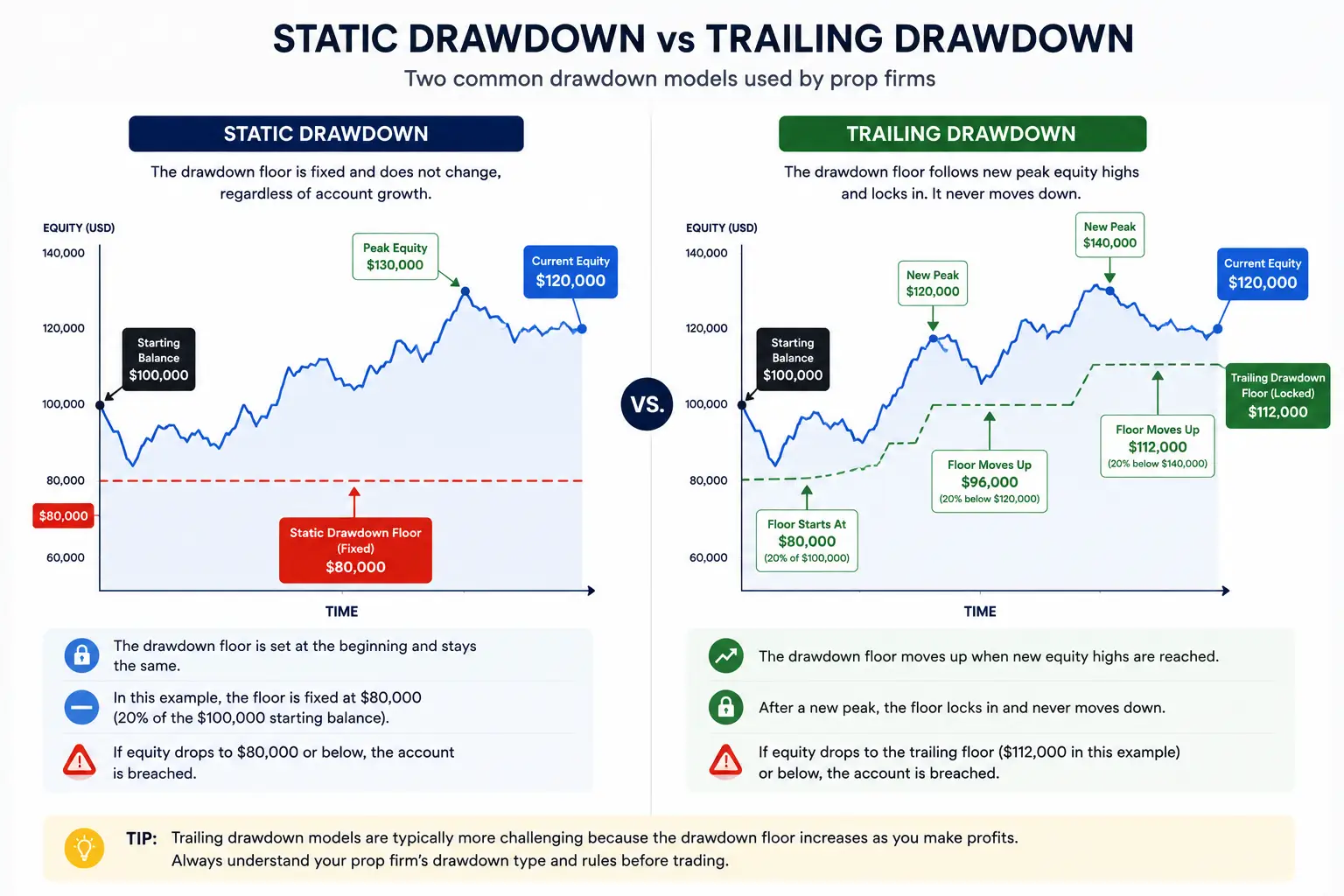
The same profitable run actually tightens your available buffer under trailing drawdown rules. That detail is worth sitting with before you place your next trade.
How Trailing Drawdown Moves Against You During Open Trades
Here is the part most traders miss: some firms calculate trailing drawdown from your equity, which includes open, unrealized PnL.
If you open a trade and it runs $2,000 in profit before you close it, your trailing drawdown floor may have already moved $2,000 higher while the trade is still live. If that trade then reverses and you close it at breakeven, you are flat on the trade but your drawdown floor has shifted against you permanently.
This is how certain firms structure trailing drawdown, and it means letting winners run without understanding your firm’s equity versus balance calculation can quietly close off your buffer without any warning sign on your screen.
Always confirm whether your firm trails from balance or equity before you place a trade.
Calculating Your Real Available Risk Buffer
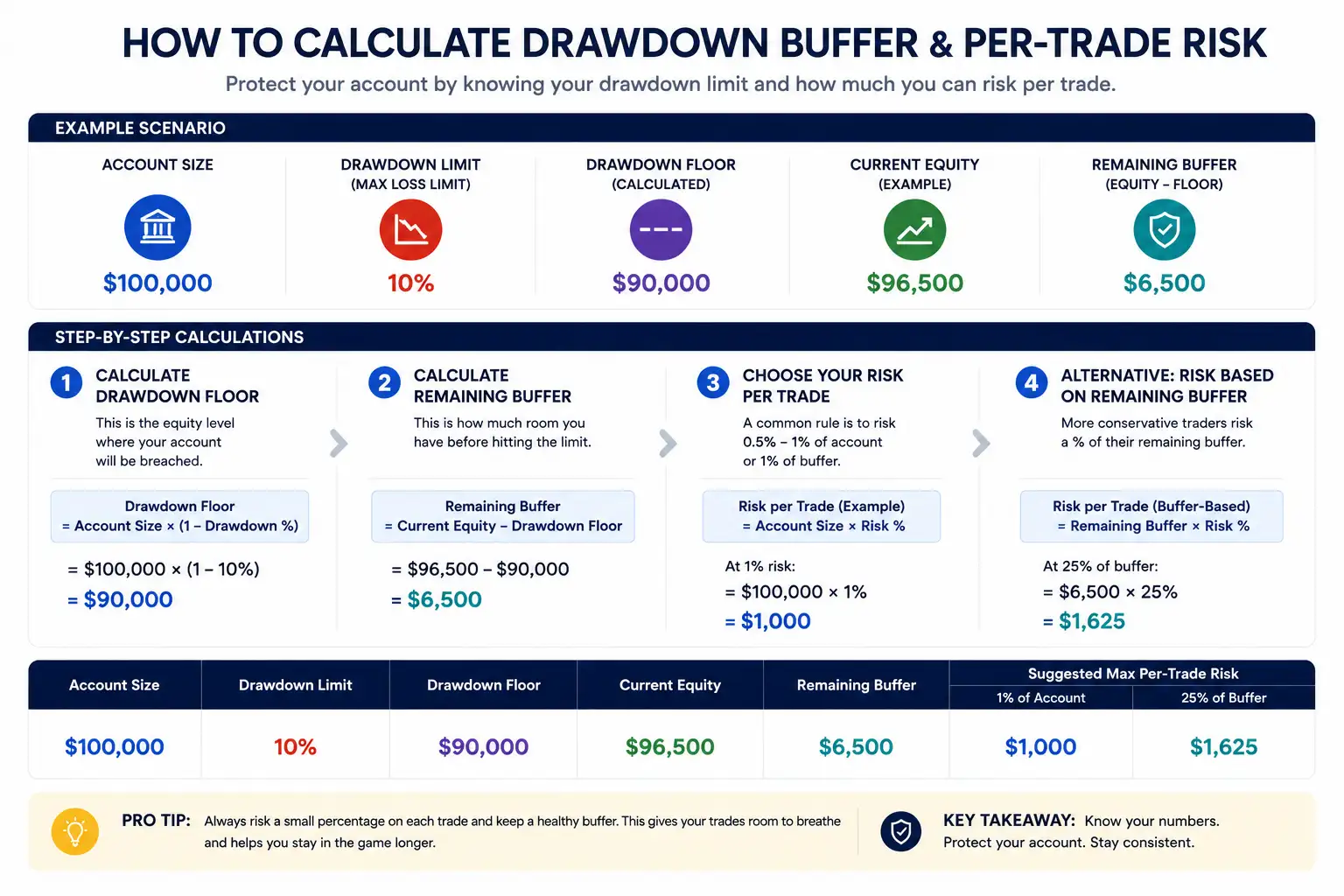
Before you take a single position, calculate your actual risk buffer. This is the distance between your current equity and your drawdown floor.
The formula:
Risk Buffer = Current Equity – Drawdown Floor
Example: Your funded account started at $100,000. You have a trailing drawdown of 8%. Your account equity is currently $103,000, but your trailing floor has moved up to $96,000 based on a previous equity peak.
Risk Buffer = $103,000 – $96,000 = $7,000
That $7,000 is the only capital you are actually managing. Every position you take draws from that number. Your position sizing, your stops, your daily limits: everything anchors to $7,000, not $103,000.
Building a Position Sizing System for Prop Firm Constraints
Knowing your buffer matters only if your position sizing reflects it. A solid sizing system takes the risk buffer as its foundation and builds outward from there. For a deeper look at how sizing frameworks work across different account types, the position sizing and risk management guide on this site covers the mechanics in full.
Starting With Your Drawdown Buffer, Not Your Risk Appetite
Most traders carry a habit from personal accounts: risk a percentage of total balance. On a funded account, that approach can wipe you out while still feeling conservative in the moment.
Risk a percentage of your buffer instead. This is the only figure that reflects your true exposure to breach.
Example using a $7,000 buffer:
- 1% of buffer = $70 per trade
- 2% of buffer = $140 per trade
This keeps your sizing grounded in your real operational limits. As the buffer tightens, sizing adjusts downward automatically. As the buffer grows, you can scale up proportionally.
The 1% Rule Is Not Enough (And Here Is Why)
The 1% rule (risk no more than 1% of your account per trade) is a reasonable starting point for personal trading. For funded accounts, it needs context.
Applied to your full account balance on a trailing drawdown account, 1% may represent 3-5% of your actual buffer per trade. At that rate, 20 consecutive losing trades could end the account, a number that is entirely reachable during a normal drawdown period with no catastrophic errors involved.
The percentage that makes sense depends on:
- Your win rate and average risk-reward ratio
- How many positions you typically hold simultaneously
- How much buffer you have at this specific moment
- Your trading frequency (more trades per week means more buffer events)
The framework gives you the right denominator: always calculate risk relative to your buffer, not your balance. Any specific percentage is a reference point to test against your own data.
Adjusting Position Size for Volatility and Trade Frequency
A fixed dollar risk per trade ignores one important variable: how far your stop needs to be for a given setup. A 10-pip stop on EUR/USD and a 50-pip stop on GBP/JPY produce very different lot sizes for the same dollar risk.
The calculation you need:
Lot Size = Dollar Risk / (Stop Size in Pips x Pip Value)
Example: If you are risking $100 with a 20-pip stop on a pair where one standard lot carries a pip value of $10:
Lot Size = $100 / (20 x $10) = 0.50 lots
On high-volatility sessions or pairs, natural stop distances widen. Fail to reduce your lot size accordingly, and your dollar risk per trade increases quietly and automatically.
On days when you plan multiple trades, track cumulative exposure. If your personal daily cap is $200 and you have already committed $140 across two trades, your next trade has $60 of budget available, not $200.
How to Size Across Multiple Open Positions Without Stacking Risk
Running multiple positions simultaneously compounds your exposure. When several trades correlate (meaning they tend to move together) a single market event can hit all of them at once.
Practical rules for managing concurrent exposure:
- Know the correlation between instruments before entering simultaneous positions. EUR/USD and GBP/USD, for example, often move in tandem.
- Treat correlated positions as a combined single risk event, not independent bets.
- Cap your total open risk at a set percentage of your buffer, not just per-trade risk.
- Reduce individual position sizes when running more than two open trades at once.
If you would not be comfortable with a single trade carrying your total combined exposure, you should not be comfortable running that cluster of positions.
Stop-Loss Discipline in a Funded Account Context
On a personal account, a mental stop is a bad habit. On a funded account, it is a liability you genuinely cannot afford.
Why Your Stop Has to Account for the Drawdown Limit, Not Just the Setup
Stop-loss placement on a funded account serves two purposes: the trade thesis and the drawdown boundary. The setup tells you where price needs to go for your thesis to be wrong. The drawdown limit tells you how much you can lose before the account closes.
If the technically correct stop requires more risk than your remaining buffer can support, two options exist: skip the trade or reduce the size. There is no third option that preserves the account.
A stop placed at the right technical level but the wrong dollar size is the same problem at a different scale.
Hard Stops vs. Mental Stops: Only One Is Acceptable Here
Hard stops (orders placed in the market at your defined risk level) are the only acceptable format on a funded account. Mental stops require flawless execution under real-time pressure, and funded account pressure is a specific psychological weight.
Most traders who intend to honor a mental stop find reasons not to when the moment arrives. That hesitation is normal and human. It is also incompatible with prop firm risk rules.
Set the hard stop before the position goes live. Do not move it away from price when the trade turns against you. Widening a stop to give a trade more room is not managing risk. It is overriding your risk management.
Avoiding the Gap Between Your Stop and the Drawdown Boundary
Your stop does not guarantee execution at your exact price. During volatile sessions, data releases, or fast-moving markets, your actual fill can land worse than your stop level. This is slippage, and it means your realized loss can exceed your planned risk.
On a funded account with a tight remaining buffer, slippage on a losing trade can push you past a limit you believed you had headroom on.
Practical protections:
- Leave a gap between your maximum per-trade risk and your drawdown floor. Do not plan for perfect fills.
- Avoid entering positions immediately before high-impact news events where gaps are more likely.
- Size conservatively on instruments known for wide spreads or thin liquidity during your trading session.
Daily Loss Limits and Session Management
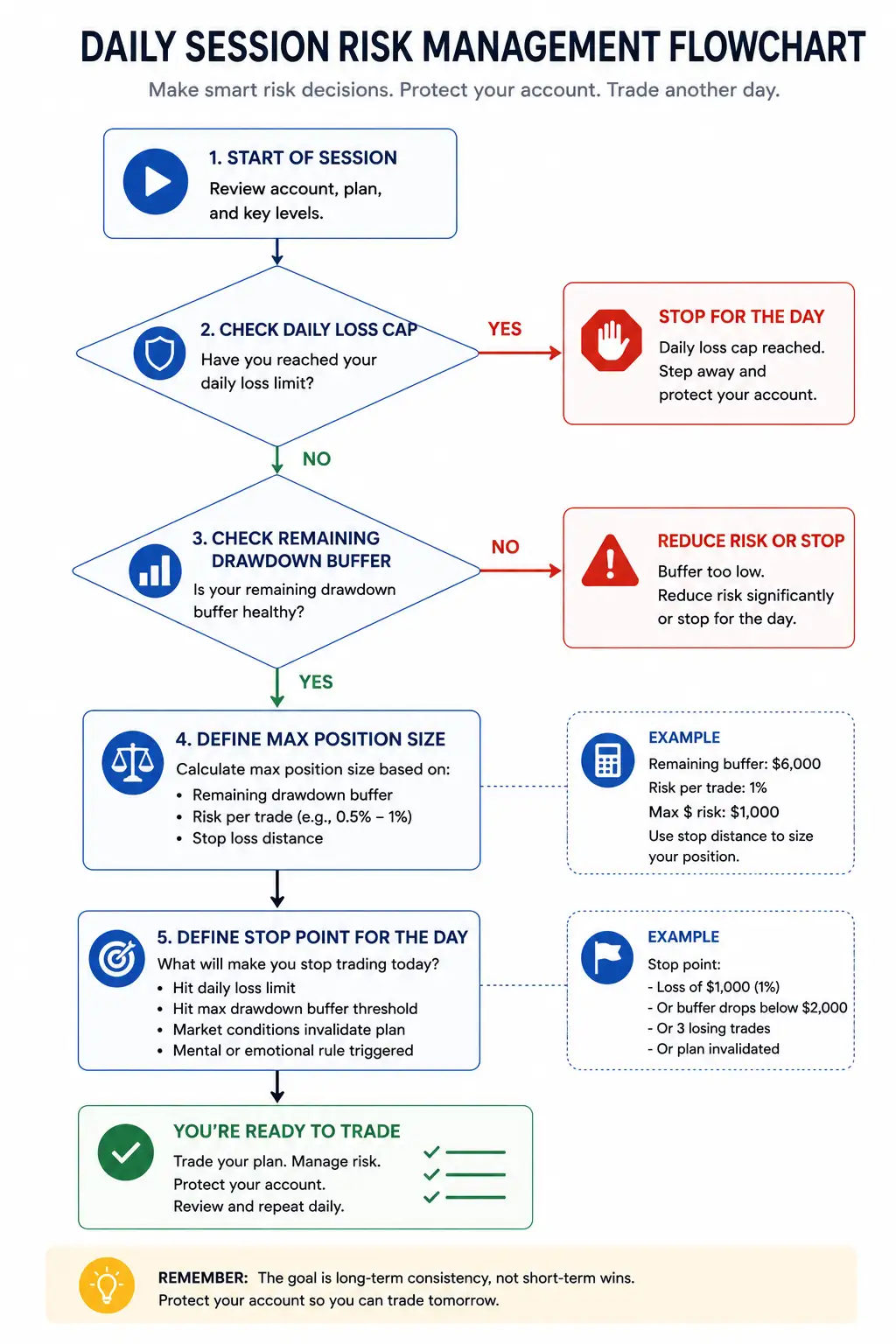
The firm sets a daily loss limit. Your job is to set a personal one below it and hold it with the same discipline you apply to your stops.
Setting a Personal Daily Cap Below the Firm’s Limit
If the firm’s daily loss limit is 4% of your balance, your personal cap should sit at 2-3%. That gap exists for one reason: to absorb slippage, spread costs, and human error before you hit the line that ends your trading day by rule.
A personal cap also keeps bad days contained. Reaching your self-imposed limit at 2% leaves the account intact and gives you a clean, rule-based reason to stop. Reaching the firm’s 4% limit may put you right at the edge of a drawdown breach with no room for the session’s final trade to settle cleanly.
Think of your personal cap as the circuit breaker that trips before the one that actually hurts.
When to Stop Trading for the Day
Your daily cap is the hard rule. Several conditions should trigger a stop before you reach it:
- Three consecutive losing trades in the session
- Performance running significantly below your normal session average
- Awareness of emotional state shifts: frustration, urgency, or a pull to recover losses quickly
- Market conditions that have moved outside the environment your setups are designed for
None of these are signs of weakness. Stopping early when conditions have shifted is risk management. Continuing because the session has time remaining is not.
How Losing Days Compound and What to Do Before the Next Session
A 2% loss on Monday does not reset cleanly on Tuesday. Your buffer is smaller, which means your position sizing on Tuesday should be smaller too. Traders who recalibrate to their updated, lower buffer after a losing day protect themselves from compounding damage. Traders who hold the same sizing as if nothing changed accelerate toward a breach.
Before your next session:
- Recalculate your risk buffer from actual current equity and your updated drawdown floor position.
- Reset position size calculations to reflect the new buffer.
- Identify whether losses came from execution errors, poor setup selection, or difficult conditions, then adjust your approach accordingly.
- Do not attempt to recover the previous session’s loss in a single day.
Common Behavioral Patterns That Cause Drawdown Breaches
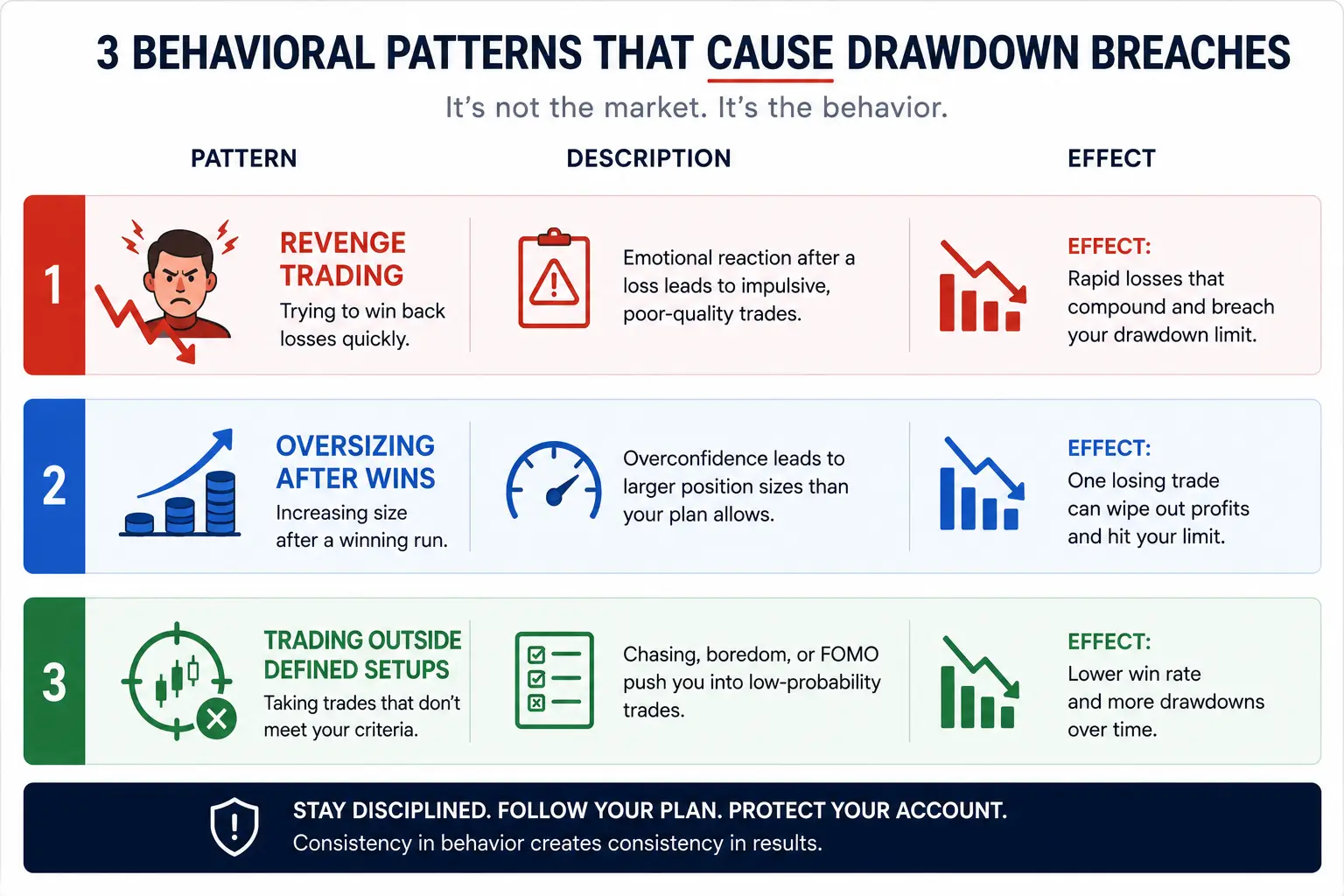
Technical risk management covers sizing and stops. Behavioral risk management covers what happens when those rules meet real-time pressure. Most drawdown breaches come from a sequence of smaller decisions made in compromised states.
Revenge Trading After a Loss Sequence
After a loss or a losing run, the pull toward immediate recovery is strong. The internal logic feels plausible: one good trade and the session looks normal again. That’s what we call revenge trading, and it almost never works out.
What actually happens is well documented. Positions get larger, stops get widened or abandoned, trades get entered without proper confirmation, and losses exceed the original damage. The emotional driver is discomfort avoidance. Losing feels bad, and placing another trade creates the feeling of doing something about it.
A practical rule: after two consecutive losses, take a mandatory pause of at least 30 minutes.
Oversizing After a Winning Run
Winning streaks create a version of the same problem in reverse. After several profitable trades, confidence builds and position sizes often drift upward, sometimes without deliberate intention.
Oversizing during a winning run is how traders surrender several sessions of profit in a single position. The account balance has grown, which creates a feeling of permission to take larger exposure. Under trailing drawdown rules specifically, your buffer may not have expanded by the same proportion as your balance. Your actual risk tolerance has not changed.
Size according to your buffer.
Trading Outside Defined Setups Under Account Pressure
When account pressure builds (a thinning buffer, a difficult week, the awareness of what it costs to pass the challenge) traders frequently enter trades that do not meet their own criteria.
Each of these compromises feels minor individually. As a pattern, they are how funded accounts end during periods that never contained a single dramatic event. The account simply eroded.
The defense is a written trading plan with objective, reviewable criteria, checked before each session. If a trade does not meet those criteria on paper, it does not get taken. The funded account context makes them more important.
Adapting Your Risk Rules to Specific Prop Firm Structures
Risk management principles are broadly consistent.
Different firms use different rule structures, and your framework has to fit your specific agreement, not a generalised version of one. The prop firm comparison guide available here breaks down how rule structures vary across major providers if you want to see the differences mapped out directly.
How Rules Differ Across Firms (Without Recommending Any Specific One)
Across prop firm structures, you will encounter variations in:
- Drawdown type: Static, trailing from balance, trailing from equity, or a hybrid of both
- Daily loss limits: Some firms calculate from the starting daily balance; others from the session’s peak equity
- Lot and position limits: Some accounts restrict maximum open lots, maximum concurrent positions, or both
- News trading rules: Many firms prohibit or restrict trading within a defined window around major scheduled events
- Scaling structures: Some firms adjust drawdown rules as you progress through payout tiers
Keep your firm’s specific rule parameters written somewhere accessible and quick to check. If you are still choosing a provider, the prop firm reviews section covers the rule structures of leading accounts in plain terms.
Checking Trailing Drawdown Calculation Methods Before You Trade
Before trading a funded account, confirm these specific points in your firm’s documentation or through their support channel:
- Is trailing drawdown calculated from balance, equity, or both?
- Does the trailing floor lock in at the highest equity reached, or does it update in real time during open trades?
- Is there a point at which trailing drawdown converts to static drawdown? Some firms implement this at a defined profit level.
- How is the daily loss limit calculated: from the daily opening balance or peak intraday equity?
If the documentation is ambiguous, ask support directly and save the response.
Frequently Asked Questions


Comments