


Trading involves significant risk of loss. The information in this article is intended for educational purposes and does not constitute financial advice. Past performance on a demo account does not predict live trading results.
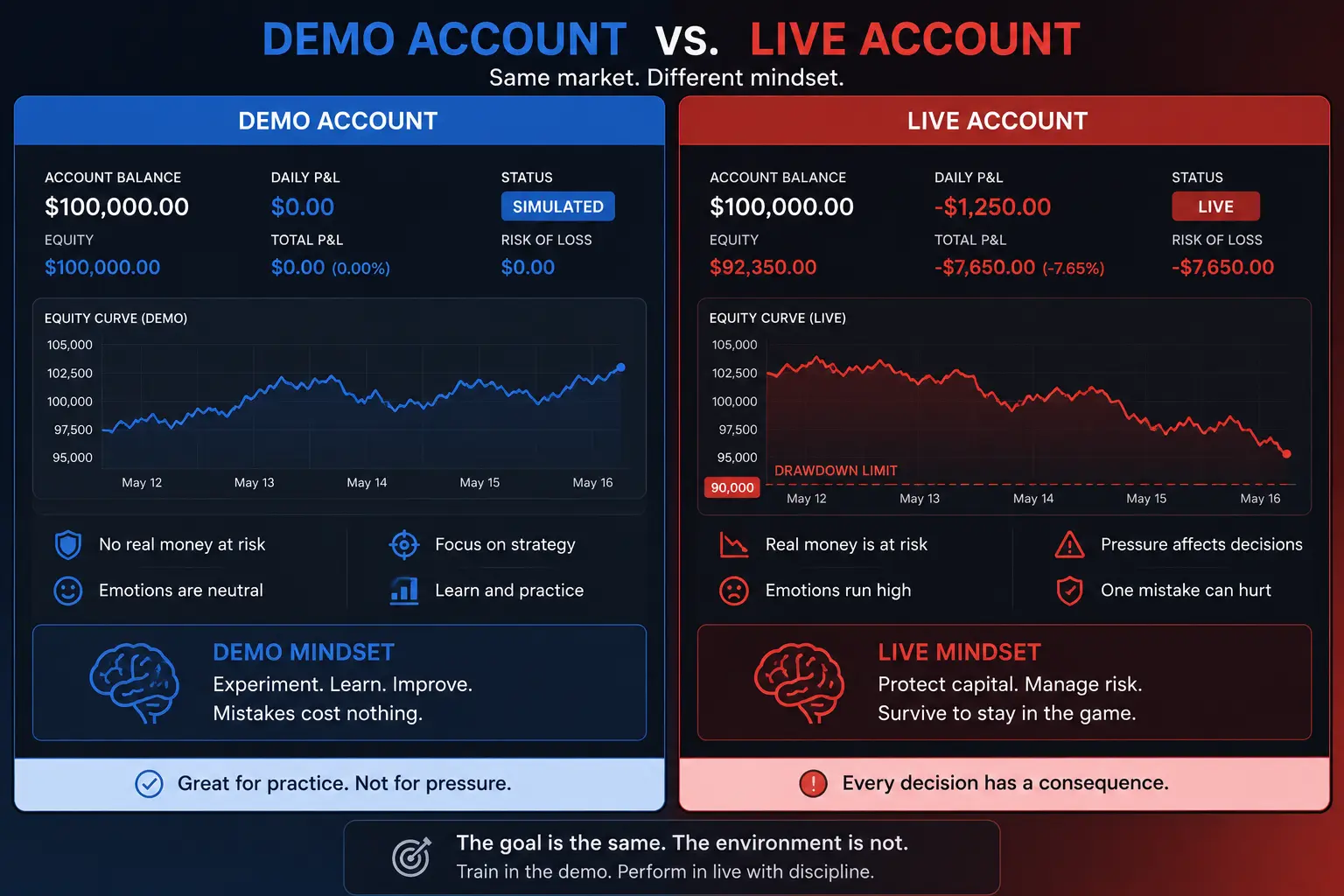
This guide covers what it actually takes to move from demo trading to a live account without destroying your capital in the first month. If you have put in the demo hours and are weighing whether you are ready, and what to do once you get there, this is the framework you need.
Why Most Traders Struggle When They Go Live
Many traders have solid results on their demo accounts. But when they open a live account something goes sideways, and fast. This pattern is one of the most consistent in retail trading, and it has a clear explanation.
The Demo Performance Illusion
Demo trading creates a version of markets that is technically accurate but behaviorally false. The prices are real. The charts are real. Your emotional relationship to those outcomes, though, remains entirely disconnected from financial consequence.
On a demo account, you are essentially playing with house chips. You click buy, you click sell, and you observe the result with the detached curiosity of someone checking yesterday’s weather. No real consequences means your decision-making runs without friction. Live trading introduces that friction the moment your own money is on the line.
This produces inflated results for most traders. You hold winners longer because you are not anxious. You cut losers without hesitation because it does not actually hurt. You re-enter after a loss with no emotional residue.
Your demo performance measures your strategic logic in a pressure-free environment. What it cannot measure is how you will behave when real money is bleeding.
What Changes the Moment Real Money Is on the Line
Several things shift simultaneously when you go live, and most traders underestimate how many:
- Execution quality drops. Spreads widen during news events. Slippage occurs at fast-moving prices. Fills are not always at the price you saw on the chart.
- You start second-guessing valid setups. A trade that looked clean on demo suddenly feels uncertain when the entry costs real money.
- You exit winners too early. The urge to lock in a confirmed gain overrides your original plan.
- Losses feel disproportionately large. Even a small drawdown within your own risk parameters can trigger an emotional response that distorts your next decision.
- Spread and commission awareness increases. On demo, you rarely notice these costs. On live, you will feel every pip eroded before the trade even moves.
Are You Actually Ready to Go Live?
The question of when to go live has a measurable answer, and it is worth being honest about where you stand.
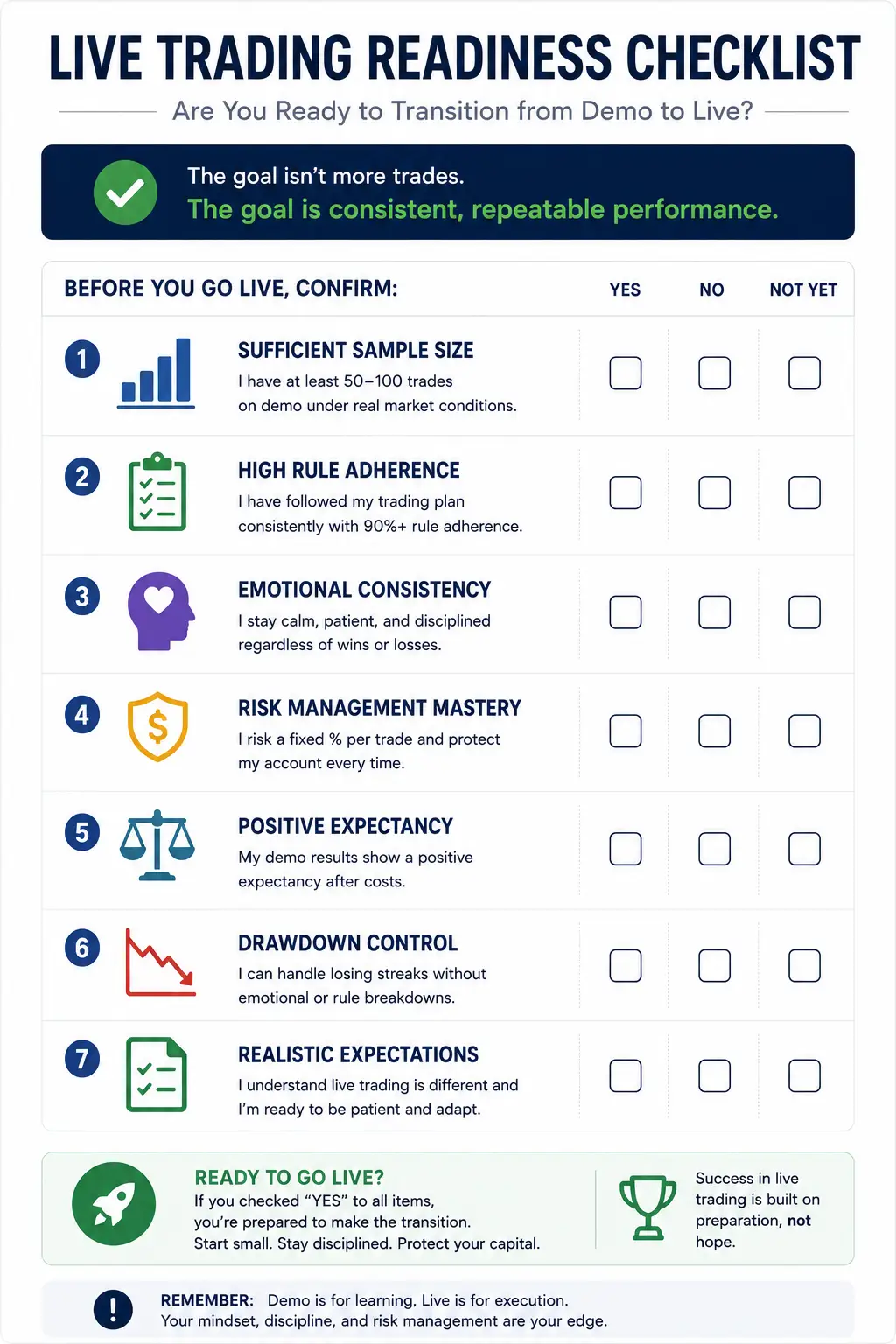
Performance Benchmarks to Meet Before You Switch
Before you fund an account, your demo record should show evidence of the following across a meaningful sample: a minimum of 30 to 50 trades.
- Consistent rule-following. Every trade has a documented reason. No impulse entries.
- Positive expectancy. Your average winner exceeds your average loser over a sample large enough to smooth out variance.
- Defined and respected stop losses. You have not moved a stop to avoid a loss during this period. Not once.
- Drawdown within a pre-set limit. You have set a maximum daily or weekly loss threshold and have not breached it.
- A written trading plan. Not a mental framework. A written plan covering setup criteria, entry triggers, risk per trade, and exit rules.
- Emotional stability across losing streaks. You have experienced two or three consecutive losing trades and continued to follow your process without revenge trading or position-size inflation.
If you cannot confirm all of these from your demo history, going live is premature. This is basic risk management for your own capital.
Red Flags That Mean You Are Not Ready Yet
Pause if any of the following describe your current situation:
- You have been profitable on demo for less than four to six weeks
- You cannot explain, in writing, why you entered your last five trades
- You have blown your demo account more than once and restarted without changing your approach
- Your position sizes have been inconsistent or emotionally driven
- You are going live because you are bored with demo, not because your results justify it
Going live out of boredom, without results that justify it, is a reliable path to an expensive and unnecessary setback.
Setting Up Your Live Account the Right Way
How you structure your live account before your first trade matters more than most traders realise. The decisions made at the setup stage are the ones you fall back on when you are under pressure and your judgment is stretched thin.
Choosing the Right Account Size for Your Stage
Your starting capital should reflect one thing: the amount you can afford to lose entirely without affecting your financial stability or your willingness to continue learning.
Early live trading is part of your education, and the cost of mistakes is a real consideration. A few general principles:
- Start smaller than you think you need to. A smaller account with disciplined risk management teaches more than a larger account traded recklessly.
- If you are considering a prop firm challenge as an alternative to self-funding, compare prop firm options and their risk parameters before committing. The structure suits some traders well at this stage.
- Do not fund a live account with money that is borrowed, reserved for expenses, or emotionally significant in ways that will distort your decisions.
Position Sizing on a Live Account: The Only Number That Matters Early On
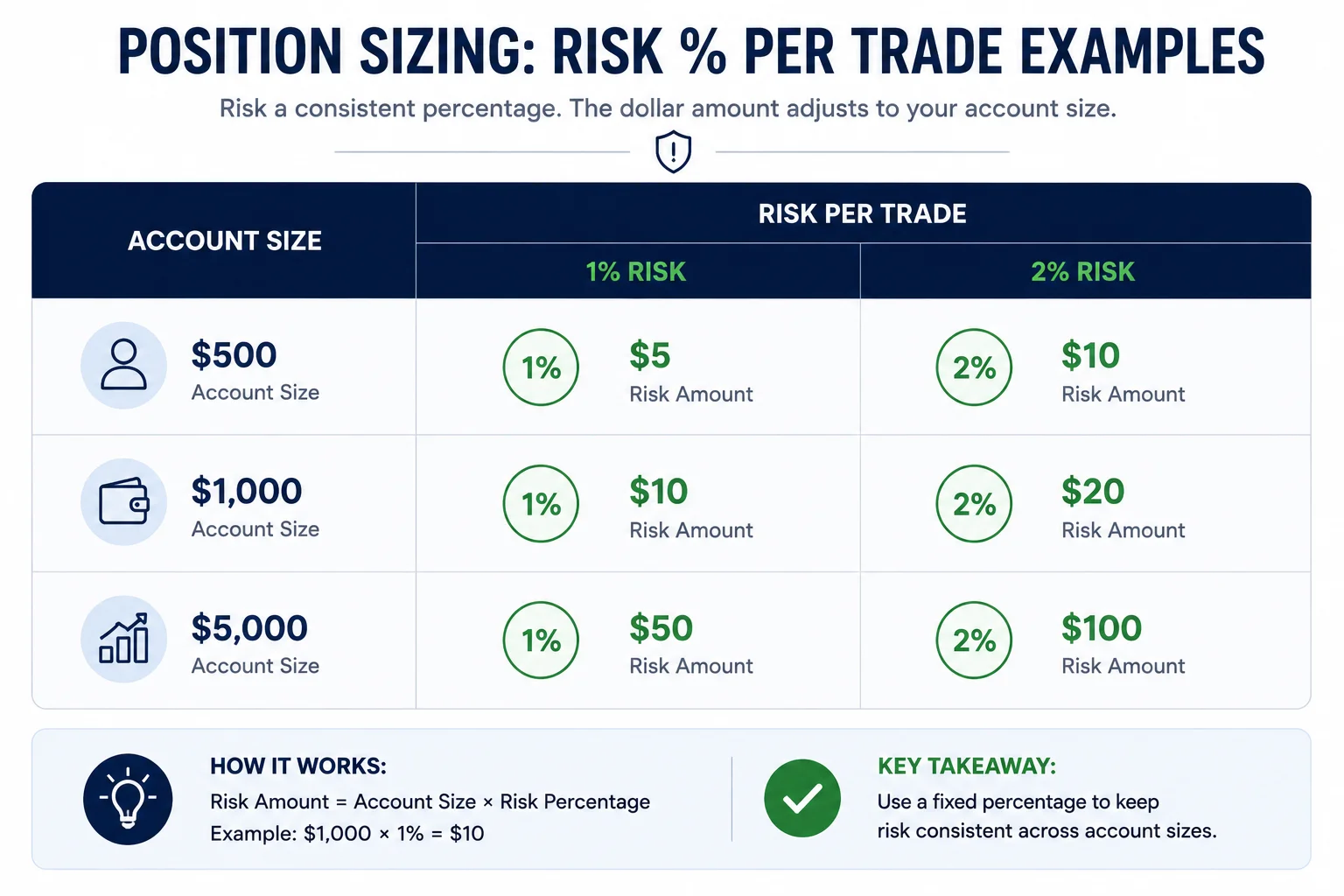
Risk per trade is the single most important variable in your early live trading. Your setup quality, your entries, your targets: all of it depends on staying in the game long enough to develop skill. One or two badly sized trades can end that before it begins.
The general principle used by most disciplined traders:
- Risk 0.5% to 1% of your account per trade during your first month live
- Calculate position size from your stop loss distance, not from a gut feel about lot size
- As a formula: Position size = (Account value x Risk %) / Stop loss in pips (or points)
On a $2,000 account risking 1% with a 20-pip stop, you are risking $20 per trade. That gives you dozens of trades before meaningful capital erosion occurs, which is exactly the buffer you need while adjusting to live conditions.
For a deeper breakdown of how to apply this across different instruments, see the position sizing and risk management guide.
Setting Hard Rules Before Your First Trade
Write these down and commit to them before your account is funded:
- Maximum daily loss limit: the point at which you close the platform and stop trading for the day
- Maximum weekly drawdown: the threshold that triggers a pause and review, not an immediate re-entry
- No revenge trading rule, defined explicitly: after a losing trade, a minimum of 15 to 30 minutes before your next entry
- Position size ceiling: a fixed maximum that does not increase based on conviction or emotion
Rules made in calm conditions protect you during emotional ones. That is their entire purpose.
The Psychology of Live Trading for Beginners
If the mechanical side of going live is a step change, the psychological side is a gear shift you did not know existed.
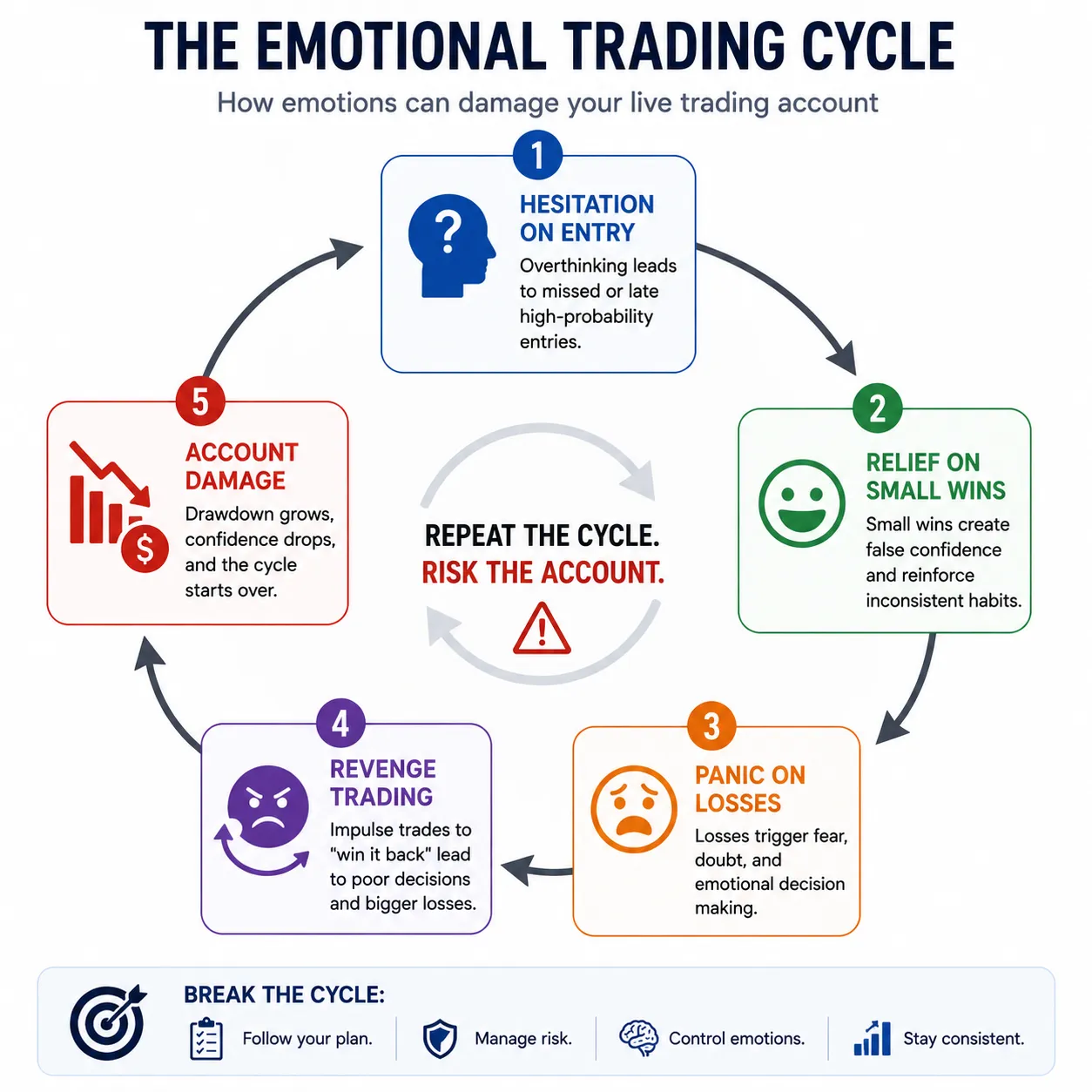
Why Your Brain Behaves Differently With Real Money
Research in behavioral finance consistently shows that the emotional weight of a financial loss tends to feel heavier than the satisfaction of an equivalent gain. On demo, this mechanism is largely inactive. On live, it runs continuously from the moment you open a position.
It causes you to:
- Exit profitable trades early to relieve the anxiety of uncertainty
- Hold losing trades longer to avoid confirming a loss
- Increase position size after a win, mistaking momentum for skill
- Freeze at valid entry points because the cost of being wrong is suddenly real
Recognising the pattern when it starts is a meaningful advantage.
Managing Fear, Hesitation, and the Urge to Overtrade
Fear, hesitation, and overtrading form a cycle that destroys more first live accounts than bad strategies do:
- Fear causes hesitation
- Hesitation causes missed trades
- Missed trades cause frustration
- Frustration causes overtrading to recover lost opportunity
- Overtrading causes losses
- Losses reinforce fear
Breaking this cycle requires behavioral structure:
- Journal every trade, including your emotional state at entry and exit. Patterns surface quickly when you have a written record.
- Accept small losses as operating costs. A stopped-out trade within your risk parameters is not a failure. It is the cost of finding out whether your thesis was right.
- Limit your daily trade count early on. Two to three trades per day maximum in your first month. This reduces the window for impulsive decisions.
- Review your written rules before each session, not after something goes wrong.
For a more detailed framework on managing trading psychology, see the trading psychology resource here.
Your First Week Live: A Structured Approach
Your first week live is about confirming that your process transfers intact from demo conditions to real ones. Keep expectations calibrated accordingly.
Day One Protocol
On your first day live, follow this sequence:
- Open with your smallest permitted position size, half your standard risk if possible
- Take only your highest-conviction setup: the one that most clearly matches your written criteria
- Set your stop and target before entry, not during the trade
- Do not adjust the trade once it is open unless your plan explicitly includes a trail mechanism
- Close the platform after one trade, regardless of the outcome
- Write a trade review immediately while the decisions are fresh
The goal is to execute your process cleanly under real conditions, without emotional interference.
What to Track and Review Daily
Every evening of your first week, review the following:
- Did you follow your entry criteria, or did you improvise?
- Were your stop losses set before entry and left in place?
- Did you exceed your daily trade limit?
- What was your emotional state during the trade: calm, anxious, overconfident?
- Did the outcome match your process quality, or did a poor trade happen to work out?
You are building a behavioral dataset. After week one, that record tells you more about your readiness than your P&L does.
Common Mistakes That Blow Up First Live Accounts
These are the specific failure modes that appear, with predictable regularity, in the first live accounts of traders who had solid demo records.
Oversizing Positions Too Early
The most common and most destructive error. A trader runs a few successful live trades, gains confidence, and increases position size beyond their risk framework, usually without explicitly deciding to do so.
Two or three oversized losers at this stage can erase weeks of gains and, more critically, trigger the emotional spiral that leads to further poor decisions. Your position size ceiling is not a suggestion. Treat it as a circuit breaker.
Abandoning the Trading Plan Under Pressure
When a trade moves against you, the plan feels wrong. The temptation is to exit early, move the stop, or add to the position to average down. Each of these is a deviation from your pre-set rules, made under emotional pressure, which is exactly the worst condition for making trading decisions.
If your trading plan was built on sound logic during a calm moment, it deserves to play out. Override it enough times and you no longer have a plan. You have a collection of impulses dressed up as one.
Chasing Losses After Early Drawdown
Early drawdown is normal. The psychological pressure to recover quickly pushes traders into setups they would not otherwise take, at sizes larger than their rules permit.
This is where accounts go from a manageable drawdown to a serious problem. If you hit your daily loss limit, stop trading. The market will be there tomorrow. Your capital might not be if you keep going.
How to Know the Transition Is Working
In the early weeks, a successful transition has specific markers:
- Your actual trades match your planned trades: same criteria, same sizing
- Your emotional responses are present but not controlling your decisions
- Losses fall within your pre-set daily and weekly limits
- You are not increasing position size based on emotion or impatience
- Your journal shows consistent reasoning, not post-hoc justification
- You can sit out an entire session because no valid setup appeared, without it feeling like failure
Profitability tends to follow process consistency over time. If your process is intact and your capital is managed, you are in a position to develop. If your process is eroding, that is the signal to reduce size, return to demo, or pause entirely for review.
Frequently Asked Questions


Comments