


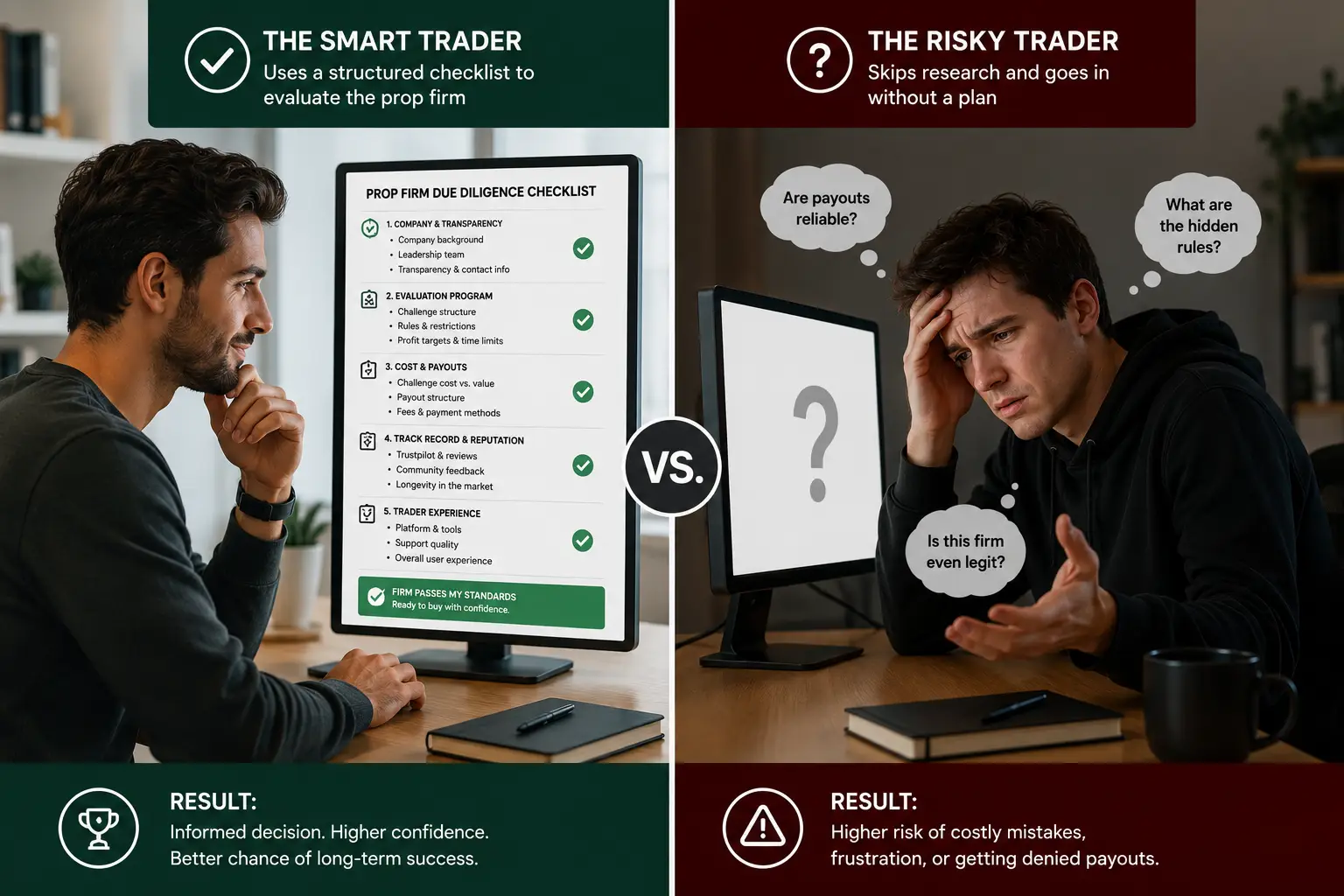
Buying a prop trading challenge is a financial decision, and like any financial decision, it deserves real scrutiny before you commit.
This article gives you a structured due diligence framework you can apply to any prop firm (established or brand new) before you hand over a cent.
Why Due Diligence Matters Before You Pay
Most traders spend more time refining their entry strategy than vetting the firm they’re about to pay. That imbalance is expensive.
The cost of choosing the wrong firm
Depending on the account size you’re targeting, you could be spending anywhere from $50 to several hundred dollars per attempt. And that’s before resets, retakes, or upgrade tiers enter the picture.
If the firm pays out inconsistently, changes its rules mid-cycle, or shuts down entirely, you lose that money with no meaningful recourse. There are no regulatory safety nets in most prop firm jurisdictions. In practical terms, you are an unsecured creditor to a private company with limited public accountability.
The cost of getting this wrong is not just the challenge fee. It’s the time, the emotional energy, and the opportunity cost of chasing a firm that was never going to pay you fairly.
What the industry’s track record tells us
The prop trading industry has grown rapidly over the last several years, and that growth has not been even or clean. Several high-profile firms have collapsed, suspended payouts without notice, or retroactively altered payout conditions after traders had already passed their challenges.
Some changed consistency rules mid-stream, added restrictions absent at sign-up, or shifted goalposts in ways that conveniently disqualified accounts approaching large withdrawals.
Plenty of firms have operated reliably for years, so the model itself is not the problem. The lack of regulation, however, means the burden of verification falls entirely on you. Which brings us to the framework.
The Core Evaluation Framework
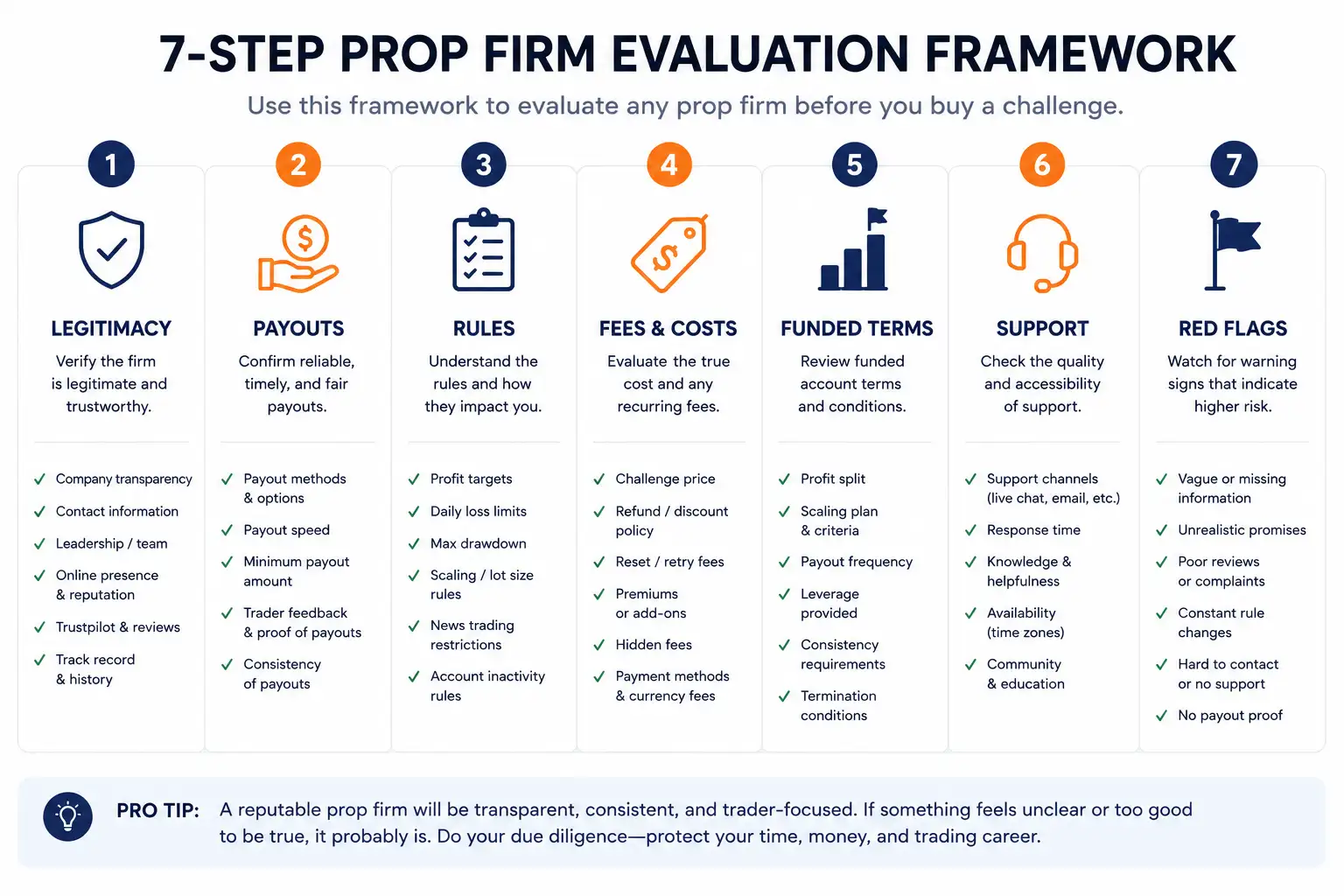
Before spending money on a challenge, evaluate any prop firm across seven dimensions:
- Legitimacy and track record
- Payout reliability
- Challenge rules and trading conditions
- Fee structure
- Funded account terms
- Customer support
- Risk signals
The sections below walk through each dimension in detail, with a consolidated checklist at the end for quick reference.
If you’re still getting familiar with how prop firm challenges work, start there before applying this framework. It will make the criteria here considerably easier to apply.
1. Firm Legitimacy and Track Record
A firm that cannot demonstrate a verifiable operational history deserves extra scrutiny, not the benefit of the doubt.
How long has the firm been operating?
Longevity is an imperfect signal, but it is still a signal. A firm running for three or more years has at least demonstrated some capacity to sustain operations, ruling out a category of risk that newer entrants carry by default.
For firms under 12 months old, your diligence bar should be considerably higher. You are taking on more uncertainty, and you should weigh that honestly against any pricing advantages on offer.
Is there verifiable public information about the company?
Look for:
- A registered company name and jurisdiction, cross-referenced with the relevant business registry
- Named founders or leadership with a traceable public professional profile
- A physical address that is not a virtual office shell
- Terms and conditions written with legal specificity, not generic filler
- A clear operational history on their website or public communications
Each gap is a point against them. A firm that cannot or will not tell you who is running it is not a firm you should be paying money to.
Community reputation and third-party reviews
Check Trustpilot, prop firm communities on Reddit, Discord servers, and trading forums. Look specifically for:
- Patterns in negative reviews: payout delays, rule disputes, account closures
- How the firm responds publicly to complaints
- Whether positive reviews feel authentic or templated
- The ratio and recency of feedback
A firm with 500 reviews averaging 4.1 stars is more informative than one with 30 reviews at 4.9. Treat thin review histories with the same scepticism you would apply to thin trading track records.
Want a side-by-side look at how established firms stack up? Our prop firm reviews and comparisons cover the operational track records of major players across these exact criteria.
2. Payout Reliability
This is the axis everything else rotates around. A firm with excellent rules and unreliable payouts is, by definition, not worth trading with.
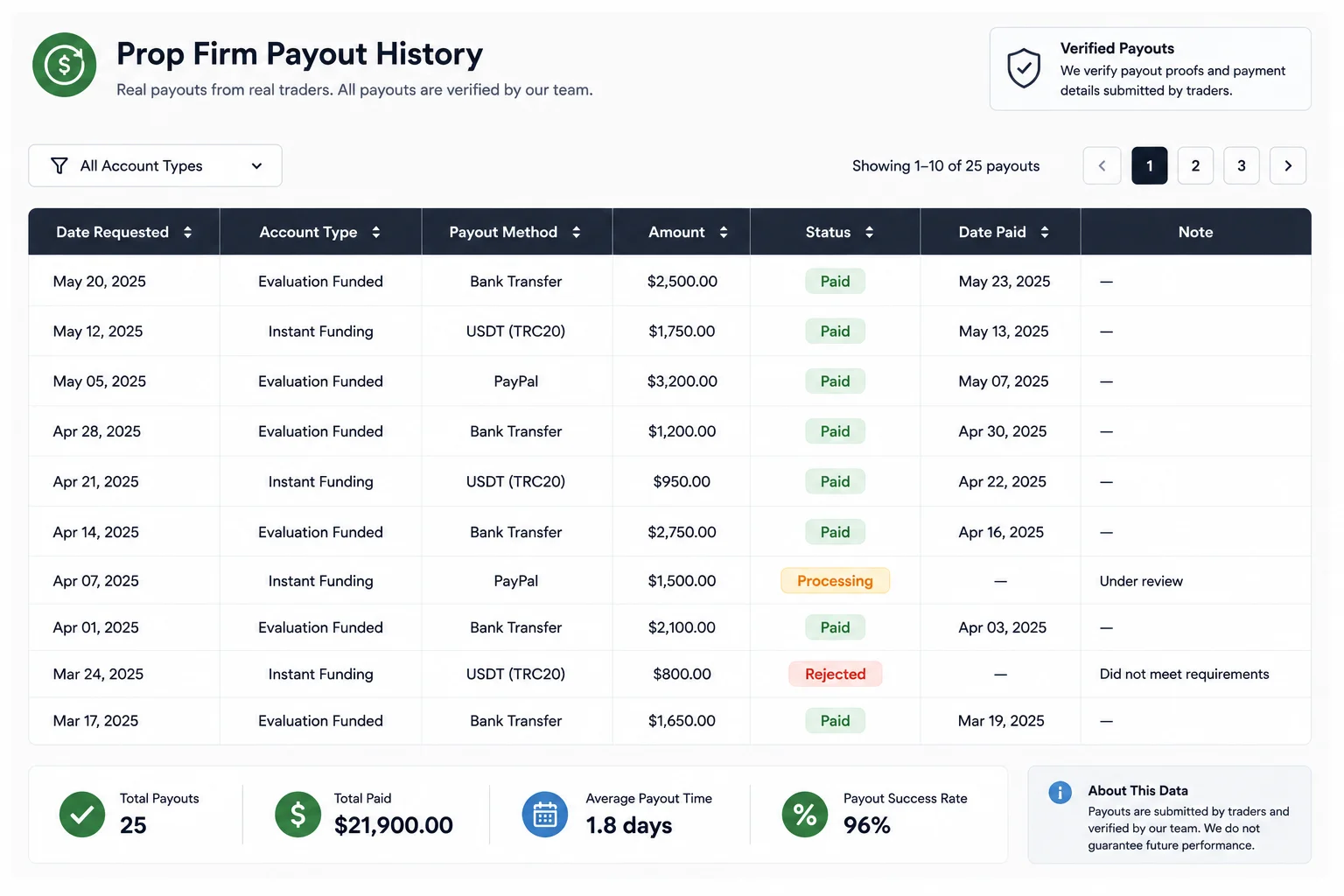
Payout history: What to look for and where to find it
Independent verification is what matters here. Marketing copy from the firm itself tells you nothing useful. Instead:
- Search for payout proof in trading communities, on YouTube, and in Discord servers, specifically from people who are not affiliates of the firm
- Look for consistency in processing time: did payments arrive within the stated window, or were delays routine?
- Check whether payout complaints cluster around certain dates, account sizes, or market conditions. That pattern can indicate selective processing
Affiliate-driven content is noise. You are looking for unsponsored trader experience.
Payout frequency and method
Firms vary significantly in when and how they pay. Some process on-demand; others run fixed weekly or bi-weekly cycles. Check:
- Whether the payout frequency fits your needs as a trader
- Which payment methods are available: bank transfer, crypto, payment platforms
- Whether certain methods carry processing delays or additional fees
Withdrawal terms and conditions
Read the actual terms, not the marketing summary. Specifically check:
- Minimum withdrawal thresholds
- Whether withdrawals are capped by a percentage of account size or gated by time since your last withdrawal
- Whether there are holding periods after a profitable period before you can submit a request
Vague terms or language that gives the firm unilateral discretion over withdrawal approval are material concerns, not minor footnotes.
3. Challenge Rules and Trading Conditions
Rules that look reasonable in the headline can carry serious restrictions in the fine print.
Profit targets and drawdown limits
Most challenges use a two-step structure with a profit target at each phase and both a daily and maximum drawdown limit. Standard ranges commonly cited in the industry run roughly:
- Profit target: 8-10% (Phase 1), 4-5% (Phase 2)
- Daily drawdown: 4-5%
- Maximum drawdown: 8-10%
Understand whether drawdown is calculated on the starting balance (static) or the highest account value reached (trailing). The trailing drawdown mechanic is significantly more restrictive and catches many traders off guard.
Restricted trading styles and instruments
Check whether the firm restricts:
- News trading around high-impact economic events
- Holding positions over the weekend
- Scalping or high-frequency approaches
- Specific instruments or asset classes
- EAs or copy trading tools
Any restriction that conflicts with how you actually trade is a disqualifier, regardless of how strong the firm looks on everything else.
Consistency rules and time requirements
Some firms require that no single trading day account for more than a fixed percentage of total profits, that you trade a minimum number of days, or that your activity meets a consistency threshold. These rules need to match your actual trading patterns. A swing trader facing a daily trade minimum will find the challenge considerably harder than the headline rules suggest.
4. Fee Structure and Refund Policy
The challenge fee is a data point about how the firm is positioned and what incentives are driving their model.
Challenge fee relative to market norms
Fees vary by account size and firm. Know what the market rate looks like for your target account size before evaluating any specific offer.
A significantly discounted fee from a newer firm may reflect a legitimate attempt to attract traders, or it may reflect a model that depends on challenge volume rather than funded trader success. Price alone does not tell you which.
Whether the fee is refundable upon passing
Many firms refund the challenge fee with your first payout after passing. This matters because it converts a sunk cost into a recoverable one. Verify:
- Whether the refund is automatic or requires a request
- Whether it applies to the full fee or only part of it
- Whether attached conditions reduce the realistic likelihood of receiving it
Hidden costs (resets, scaling fees, upgrade tiers)
This is where the real fee structure often lives. Look for:
- Reset fees if you breach a rule during the challenge
- Charges associated with scaling your account
- Optional or mandatory upgrade tiers that add cost
- Subscription or platform fees separate from the challenge cost
Map the full cost of realistic failure scenarios, not just the base fee. That is what the experience will actually cost you.
5. Funded Account Terms
Passing the challenge is the beginning, not the destination. The terms of the funded account determine whether any of this was worth your time.
Profit split percentage and escalation
Most funded accounts offer somewhere between 70% and 90% profit split, with some firms advertising higher figures as part of their marketing. Verify:
- What the base split is
- Whether it escalates with account performance, and under what conditions
- Whether any deductions apply before the split is calculated
Scaling plan structure
A credible scaling plan should have:
- Clear, objective milestones rather than vague performance requirements
- Defined account size increases at each tier
- No conditions that effectively reset your progress
Scaling plans that sound generous in the marketing but include performance consistency clauses that are practically difficult to meet deserve a second read before you factor them into your decision.
Capital allocation and account size offered
Check the maximum account size on offer, whether you can hold multiple funded accounts simultaneously, and whether the capital allocation model is realistic given what you know about the firm’s overall scale.
A small firm offering unlimited $200,000 accounts to anyone who passes is worth interrogating on the underlying economics.
6. Customer Support and Dispute Resolution
You will probably never need this section. And then one day you will, and you will be glad you checked.
Support availability and response quality
Before buying a challenge, contact support. Ask a straightforward question about the rules or withdrawal process. Evaluate:
- How long they take to respond
- Whether the answer is accurate and specific, or generic and deflecting
- Whether live chat is available or whether everything routes into a ticket queue with no stated response time
Firms with fast, knowledgeable support are demonstrating operational competence. A firm that takes three days to answer a pre-sale question will not improve once you have already paid.
What happens when things go wrong
Look for publicly available records of how the firm has handled disputes: rule interpretation disagreements, payout delays, account terminations. Specifically:
- Do they engage with complaints professionally, or go quiet?
- Is there a formal dispute process?
- Is the pattern one of resolution, or of complaints being closed without explanation?
No firm handles every dispute perfectly. A consistent pattern of reasonable behaviour is what you are looking for.
7. Risk Signals and Red Flags
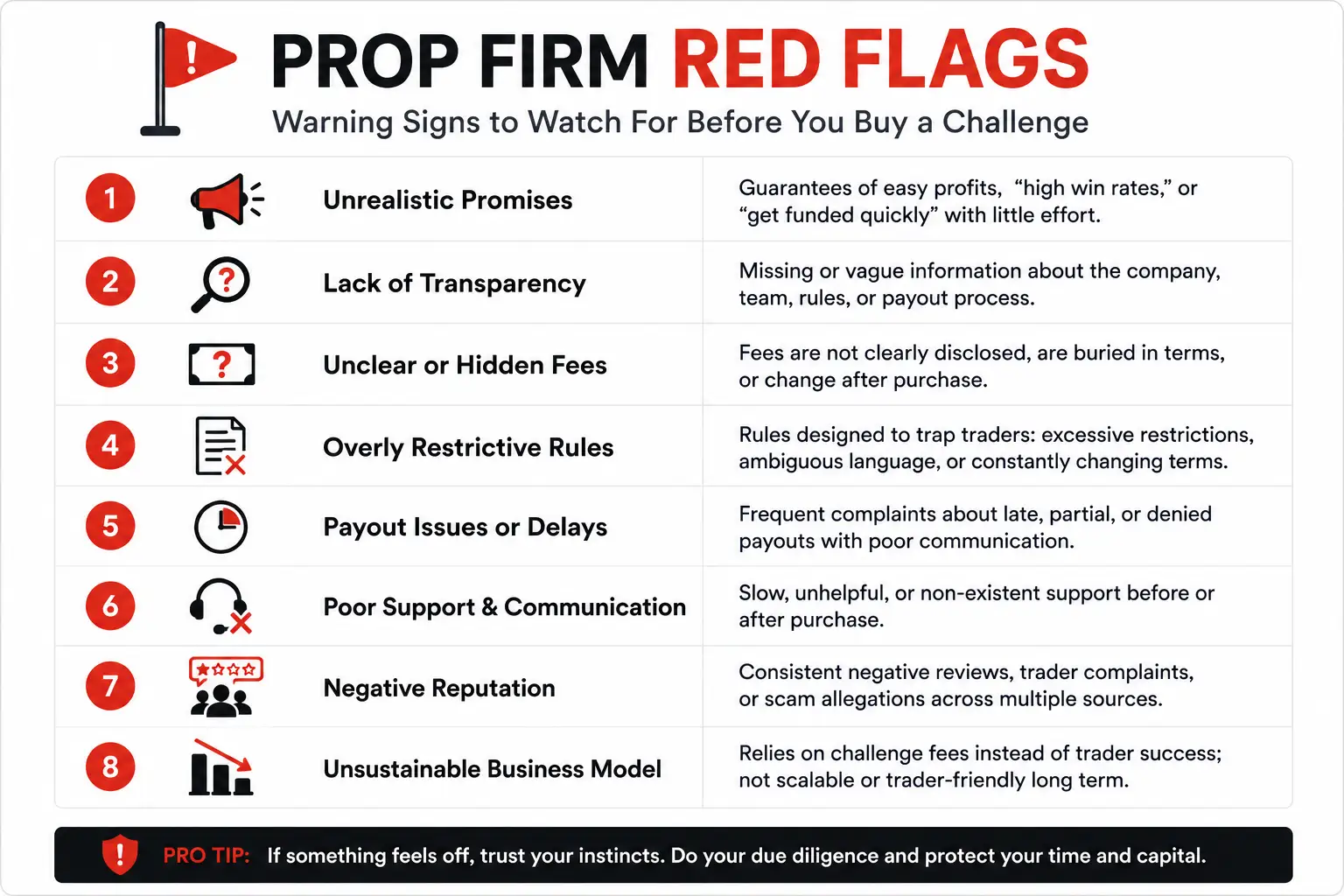
This is where everything you have gathered either confirms your confidence or earns your caution.
Pricing and promotion patterns to distrust
- Aggressive discount promotions running continuously: if everything is always on sale, nothing is
- Urgency-based marketing with countdown timers and limited-availability messaging
- Affiliate programs paying unusually high commissions relative to challenge fee revenue
- Pricing structures where the challenge fee is clearly the primary revenue source rather than funded trader capital
Structural red flags in the rules
- Drawdown or consistency rules that are subjectively interpreted rather than algorithmically enforced
- Terms giving the firm unilateral power to modify rules after your challenge begins
- Vague language around what constitutes a rule violation
- No clear definition of how disputes are resolved
- Rules that appear designed to disqualify funded accounts at the point of meaningful payout
Community and review red flags
- A company that responds to negative reviews with aggression or legal threats
- Suspiciously uniform positive reviews appearing within a short time window
- No independent payout proof from non-affiliated traders
- Community reports of rules changing post-passing, payouts delayed without explanation, or accounts closed without clear cause
- Founders or leadership with no traceable public history, or prior involvement in financially questionable ventures
Prop Firm Due Diligence Checklist
Use this as a reference before committing to any challenge. No checklist can guarantee outcomes, but working through it systematically puts you in a materially better position than going on reputation alone.
Legitimacy and Track Record
- [ ] Firm has been operating for at least 12 months (ideally 2+ years)
- [ ] Registered company entity is verifiable
- [ ] Named leadership with traceable public history
- [ ] Substantive third-party review history across multiple platforms
Payout Reliability
- [ ] Independent payout proof exists from non-affiliate sources
- [ ] Payout frequency and method are clearly defined
- [ ] Withdrawal terms are specific and non-discretionary
- [ ] No significant pattern of payout complaints in community channels
Challenge Rules
- [ ] Drawdown type (static vs trailing) is clearly stated and understood
- [ ] All trading restrictions have been checked against your strategy
- [ ] Consistency rules and minimum trading days are compatible with your approach
- [ ] Rules are algorithmically enforced, not subjectively interpreted
Fee Structure
- [ ] Fee is comparable to market norms for the account size
- [ ] Refund mechanic is confirmed and conditions are clear
- [ ] All potential costs (resets, scaling fees, platform fees) are identified
Funded Account Terms
- [ ] Profit split percentage and escalation conditions are confirmed
- [ ] Scaling plan milestones are objective and achievable
- [ ] Capital allocation model is realistic relative to firm size
Support and Dispute Resolution
- [ ] Pre-sale support contact has been made and assessed
- [ ] Response time and quality are acceptable
- [ ] Dispute process exists and is documented
Red Flags
- [ ] No significant rule-change complaints in community history
- [ ] No pattern of payout disqualification at large withdrawal amounts
- [ ] No aggressive or threatening firm responses to public complaints
- [ ] No unilateral rule modification clauses in the terms
Frequently Asked Questions


Comments