


Disclaimer: This article is for educational purposes only and does not constitute financial or investment advice.
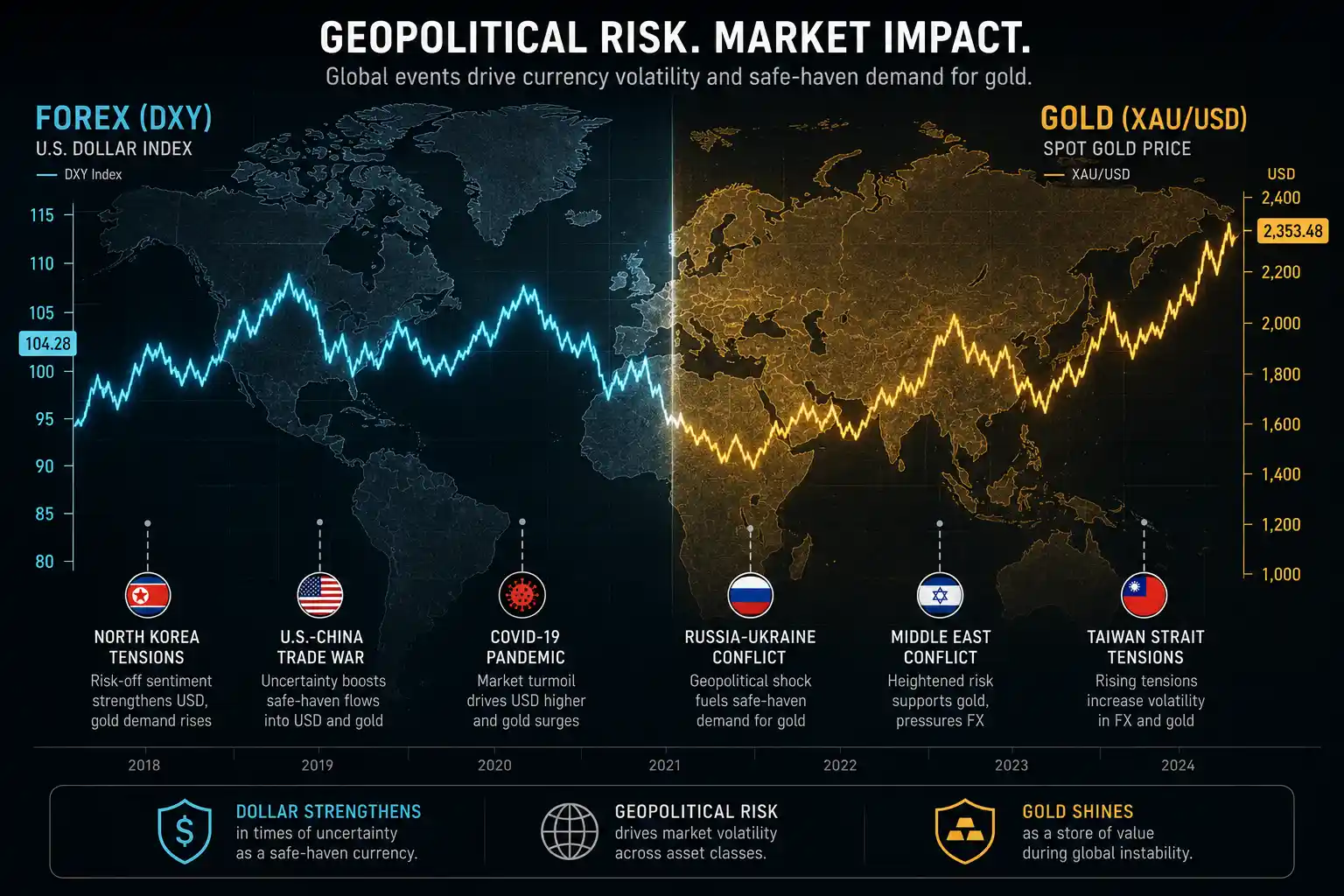
Geopolitical risk trading is one of the most demanding skills in retail finance, and Trump-era foreign policy has made it more relevant than ever. This guide breaks down how war policy, tariffs, military posture, sanctions cycles, and trade brinkmanship move the assets you’re already trading, and gives you a practical framework for making decisions when the headlines get loud.
Why Geopolitical Risk Is Different From Standard Market Volatility
If you’ve traded through earnings seasons and NFP releases, you already know the drill: event drops, market spikes or falls, price finds a new level, things settle. Geopolitical volatility doesn’t follow that script, and treating it as if it does is where most retail traders get hurt.
The Speed and Unpredictability Problem
Economic data releases have scheduled times. Earnings reports have known dates. Geopolitical events have neither. A single presidential post, a military movement, or a leaked diplomatic cable can hit the tape at 2am on a Tuesday and move gold 1.5% before your alarm goes off.
Duration is the other problem. Data-driven volatility tends to resolve quickly once markets price in new information and move on. Geopolitical events can escalate, de-escalate, re-escalate, and stay unresolved for months. That creates prolonged uncertainty rather than a single volatility spike, and uncertainty is expensive to hold positions through.
Why Retail Traders Are Structurally Disadvantaged in News Cycles
Institutional desks have geopolitical risk analysts, dedicated macro teams, and direct news feeds with sub-second latency. You have a broker platform and a social media feed. By the time a geopolitical development reaches you as a retail trader, it has already been priced into multiple market layers by faster, better-resourced participants.
That’s not a reason to step away from markets entirely. It’s a reason to understand the dynamics in advance rather than reacting in real time. Your edge in geopolitical risk environments comes from preparation, not speed.
So what does the historical record actually tell us about how these events move specific assets?
How Trump’s Foreign Policy Has Historically Moved Markets
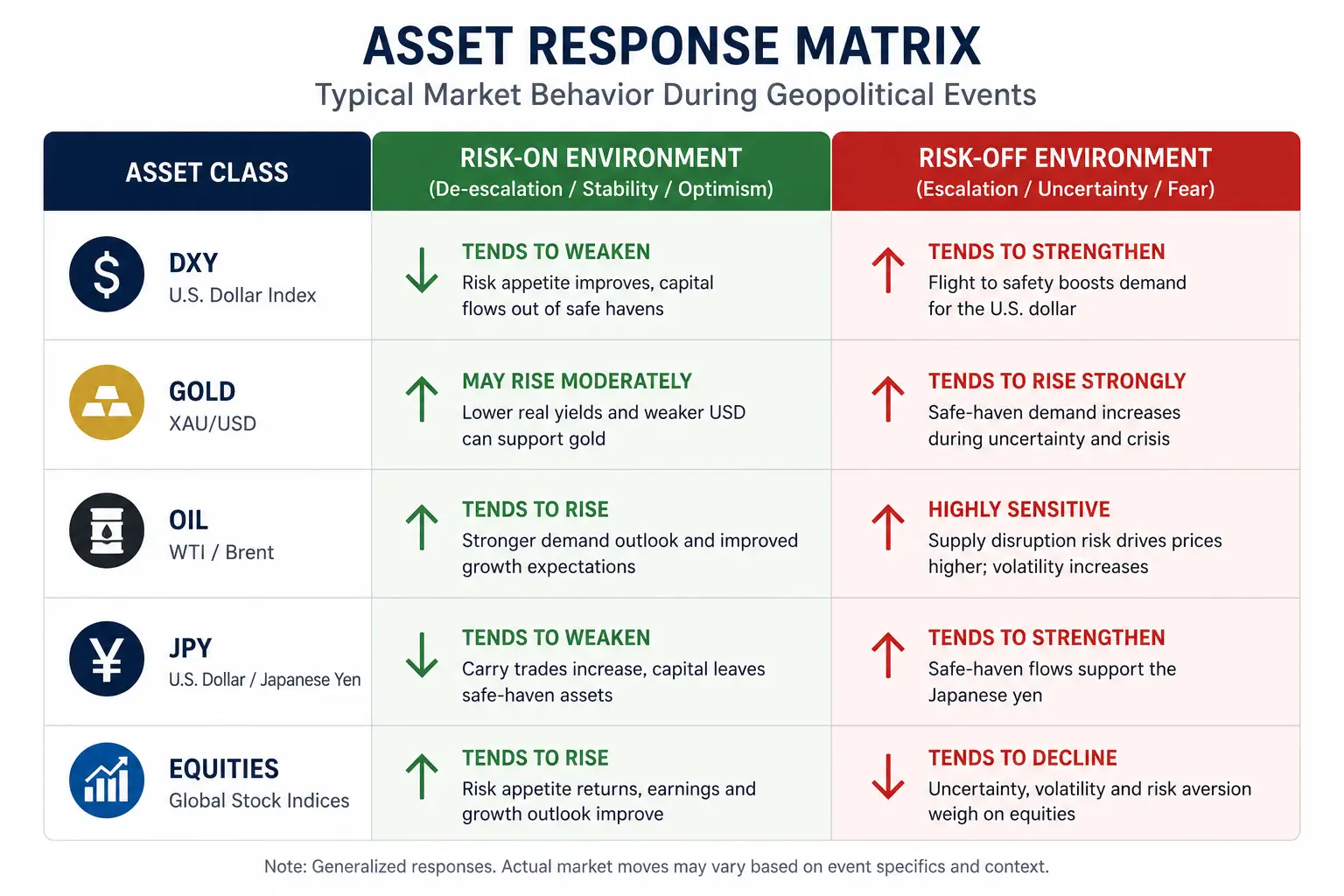
Trump’s foreign policy toolkit has included tariff escalation, sanctions packages, NATO pressure, military posture shifts, and unpredictable bilateral diplomacy. Each of these categories creates specific, observable market conditions. The reactions aren’t guaranteed to repeat exactly, but the underlying mechanics are consistent enough to inform your positioning logic.
The Dollar in War-Cycle Conditions
The intuitive assumption is that the US dollar always strengthens during geopolitical stress, given its safe haven status. The reality is more conditional. In the early stages of escalation, particularly when the US is perceived as a stable anchor or when the conflict involves non-dollar economies, you typically see DXY strengthen as capital flows toward dollar-denominated assets.
When escalation is directly tied to US foreign policy, tariff wars or sanctions that create retaliatory economic risk complicate that picture considerably. Dollar war-cycle dynamics during Trump’s first term showed periods of DXY weakness at peak tariff uncertainty, as markets priced in damage to US trade relationships and growth. The first filter for your dollar positioning is understanding which type of event you’re dealing with: an external conflict where the US is an observer, or a US-originated policy risk where the US is the actor.
Sanctions introduce a further layer of complexity worth understanding at the mechanics level:
- When the US imposes sanctions targeting an energy-producing nation, the immediate market effect is typically a supply-side risk premium in crude oil, as export capacity is removed from global markets.
- Sanctions targeting a country’s banking system or central bank create capital flow disruption and currency volatility in affected regions.
- For retail traders, the more important dynamic is often the secondary one: retaliatory sanctions, or the credible threat of them, introduce uncertainty that affects dollar positioning in ways that can run counter to the initial reaction.
Treat sanctions announcements as a two-stage event. The initial move prices the direct impact. The secondary move, which can come days to weeks later, prices the retaliatory response and the broader relationship deterioration. Both stages create tradeable conditions, and they often run in different directions.
Military posture shifts, including troop deployments, carrier group movements, base expansions, and withdrawal announcements, tend to produce sharper and shorter-lived market reactions than sanctions or tariffs. The primary driver of market response is the perceived probability of kinetic conflict.
When posture shifts raise the probability of sustained conflict, the effects tend to be durable across oil, gold, and safe haven currencies. When they represent political signalling without kinetic follow-through, the more typical pattern is a sharp spike followed by a partial reversal as the initial risk premium unwinds. Assessing which you’re dealing with in real time is genuinely difficult, which is another argument for position-size reduction rather than directional conviction during the initial move.
Equity Indices and Risk-Off Rotations
Risk-off rotation is the market’s way of saying it’s selling assets perceived as risky and moving into assets perceived as safe. During geopolitical escalation, US equity indices, particularly the S&P 500 and Nasdaq, tend to sell off as institutional money rotates toward safer ground.
The Nasdaq is typically more sensitive than the S&P 500 in these environments, given its technology weighting and higher valuation multiples. High-multiple assets are more vulnerable to discount rate uncertainty, and geopolitical stress raises uncertainty broadly. Global indices outside the US can see sharper moves depending on geographic proximity to the event or trade relationship exposure.
The pattern worth internalising is that the initial equity selloff often overshoots, and recovery can be rapid once the event reaches a perceived plateau. Chasing the selloff after the first wave has already moved is one of the more reliably unprofitable things you can do in these environments.
Commodities: Oil, Gold, and the Flight-to-Safety Hierarchy
Oil is the most directly geopolitical commodity. Any escalation touching the Middle East, major shipping lanes, or energy-producing nations creates an immediate supply-side risk premium in WTI and Brent crude. Trump administration actions affecting Iran, Saudi Arabia, or broader Middle East stability have historically produced short-term spikes in crude prices, with sanctions on energy exporters capable of sustaining that premium well beyond the initial headline move.
Gold responds less to supply disruption and more to uncertainty itself. When confidence in institutional stability drops, gold gets bought. The relationship between Trump policy announcements and gold price action has been observable across multiple escalation cycles, though the timing is where most traders come unstuck. That timing problem is covered in detail in the next section.
Safe Haven Assets in a Geopolitical Risk Environment
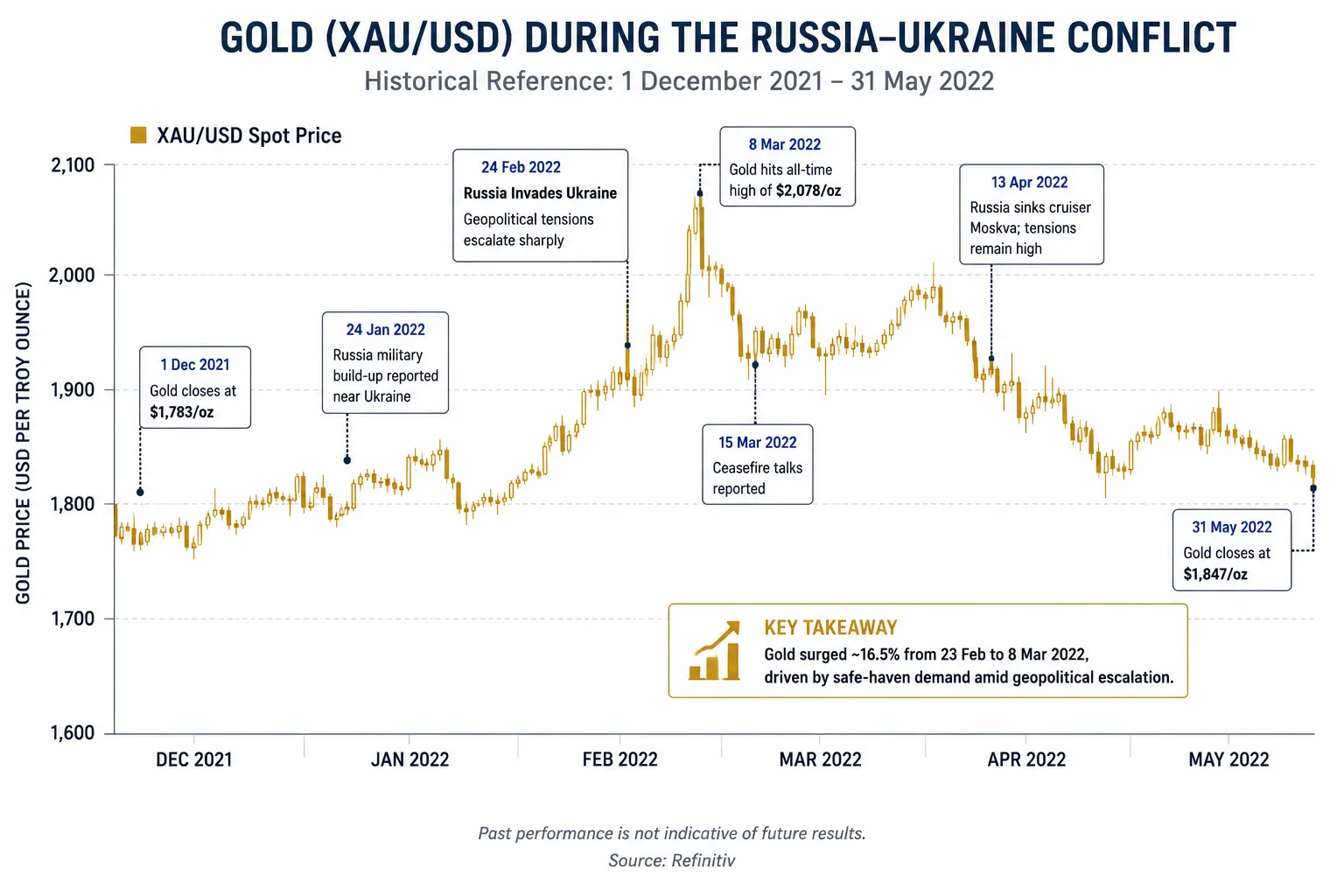
The phrase “safe haven assets” covers several instruments that behave differently from one another, for different reasons, over different timeframes. Treating them as interchangeable is a category error that costs real money.
Gold: The Default, the Limitations, and the Timing Problem
Gold is the instinctive safe haven for most retail traders, and the instinct isn’t wrong, it’s just incomplete. Gold (XAU/USD) has historically spiked during geopolitical escalation events, but the move often happens in the first hours to days of escalation and partially reverses once the situation reaches a perceived stasis. Waiting for confirmation that an event is serious before buying gold usually means missing the initial move and positioning into the mean-reversion. Building a position during periods of elevated but quiet geopolitical tension tends to produce a better risk profile than chasing a spike on a breaking headline.
The Yen, the Franc, and Currency Safe Haven Logic
USD/JPY and USD/CHF are the primary currency pairs to watch during geopolitical stress. The Japanese yen and Swiss franc both function as safe haven currencies, meaning they tend to appreciate when global risk sentiment deteriorates.
The yen’s safe haven status is partly mechanical: Japanese institutional investors hold large quantities of foreign assets and tend to repatriate capital during global stress, generating yen demand. The franc’s status reflects Switzerland’s political neutrality and strong institutional frameworks.
In practice, during a genuine risk-off event, you’d expect USD/JPY to fall (yen strengthening against the dollar) and USD/CHF to move similarly. Both pairs can snap back sharply when sentiment stabilises, which is why timing and position sizing matter enormously in safe haven currency plays.
US Treasuries and Their Role in a Dollar-Dominant Conflict Scenario
US Treasuries function as the world’s primary safe haven fixed-income asset because of their scale, liquidity, and dollar denomination. During geopolitical stress that doesn’t directly threaten US fiscal credibility, you typically see Treasury yields fall as prices rise, the classic flight-to-quality bid.
In scenarios where US policy itself is the source of instability, including trade wars and sanctions triggering retaliatory responses, the Treasury market’s behavior becomes less predictable. Foreign holders of US debt can and do adjust positions in response to deteriorating diplomatic relationships. Yield curve behavior in these scenarios is worth monitoring, with appropriate caution in how you interpret it.
Now that you have a picture of how these assets tend to behave, the practical question becomes: what do you actually do with that knowledge before, during, and after a geopolitical event?
Retail Trader Positioning: A Practical Framework
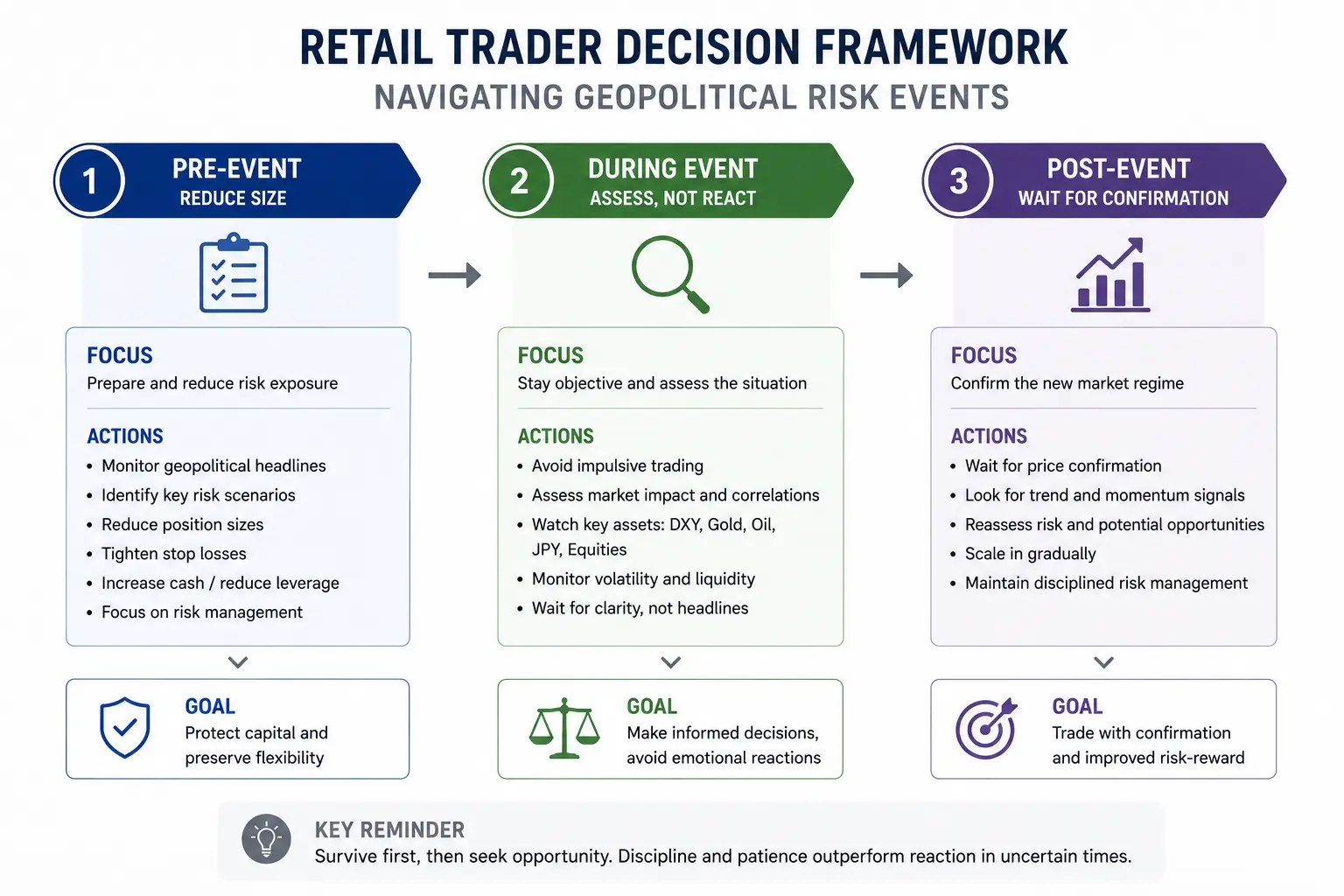
You don’t need to become a geopolitical analyst to trade better through these environments. You need a repeatable decision framework that accounts for elevated uncertainty without requiring you to predict outcomes.
Pre-Event vs. Post-Event Positioning
Pre-event positioning means adjusting your exposure before a known escalation point, a scheduled policy announcement, or an ongoing geopolitical situation that appears to be reaching a critical juncture. In practice, this means identifying the assets most likely to be affected, reducing overall position size, and potentially establishing small, defined-risk positions in safe haven instruments.
Post-event positioning is about waiting for the dust to settle before re-entering. The first price reaction to a geopolitical event is almost always an overreaction in one direction. The second move, once institutional participants have assessed the actual implications, tends to be more sustained and tradeable. Most retail traders lose money on the first move and miss the second because they’re managing the damage from it.
Position Sizing Under Elevated Geopolitical Uncertainty
When geopolitical risk is elevated, your standard position sizing rules need to be tightened, not suspended. Wider stops may seem logical given increased volatility, but the correct response is to reduce your position size so that your maximum loss remains consistent with your normal risk parameters.
The MonkeyTrade guide on risk management covers the mechanics of adjusting for volatility in detail. The core principle is that a volatile market environment doesn’t change your risk tolerance; it changes what trade size is required to express that same tolerance.
What to Do When You Have No Edge
Sometimes the honest answer is that you don’t have enough information to trade an event with any confidence. Geopolitical developments are often opaque, contradictory, and subject to rapid reversal. Sitting out is a legitimate trading decision.
Flat is a position. If you can’t identify a clearly dislocated asset, can’t determine whether you’re in a risk-on or risk-off environment, and can’t size a trade within your normal risk parameters, the highest-probability play is no play. Protecting your capital during genuine uncertainty is what gives you the ability to trade when your edge is clearer.
What to Watch: Key Signals and Indicators
Staying informed about geopolitical risk doesn’t require watching the news around the clock. A small set of specific indicators gives you a readable picture of market stress without turning you into an accidental macro economist.
Economic Calendar Events That Escalate During Geopolitical Stress
Certain scheduled events become significantly more market-moving during geopolitical escalation. The following carry heightened importance in tense periods:
- Federal Reserve communications, where geopolitical risk factors into the economic outlook
- G7 and G20 meetings, which can produce policy statements with direct market implications
- Bilateral trade talks, which may produce tariff decisions or sanctions announcements
Knowing these dates in advance and reducing exposure around them is a simple, low-cost risk management habit.
Sentiment Indicators and Volatility Gauges (VIX, MOVE Index)
The VIX (CBOE Volatility Index) measures implied volatility in S&P 500 options and functions as the market’s real-time fear gauge. A rising VIX signals that institutional participants are buying protection, broadly consistent with a risk-off environment. Key threshold levels, roughly 20, 25, and 30, are widely watched as indicators of increasing stress.
The MOVE index is the bond market equivalent of the VIX. It measures implied volatility in US Treasury options and becomes particularly relevant when geopolitical events create uncertainty about monetary policy or US fiscal stability. Watching both together gives you a more complete picture than either alone.
How to Track Policy Signals Without Becoming a News-Watcher
The most practical signal system for retail traders is to identify two or three key assets as your geopolitical stress barometers. Gold, USD/JPY, and VIX are a reasonable starting set. Check them before each session. Significant moves in these instruments that don’t correspond to scheduled economic data are usually a sign that something geopolitical is driving the market.
From there, a brief check of a trusted financial news source for context is typically sufficient. You’re trying to understand what the market is currently pricing in so you can decide whether your existing positions still make sense.
Risk Management Rules That Don’t Change Under Geopolitical Pressure
Risk management in geopolitical environments is where discipline either holds or breaks down. It breaks down because elevated volatility creates the feeling that normal rules don’t apply, that the potential for larger moves justifies larger risks. That logic runs in the wrong direction.
These principles apply regardless of what’s happening in the headlines:
- Keep maximum loss per trade consistent. If you normally risk 1% of your account per trade, that number doesn’t change because the market is moving faster. Adjust position size to maintain the same loss parameter.
- Do not remove stops because of volatility. Wide price swings are exactly the conditions stops were designed for. Moving a stop further away after a position moves against you is avoiding an uncomfortable decision, not managing risk.
- Avoid adding to losing positions during adverse moves. Geopolitical events can sustain directional pressure far longer than feels rational. Adding to a losing position during a genuine risk-off event can produce catastrophic drawdowns.
- Treat drawdown limits as hard limits. For prop firm traders in particular: geopolitical volatility spikes are among the fastest ways to breach challenge account drawdown limits, because moves can be sharp, fast, and sustained in ways that normal market conditions don’t produce. Size down before the event.
- Reassess after major moves. If your asset has moved 2-3% during a geopolitical event, your original trade thesis may no longer be valid. Reassess from a clean slate rather than defending a position built on different conditions.
Geopolitical environments test your risk discipline more than almost any other market condition. The rules don’t change. Your commitment to following them needs to.
Frequently Asked Questions


Comments