


Trading is a learnable skill that starts with grasping the fundamentals, setting up the right way, and practicing before any real money is at stake.
This guide walks you through the full process: what trading is, how to choose a broker and open your account, how to place your first trade, and what forces move prices once you’re in the market.
By the end, you’ll have a clear path forward instead of a pile of open tabs and rising anxiety.
What Is Online Trading and How Does It Work?
Online trading is buying and selling financial assets through a digital platform, aiming to profit from price changes.
Picture buying a used car you know is underpriced, then selling it for more once the market catches up. Replace the car with currencies, company shares, or commodities like gold and oil, and you’ve got the basic idea.
The “online” part means there’s no phone call to a broker or showing up at an exchange floor. Everything runs through software on your computer or phone, often settling in seconds.
How Trades Execute (Buyer, Seller, Broker)
When you place a trade, a real chain of events fires off behind the scenes.
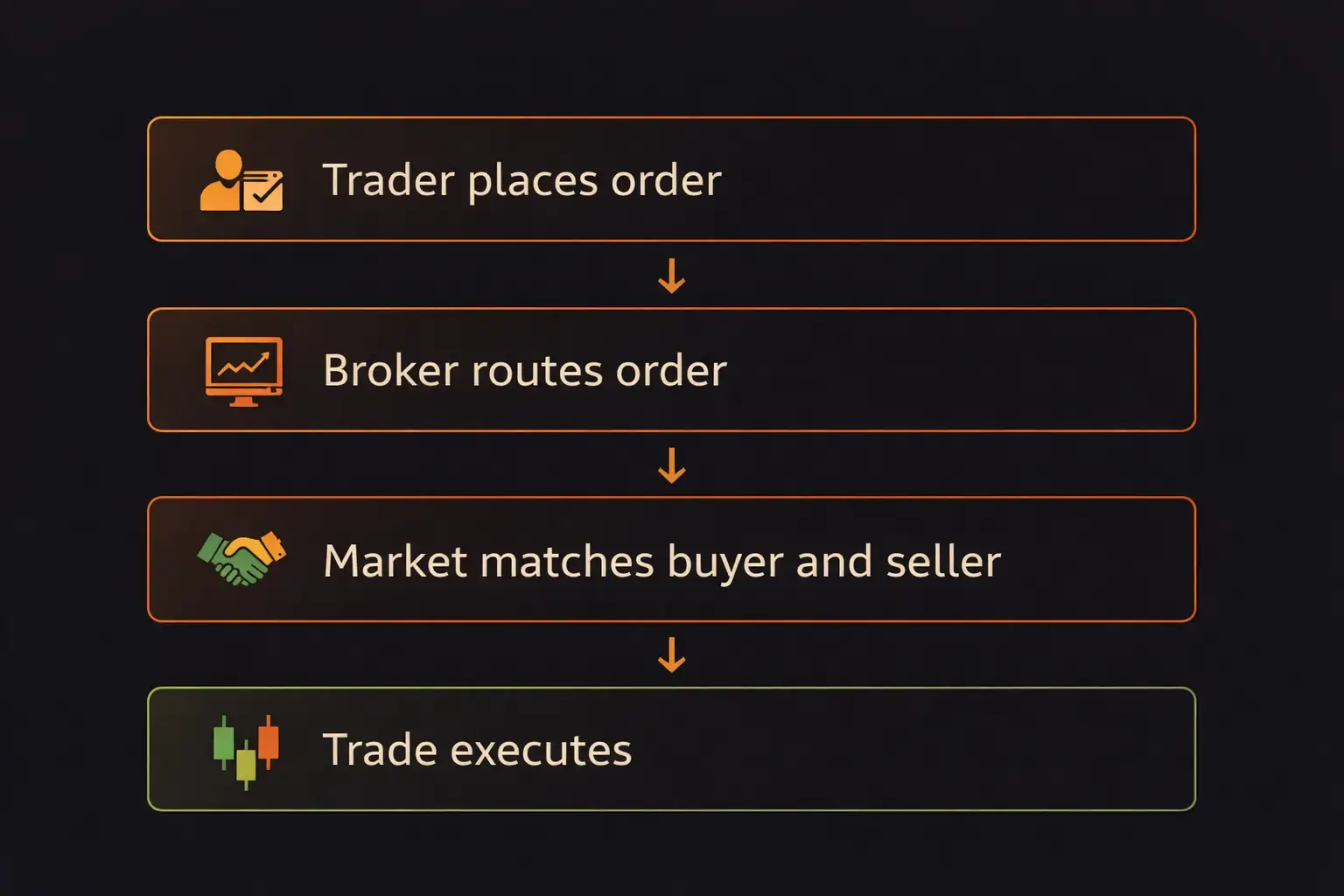
Your broker acts like a middleman at an auction house. You tell them what you want to buy or sell, at what price, and they go find someone willing to take the opposite side. Here’s the simplified version:
- You place an order on your trading platform (buy or sell, with specific conditions).
- Your broker receives the order and routes it to the appropriate market or exchange.
- The market matches your order with a counterparty willing to take the other side.
- The trade executes, and your account reflects the new position.
For liquid markets like major forex pairs or large-cap stocks, this happens almost instantly. Less popular assets might take a beat longer to find a match.
Two terms you’ll encounter constantly: market orders (buy or sell immediately at the current price) and limit orders (buy or sell only when the price hits a level you specify). Market orders prioritize speed. Limit orders prioritize price control.
Now you know how the engine works. But what roads can you actually drive on?
Types of Markets You Can Trade (Forex, Stocks, Indices, Crypto, Commodities)
One of your earliest decisions is which market to focus on. Each one has a distinct character, schedule, and set of quirks:
- Forex (Foreign Exchange): The world’s largest market, where currencies trade in pairs (like EUR/USD). Open 24 hours a day, five days a week, forex attracts beginners with low entry costs and deep liquidity.
- Stocks: Buying shares of individual companies like Apple or Tesla. Stock markets operate on set hours and are closely tied to how specific businesses perform.
- Indices: Rather than trading a single company, you trade a basket of companies grouped together (like the S&P 500 or FTSE 100). It’s a way to bet on the broader direction of a market.
- Crypto: Digital currencies like Bitcoin and Ethereum. Crypto markets never close, running 24/7, but they’re notorious for sharp, unpredictable price swings.
- Commodities: Physical goods like gold, oil, or agricultural products. Prices here are heavily shaped by supply, demand, and global events.
Starting with a single market lets you build genuine depth instead of spreading your attention too thin. Which one fits you best? That depends on your goals, schedule, and temperament, which is exactly what the next section addresses.
How to Start Trading in 6 Practical Steps
Feeling paralyzed by “where do I even begin?” is the number one reason most aspiring traders never actually start.
This section breaks the process into six concrete steps, each building on the one before, so you can move forward with clarity rather than guesswork.
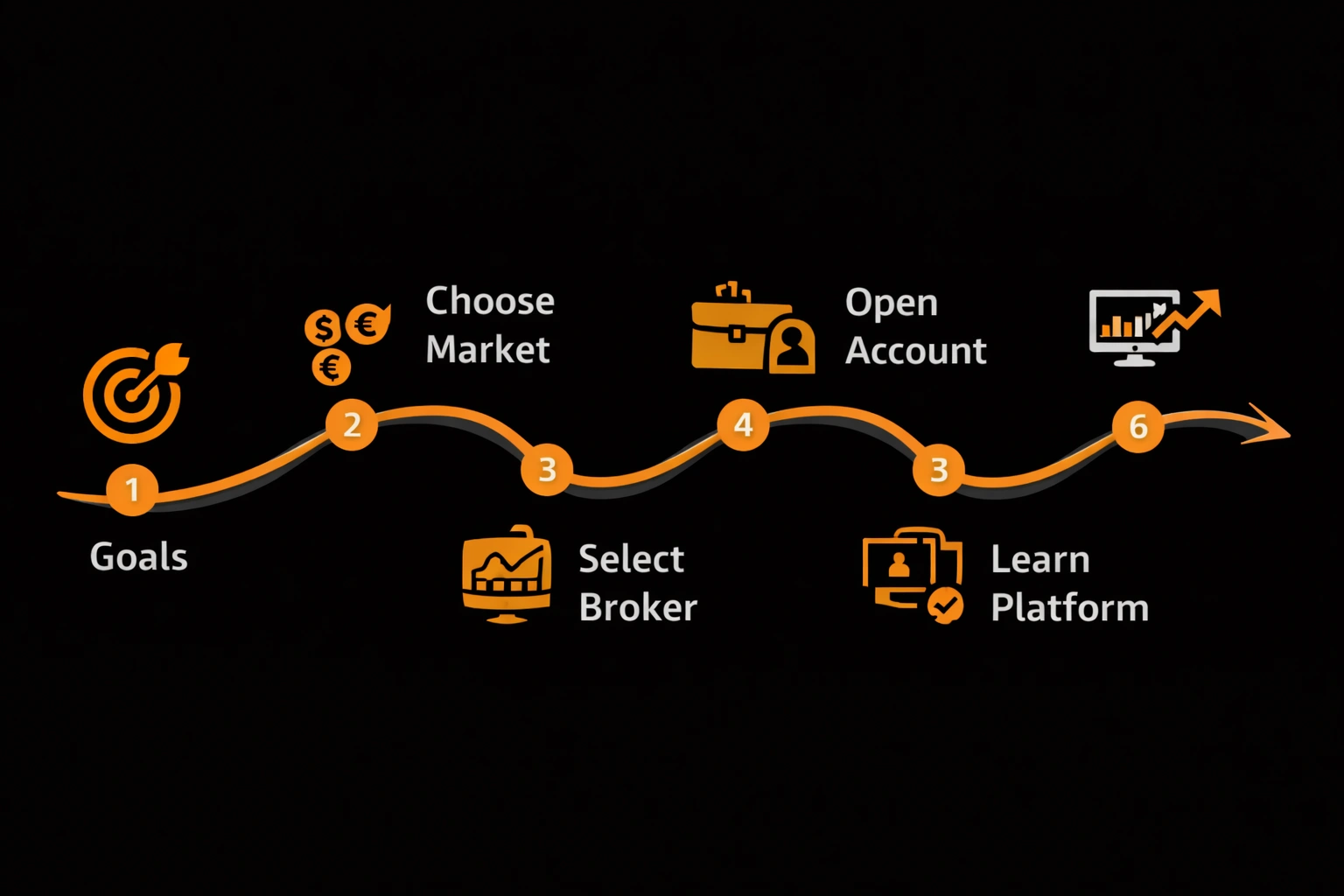
Step 1 – Define Your Goals and Risk Tolerance
Before you touch a trading platform, sit with two honest questions:
- What are you trying to achieve?
- How much could you lose without it disrupting your daily life?
Your trading goals shape every decision that follows. Someone learning a new skill on the side will approach trading very differently from someone who eventually wants it as a primary income stream. Neither goal is wrong, but they lead to different choices about time commitment, capital, and market selection.
Risk tolerance is just as personal. A solid starting principle: never trade with money earmarked for rent, bills, or emergencies. The capital you put toward trading should be money you could lose entirely without it derailing your finances.
Step 2 – Choose a Market That Fits Your Situation
With your goals clear, it’s time to match them to a market. Weigh these factors:
- Available time: Forex suits people who can trade at varied hours. Stocks demand attention during specific exchange sessions.
- Starting capital: Forex and crypto often have lower minimum deposits. Stocks can require more capital to build meaningful positions.
- Volatility comfort: Crypto swings hard. Indices tend to move more gradually. Your tolerance for price swings matters more than you might expect.
- Interest: You’ll stick with something that genuinely holds your attention. If global economics pulls you in, forex might click. If you love following companies, stocks could be your lane.
Don’t overthink this decision. You can always explore other markets later. Right now, the goal is to pick one and learn it properly.
Step 3 – Select a Regulated Broker
Your broker is the company that gives you access to the markets. Choosing the wrong one can cost you money before you’ve even placed a trade, which is why regulation matters more than flashy features or slick marketing.
A regulated broker means a government financial authority oversees their operations, protecting your funds and enforcing fair practices. Look for brokers regulated by well-known bodies like the FCA (UK), SEC/FINRA (US), ASIC (Australia), or CySEC (EU).
When evaluating brokers, pay close attention to:
- Regulatory status (non-negotiable; verify directly on the regulator’s website)
- Fee structure (spreads, commissions, withdrawal fees)
- Available markets (does the broker offer the market you chose in Step 2?)
- Platform quality (clean interface, reliable execution, mobile access)
- Customer support (responsive and available in your language)
If you want to dig deeper into comparing options, check out our AI broker matchmaking tool for detailed breakdowns.
Step 4 – Open and Fund Your Account
Once you’ve chosen a broker, opening an account is relatively straightforward. You’ll typically need to:
- Fill out a registration form with personal details.
- Verify your identity (government-issued ID and proof of address are standard).
- Answer a short questionnaire about your trading experience and financial situation.
- Fund your account via bank transfer, card, or e-wallet.
Many brokers let you open an account with a modest deposit, and there’s no reason to load up a large balance while you’re still finding your footing.
Step 5 – Learn the Trading Platform (Demo First)
This is the step most beginners skip, and it’s often the reason they lose money in their first week. Before you risk a single dollar, spend real time on a demo account.
A demo account is a practice environment your broker provides. It mirrors a live account exactly: same charts, same tools, same order types. The only difference is the money is virtual. That means you can:
- Get comfortable with the platform’s layout and features
- Practice placing different order types (market orders, limit orders, stop-losses)
- Test your understanding of the market you’ve chosen
- Build confidence without any financial consequences
Treat demo trading like it counts. If you wouldn’t make a move with real money behind it, don’t make it on demo either. Most traders benefit from at least two to four weeks of consistent demo practice before going live.
Step 6 – Place Your First Trade
You’ve defined your goals, chosen a market, selected a broker, funded your account, and put in the practice hours. Now it’s time.
For your first real trade, keep things deliberately simple:
- Identify a setup based on what you’ve practiced (not a hunch or a hot tip).
- Decide your entry price and whether you’re buying (going long) or selling (going short).
- Set a stop-loss to cap your potential downside on this trade.
- Set a take-profit to lock in gains if the price moves in your favor.
- Choose a small position size, smaller than you think you need.
- Execute the trade and observe.
Your first trade is about executing a plan and feeling how the market behaves in real time. The real learning begins after you click that button.
Here’s the thing, though: once your trade is live, the market keeps moving. Prices shift for identifiable reasons. So what exactly pushes your trade into profit, or drags it into loss?
What Can Affect Your Trades?
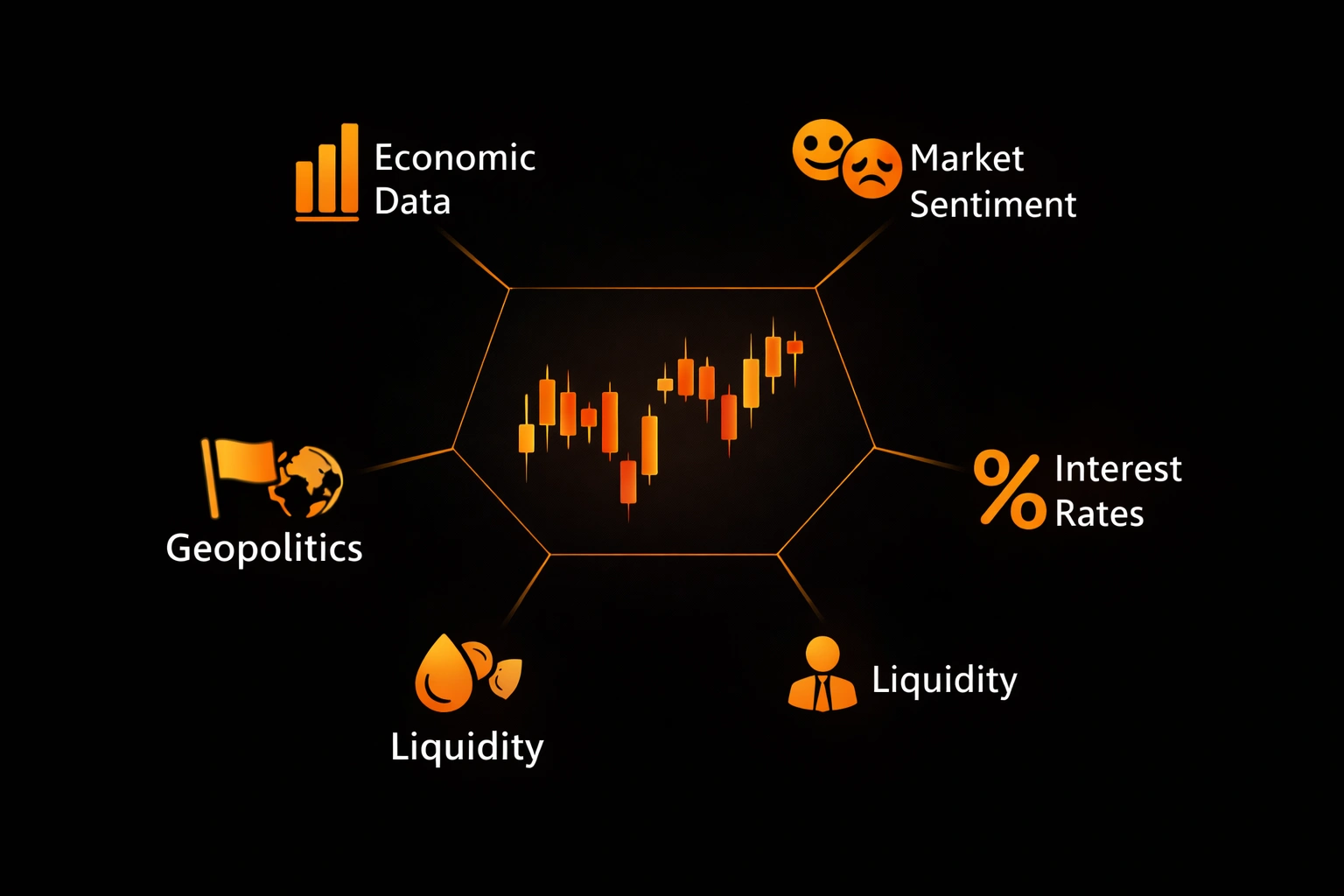
Understanding why prices move is what separates informed traders from people rolling dice. Identifiable forces act on price at all times, and recognizing the major ones gives you a meaningful edge, even early on.
Economic Data and News Events
Economic reports act as a vital-signs monitor for an economy. When key data drops (employment numbers, inflation reports, GDP figures), markets can react sharply and fast.
Picture this: a country’s unemployment report comes in far worse than expected. Traders read that as economic weakness, and the country’s currency or stock market may sell off. Strong data can trigger the opposite reaction.
An economic calendar is one of the most practical tools you’ll use. It lists upcoming data releases, their expected impact, and previous readings. Bookmark one and check it daily. It takes two minutes and can save you from unpleasant surprises.
Market Sentiment and Crowd Behavior
Sometimes markets move because of how traders collectively feel. This is market sentiment: the prevailing mood driving buying or selling decisions.
Think of a crowded theater. If a handful of people near the exit suddenly rush out, others follow, even if there’s no actual fire. In markets, fear and greed create momentum that feeds on itself. Prices can overshoot in both directions simply because enough participants are reacting on emotion rather than analysis.
Your best defense against getting swept up in sentiment is having a plan before you enter a trade, and sticking to it even when your gut screams otherwise.
Interest Rates and Central Bank Decisions
Central banks (the Federal Reserve, European Central Bank, Bank of England, among others) set interest rates that ripple through every financial market. When a central bank raises rates, it generally strengthens that country’s currency and can put pressure on stock prices. Rate cuts tend to produce the opposite effect.
Central banks hold scheduled meetings and publish statements. Markets often react not just to the decision itself, but to hints about what comes next, which is why you’ll hear traders reference “forward guidance” so frequently.
Geopolitical Events
Wars, trade disputes, elections, sanctions, even diplomatic tensions can jolt markets, sometimes violently. These events inject uncertainty, and markets tend to punish uncertainty.
You can’t predict geopolitical developments, but you can acknowledge them as a persistent risk factor. When headlines signal escalating conflict or major political shifts, consider how exposed your open positions might be.
Liquidity and Time of Day
Markets have peak hours (when major financial centers are open) and quiet stretches. During peak times, you get deeper liquidity: trades execute faster with tighter spreads. During off-hours, spreads can widen and price movements turn choppy.
For forex traders, the overlap between the London and New York sessions is typically the most active window. Stock traders follow the specific exchange hours for their market.
Understanding when your market is most active helps you avoid sluggish fills and unpredictable slippage. But knowing what drives price is only useful if you can protect yourself when things go wrong. That brings us to the skill every trader needs from their very first trade.
Essential Risk Management for New Traders
If there’s one section of this guide worth reading twice, it’s this one.
Risk management is the single factor that determines whether you last long enough to become competent. Every consistently profitable trader has a risk management system.
Setting Stop-Losses and Take-Profits
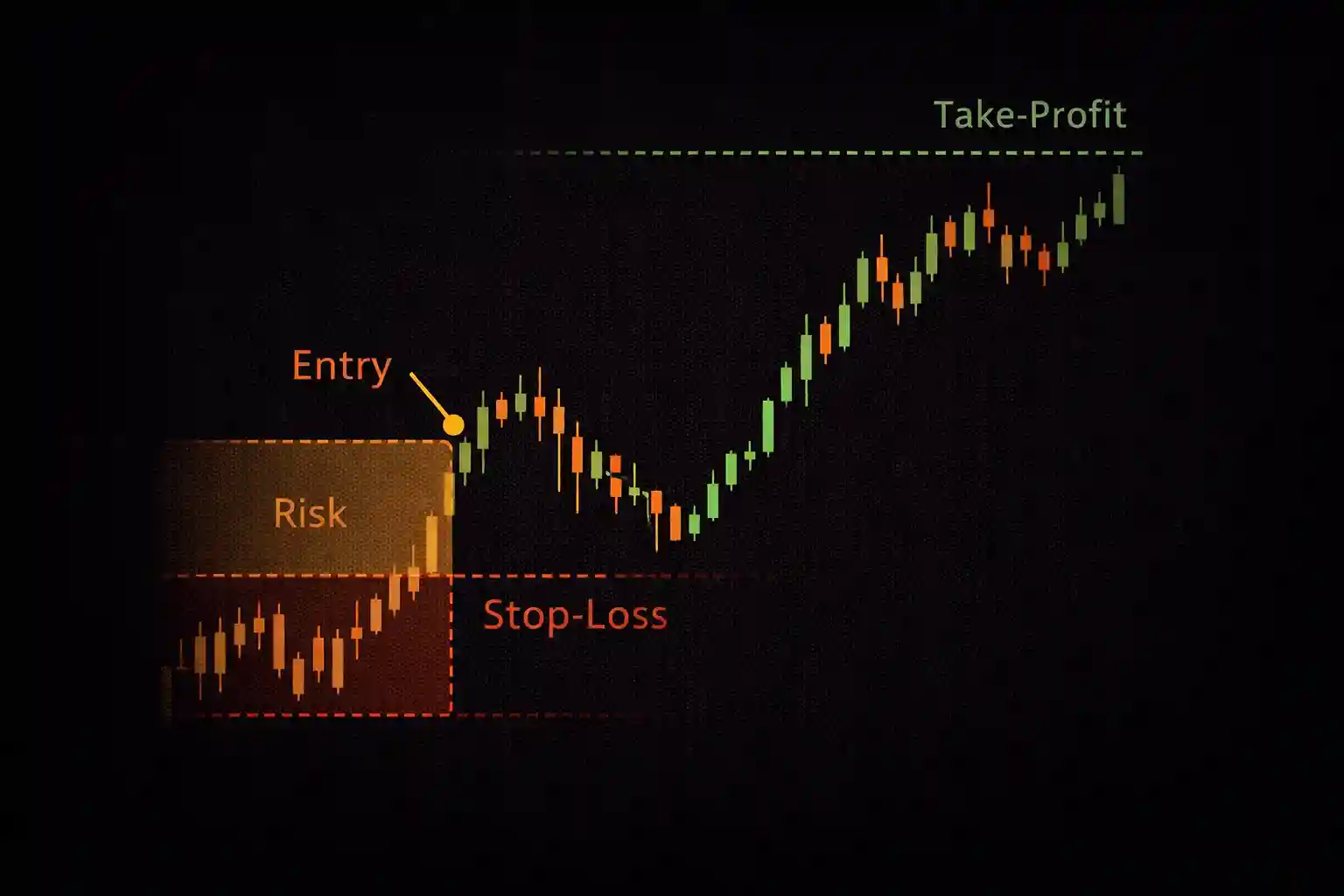
A stop-loss is an order that automatically closes your trade if the price moves against you by a set amount. It’s your safety net, your predefined “worst case” exit. Without one, a single bad trade can erase weeks of careful progress.
A take-profit works in reverse: it automatically closes your trade when the price hits your target, securing your gains.
Together, these two orders define the boundaries of every trade before you enter it. You decide in advance exactly how much you’re willing to lose and how much you’re aiming to gain.
Position Sizing Basics
Position sizing answers a simple but vital question: how much of your account should you risk on any single trade?
A widely used guideline is the 1-2% rule: risk no more than 1-2% of your total account balance on an individual trade. Here’s why that matters:
- If you have a $1,000 account and risk 2% per trade, your maximum loss on one trade is $20.
- Even a streak of five losing trades in a row (which happens to everyone eventually) would only cost you $100, leaving $900 to keep trading.
Compare that to risking 20% per trade, where five consecutive losses would wipe out roughly two-thirds of your account. Position sizing is what keeps you in the game long enough to improve.
The Role of Leverage (and Why It Cuts Both Ways)
Leverage lets you control a larger position than your account balance would normally allow. A broker offering 10:1 leverage means you can trade $10,000 worth of an asset with just $1,000 in your account.
Leverage amplifies losses with the same force it amplifies gains. If the market moves 1% against a 10:1 leveraged position, you don’t lose 1% of your capital. You lose 10%.
Think of leverage as a magnifying glass held over your trading account. It can focus sunlight to start a fire, or it can illuminate fine details. The outcome depends entirely on how you handle it. As a beginner, use the minimum leverage available (or none at all) until you genuinely understand how it affects your real positions.
Risk management is the foundation everything else rests on. But even with solid risk practices, beginners tend to fall into predictable traps. Here are the most common ones, so you can spot them before they become expensive habits.
Common Beginner Mistakes to Avoid
Nearly every new trader makes the same handful of errors. Knowing them ahead of time will sharpen your ability to recognize warning signs before they calcify into costly patterns.
- Trading without a plan: Entering trades on impulse, tips, or “feelings” instead of a defined setup with clear exit rules.
- Risking too much on a single trade: Ignoring position sizing because “this one feels like a sure thing.” No trade is ever a sure thing.
- Skipping the demo phase: Jumping straight into live trading before understanding the platform or testing a basic approach.
- Overtrading: Placing too many trades out of boredom, excitement, or a desperate need to recover losses. Quality beats quantity, always.
- Chasing losses: Immediately entering another trade after a loss to “make it back.” This emotional spiral leads to bigger losses, not recovery.
- Ignoring the economic calendar: Getting blindsided by a major data release that spikes volatility right through your open position.
- Switching strategies constantly: Abandoning an approach after two or three losing trades instead of evaluating it over a meaningful sample size.
- Neglecting to journal: Failing to track what you traded, why, and what happened. Without records, you can’t identify patterns in your own behavior.
Notice the common thread? Nearly all trading beginner mistakes are emotional. The traders who progress fastest are the ones who treat early losses as tuition, not trauma.
So you’ve placed your first trade, managed your risk, and sidestepped the worst pitfalls. What happens next?
What to Do After Your First Trade
Your first trade, whether it ends in a win or a loss, is just the starting line. What you do in the days and weeks that follow determines whether trading becomes a genuine skill or a brief experiment.
Review your trade honestly.
- Did you follow your plan?
- Did your stop-loss and take-profit levels work as intended?
- Were your emotions manageable, or did you feel the itch to intervene?
Write it all down. A simple trading journal, even a spreadsheet with the date, setup, entry, exit, result, and notes, is one of the most powerful learning tools at your disposal.
Stay on demo (or keep positions tiny). There’s no rush to scale up. Many seasoned traders recommend spending several weeks, sometimes months, cycling between demo and very small live trades. The objective is building consistency, not building a fortune overnight.
Keep learning, but stay focused. It’s tempting to chase every strategy, indicator, and trading style that crosses your screen. Resist that urge early on. Pick one approach and give it an honest shot over at least 20-30 trades before deciding whether it works for you.
Accept that losses are part of the process. No trader wins every trade. What matters is that your winning trades outweigh your losing trades over time, in both frequency and size. That only happens with discipline, patience, and consistent risk management.
Your first trade opened a door. What you build beyond it is entirely up to you.
Frequently Asked Questions


Comments