


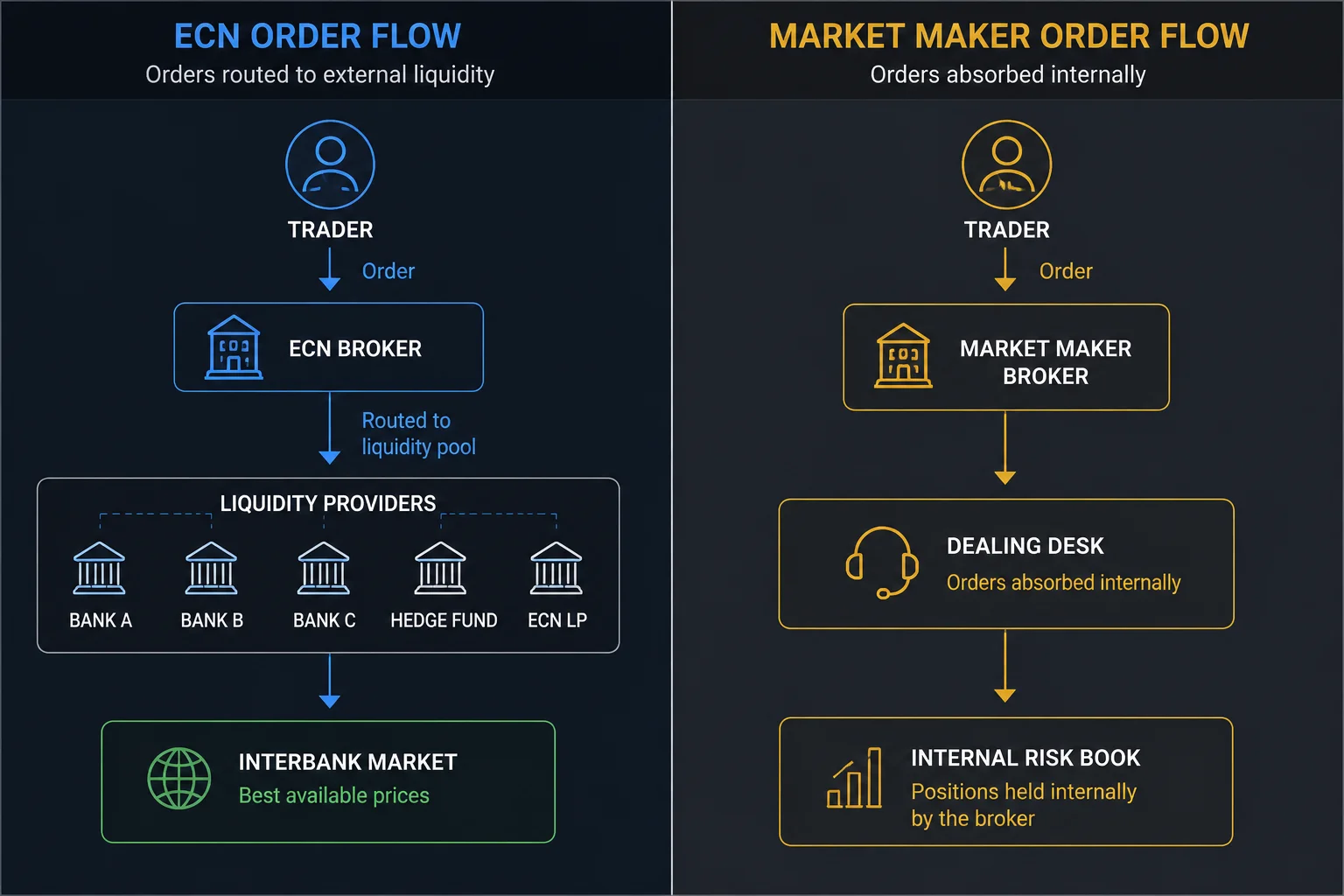
The broker you trade with is not a neutral party. Depending on their model, they either connect you to the market or become the market, and that distinction has a direct, measurable impact on your bottom line. This article breaks down how ECN and market maker brokers work structurally, what each model actually costs across different trading styles, and how to tell whether a broker’s claims match their reality.
What Is an ECN Broker?
Your broker’s fee structure is a direct consequence of how they handle your orders, and the ECN model makes that relationship unusually transparent. ECN stands for Electronic Communication Network. It describes a broker that routes your orders to an external pool of liquidity providers: typically banks, institutional traders, hedge funds, and other market participants. The broker itself acts as a conduit.
How ECN Execution Works
When you place an order with an ECN broker, it goes out to a network of liquidity providers who compete to fill it. The best available bid or ask price at that moment is what you get. The spread you see reflects real supply and demand in the market.
This is why ECN spreads are variable. During liquid market hours, EUR/USD might trade at 0.1 pips. During a major news release, that same pair could gap to 3 or 4 pips.
The process works roughly like this:
- You place an order.
- The ECN sends it to multiple liquidity providers simultaneously.
- Providers quote competing prices.
- Your order fills at the best available price.
- The broker charges a fixed commission per lot for facilitating the transaction.
The Real Cost Structure: Spreads Plus Commission
ECN cost = spread + commission per lot.
A common structure might be a raw spread of 0.0-0.2 pips on major pairs, plus a commission of $3-$7 per side per standard lot. A round-trip trade (open and close) on one lot of EUR/USD could cost you $6-$14 in commission, plus whatever spread existed at execution.
This structure is transparent. You know exactly what the broker earns from every trade. The broker makes money on volume.
So what happens when a broker does not use this model?
What Is a Market Maker Broker?
Market maker brokers create the market for you internally. Their dealing desk sets the bid and ask prices you trade on, and in most cases, they take the opposite side of your position directly.
How Market Makers Handle Your Orders
When you buy, the market maker sells to you. When you sell, they buy. Your order rarely touches the interbank market. Instead, it is internalized within the broker’s own book.
Revenue comes through the spread markup. If the interbank rate on EUR/USD is 1.10500/1.10502 (a 0.2 pip spread), a market maker might quote you 1.10498/1.10508, a 1.0 pip spread. The difference between the raw rate and what you pay is the broker’s margin.
This is why market maker accounts often advertise zero commission. That is accurate in the narrow sense. The commission equivalent is already inside the spread you are paying.
The Conflict of Interest Question
The structural reality of the market maker model is straightforward: when you lose a trade, the broker profits directly from that loss. When you win, the broker absorbs that cost.
This creates an incentive misalignment: the model’s incentives do not run in the same direction as yours. Most regulated market makers hedge a portion of client positions in the interbank market, which reduces their net exposure when those positions move in the client’s favour. But the underlying incentive structure remains.
This does not mean market maker brokers are operating improperly. Many are well-regulated and treat clients fairly. The point is that the model creates a structural tension that ECN brokers simply do not have. And understanding that tension is part of evaluating your broker honestly.
ECN vs Market Maker: Side-by-Side Cost Breakdown
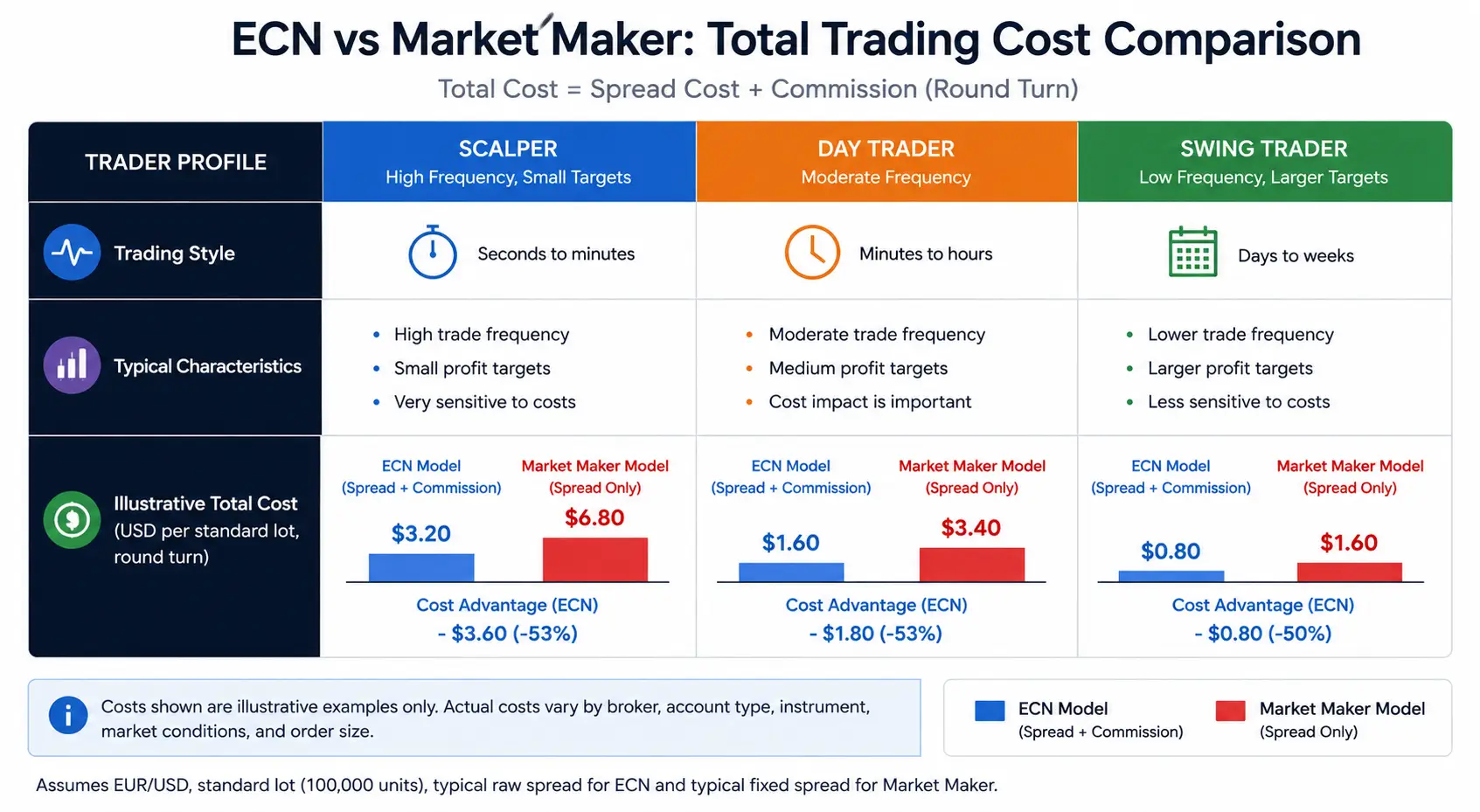
The spread you see quoted is only part of what you actually pay. Total trading cost combines spread, commission, slippage, and overnight financing, and the balance between those components shifts significantly depending on which broker model you are using.
The figures below are illustrative examples based on typical industry ranges; actual spreads and commissions vary by broker, account type, and market conditions. Use them as a framework for your own calculations, not as guaranteed quotes.
Cost Comparison by Trading Style
Trading Style | Typical Volume | ECN Total Cost (per round trip, 1 lot) | Market Maker Total Cost (per round trip, 1 lot) | Cost Advantage |
Scalper | 20-50 trades/day | $7-$10 (0.1 pip spread + $6-$7 commission) | $10-$20 (1.0-2.0 pip spread, no commission) | ECN, especially at high volume |
Day Trader | 3-10 trades/day | $8-$12 | $10-$18 | ECN for tight pairs; variable for others |
Swing Trader | 2-8 trades/week | $8-$14 | $10-$16 | Often comparable; depends on pair liquidity |
For a scalper placing 30 round-trip trades per day on EUR/USD, the difference between a 0.5 pip ECN cost and a 1.5 pip market maker cost is roughly $300 per day per lot traded. Over a month, that is a significant drag on returns.
For a swing trader making five trades per week, the gap narrows considerably.
Volume and frequency are the key variables. The more you trade, the more the spread structure matters.
Hidden Costs That Don’t Appear in the Spread
Spread and commission are the visible costs. These are the ones that matter in practice:
- Slippage: The difference between the price you ordered and the price you received. Slippage occurs in both models but tends to be more significant with market makers during fast-moving markets, since the dealing desk controls the fill.
- Requotes: A requote happens when the broker cannot fill your order at the quoted price and asks if you want to fill at a new price. More common with market maker models, particularly around news events.
- Spread widening during news: ECN brokers widen spreads because liquidity genuinely thins out. Market makers may widen spreads as a risk management measure on their book. The result looks similar on screen, but the cause is different.
- Swap rates (overnight financing): Charged by both broker types but can vary significantly. A market maker may offer more favourable swap rates to attract longer-term traders.
- Deposit and withdrawal fees: Not execution-related, but worth factoring into your total cost of doing business with any broker.
What it costs to trade is the sum of all of these, not just what the spread ticker shows you.
When a Market Maker Is the Better Choice
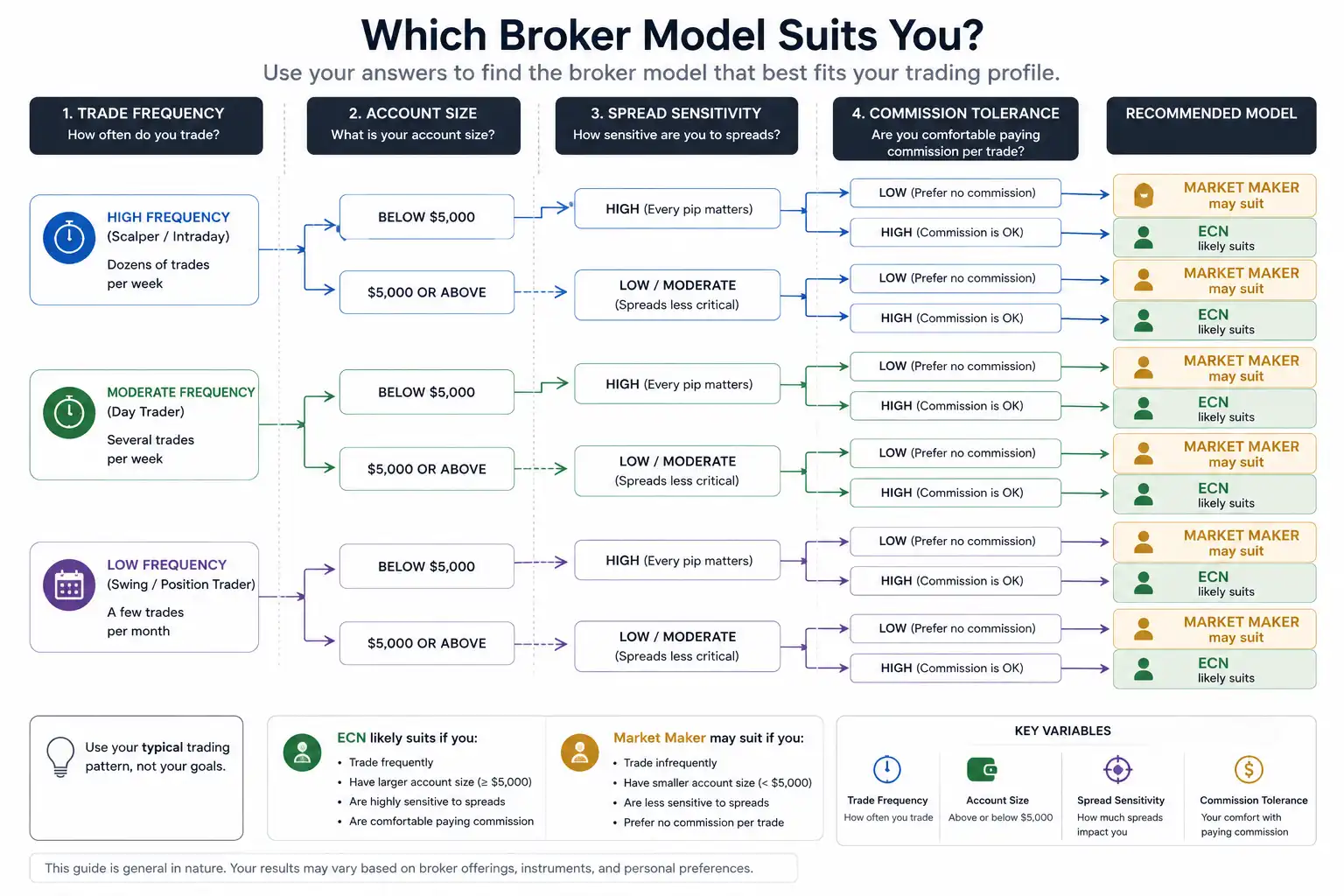
Market maker brokers exist because they serve a genuine segment of the trading population well. For the right profile, the structure is simply a different cost model.
Conditions Where Market Maker Structure Works in the Trader’s Favour
A market maker structure can be the pragmatic choice under these conditions:
- Small account sizes: Many ECN brokers have minimum deposit requirements or commission structures that eat a disproportionate share of small account returns. A market maker with a wider spread but no commission may be cheaper on a per-trade basis at lower volumes.
- Fixed spread preference: Some traders, particularly those who use risk models built around predictable costs, prefer fixed spreads. Market makers often offer these, which simplifies cost modelling even if the absolute cost is slightly higher.
- Infrequent trading: If you are placing a handful of trades per week on major pairs, the cumulative cost difference between a 1.0 pip market maker spread and a 0.2 pip ECN spread plus commission is often minimal.
- Beginner traders: A simplified fee structure (no commission invoices, clearer spread display) and often lower minimum deposits make market maker platforms a more accessible starting point.
- Specific asset availability: Some market makers offer instruments or markets that ECN networks do not include, particularly for exotic pairs or CFDs on niche indices.
When an ECN Broker Is the Better Choice
The ECN model earns its reputation among active traders for a reason. When volume goes up, the per-unit cost advantage compounds.
Account Sizes and Strategies That Benefit Most
ECN brokers tend to deliver a tangible advantage for:
- Scalpers and high-frequency traders: Raw spreads near zero mean lower cost per trade at high volume. This is the profile where ECN pricing makes the biggest difference to net returns.
- News traders: True ECN execution means your order hits the real market. Market maker execution during news events can include requotes or spread widening controlled by the dealing desk.
- Algorithmic traders: Consistent, low-latency execution and raw pricing are generally more compatible with automated strategy logic. ECN environments also tend to offer better API access.
- Accounts above $5,000-$10,000: At this level, the per-lot commission on an ECN account typically becomes cheaper than the equivalent markup embedded in market maker spreads, depending on trading frequency.
- Traders who want structural transparency: Knowing exactly what your broker earns from each trade, and confirming it carries no position against yours, is something only the ECN model reliably provides.
The crossover point (the account size and trading frequency at which ECN becomes cheaper) varies by broker. Running your own trading volume against specific broker pricing schedules is the only reliable way to find it for your situation. A trading cost and risk management framework can help you structure that calculation before you commit to an account type.
How to Tell If Your Broker Is Actually ECN
“ECN” is a commonly used marketing term. Some brokers use it accurately. Others use it loosely to describe any non-standard account tier, regardless of actual execution structure.
Here is how to assess whether a broker’s ECN claims hold up.
Red Flags and Verification Methods
Signals that suggest genuine ECN status:
- Variable spreads that fluctuate visibly during news events and off-hours
- A separate, itemised commission charge per lot (visible in the trade ticket or account statement)
- Disclosure of named liquidity providers in their documentation or on request
- Order depth or Level 2 pricing available on the platform
- Regulatory filings or third-party liquidity arrangements referenced in terms
- Positive slippage is possible (you can fill better than the price you ordered at)
Red flags that should prompt further investigation:
- An account described as “ECN” with zero commission and a wide fixed spread
- No mention of liquidity providers anywhere in their terms or website
- Dealing desk disclosure buried in the terms of service
- Uniform execution at the exact quoted price every time, regardless of market conditions (characteristic of internalized order flow)
- Customer support unable to explain how your order is routed
- The spread never widens, even during major data releases
If your broker cannot explain its liquidity relationships clearly, or if its ECN account charges no commission and carries a fixed spread, the label is being used commercially rather than structurally. Dig further before committing capital.
One practical step you can take right now: ask support directly which liquidity providers the broker connects to and where your order goes when you click buy. A genuine ECN broker will have a clear answer. A non-answer also tells you something useful.
Frequently Asked Questions


Comments