


Cognitive Bias in Trading: How Mental Blind Spots Hurt Your Results
Every trader has experienced the moment where a decision that felt logical at the time but looks baffling in hindsight. You held a losing position far too long or sized up after a hot streak, then gave back weeks of gains in a single session.
These are predictable patterns wired into how the brain handles uncertainty. Understanding cognitive bias in trading is where disciplined, consistent performance begins.
This guide covers six of the most damaging biases traders face, along with practical methods to spot and counteract each one.
Disclaimer: This content is for educational purposes only and does not constitute financial or psychological advice.

What Is Cognitive Bias in Trading
Definition and Relevance to Traders
A cognitive bias is a systematic thinking error that warps judgment and decision-making. These mental shortcuts (sometimes called heuristics) evolved to help humans act quickly under uncertainty. In daily life, they’re often good enough. In trading, they tend to backfire.
Cognitive biases in trading describe these same mental patterns when they distort analysis, risk management, and trade execution. Unlike fleeting emotional reactions, biases are consistent. The same trader will repeat the same category of error, often without noticing.
Markets are particularly unforgiving because price action exploits these tendencies. Volatility triggers fear and greed. Ambiguity forces snap judgments. The tight loop between action and outcome creates ideal conditions for distorted thinking.
Recognizing your own biases opens the door to processes and rules that blunt their impact on your bottom line.
Why Traders Are Especially Vulnerable to Cognitive Biases
Trading creates near-perfect conditions for cognitive biases to take hold. Several factors make traders more exposed than people in many other decision-making arenas:
- Uncertainty never lets up. Markets deliver incomplete information, and outcomes are never guaranteed. The brain fills gaps with assumptions, and often faulty ones.
- Feedback is muddy. A solid decision can still lose money; a poor one can turn a profit. Extracting the right lessons from results is genuinely hard.
- Emotions spike. Real money on the line trips survival instincts that steamroll rational analysis.
- Decisions compress. Fast-moving markets leave no room for careful deliberation, pushing traders toward gut reactions.
- Ego gets tangled in. Being wrong on a trade can feel like being wrong about yourself, making it painful to book losses or concede mistakes.
These conditions not only invite biases, but also magnify them. A bias that causes a minor slip in everyday life can blow up a trading account.
Confirmation Bias
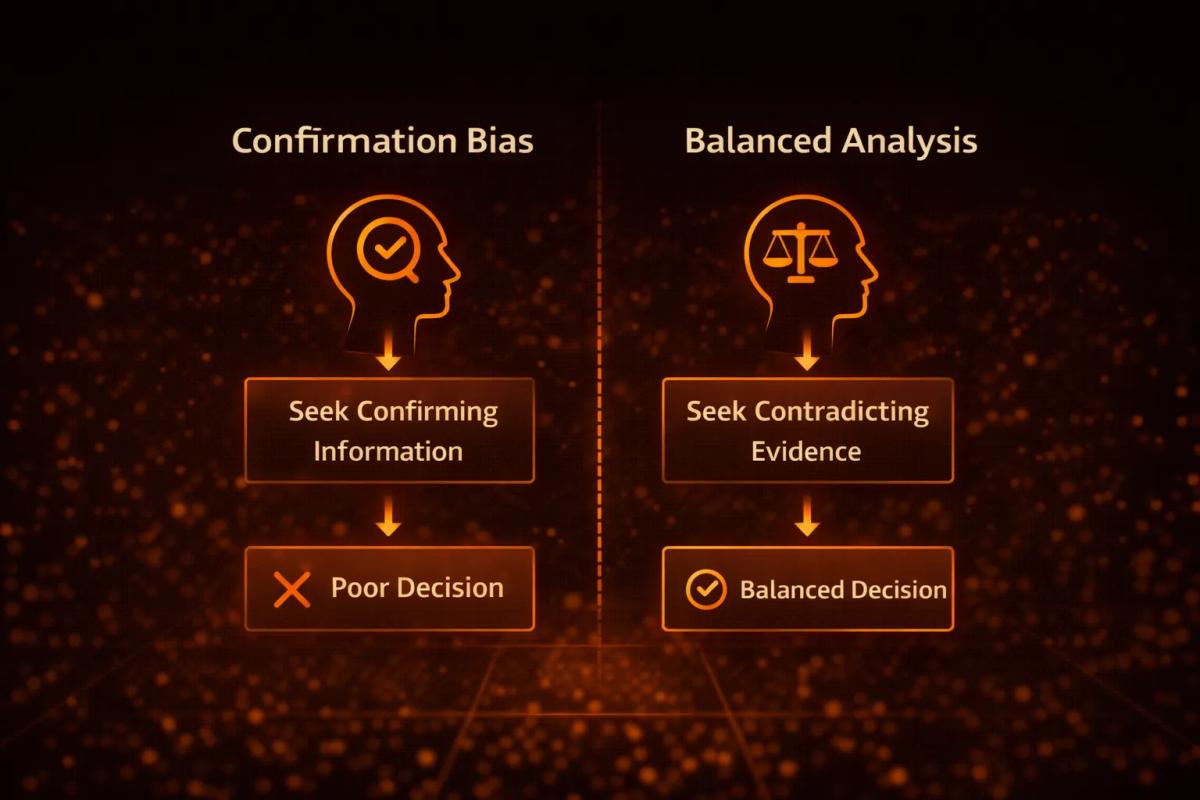
Confirmation bias is the pull toward information that backs what you already believe, while evidence that challenges it gets ignored or explained away.
How Confirmation Bias Manifests in Trading
Confirmation bias can appear in any of the market cycles. A trader who’s bullish on a stock will drift toward news, analysis, and data that support that view. Bearish signals get rationalized or simply don’t register with the same weight. The same works vice versa.
Common patterns include:
- Following only analysts or commentators who echo your market stance
- Reading ambiguous data as supportive of your position
- Waving off bad news about a holding as “already priced in”
- Remembering trades that validated your analysis while forgetting those that didn’t
- Gravitating toward chat rooms or forums where others hold similar views
The trap is that confirmation bias manufactures false conviction. You feel certain because all the evidence you’ve gathered lines up, without realizing you’ve quietly filtered out everything that doesn’t.
How to Counteract Confirmation Bias
- Hunt for disconfirming evidence. Before entering a trade, look hard for the strongest case against your thesis. What would need to be true for this trade to fail?
- Assign a devil’s advocate. If you trade with others, rotate someone into the role of arguing the opposite side of every idea.
- Use a pre-trade checklist. Build in a mandatory section where you document risks and reasons the trade could go wrong.
- Autopsy losing trades for missed signals. When a trade loses, dig into whether warning signs existed that you brushed aside.
- Widen your information diet. Follow analysts with different outlooks, including those who often disagree with your market read.
Anchoring Bias
Anchoring bias shows up when the first piece of information encountered (the “anchor”) carries outsized weight in later decisions, even when it’s stale or irrelevant.
How Anchoring Bias Manifests in Trading
Traders anchor to prices constantly, often unconsciously. The most common anchors:
- Entry price: Judging a position by whether it’s above or below your cost basis rather than its current outlook
- Prior highs or lows: Expecting a stock to revisit an old price simply because it traded there before
- Round numbers: Assigning undue importance to $100, $50, and similar levels
- Analyst targets: Treating an arbitrary number as meaningful valuation
- Original thesis: Clinging to an initial view even as conditions shift
A stock that traded at $150 last month isn’t automatically cheap at $100. That prior price is just a number and says nothing about present value. Yet traders routinely act as though past prices exert gravitational pull on future ones.
How to Counteract Anchoring Bias
- Evaluate positions from scratch. Ask: “If I had no stake, would I enter this trade today at this price?” If not, consider why you’re still in it.
- Ground analysis in current conditions. Build your case around present fundamentals and technicals, not historical price tags.
- Use multiple reference points. If anchors are unavoidable, use several (moving averages, valuation metrics, comparable assets) rather than fixating on one.
- Write down your thesis at entry. Specify why you entered and what would invalidate the idea. Review that instead of your cost basis.
- Strip price labels temporarily. Some traders evaluate charts without numbers to focus on pattern and structure rather than specific levels.
Loss Aversion
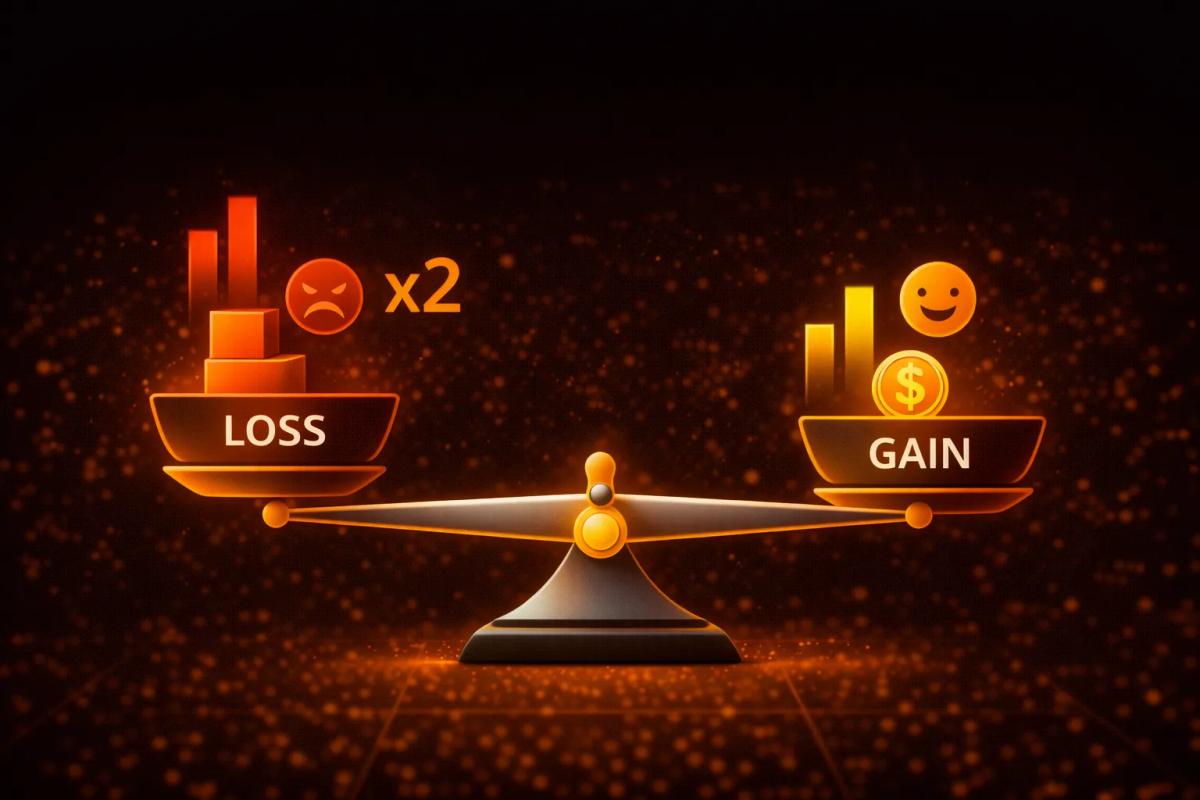
Loss aversion refers to the tendency for losses to sting roughly twice as much as equivalent gains satisfy. A $1,000 loss hurts more than a $1,000 gain pleases.
How Loss Aversion Manifests in Trading
Loss aversion breeds several damaging habits:
- Holding losers too long: Refusing to realize a loss and hoping for a bounce, even after the original thesis breaks down
- Cutting winners too short: Grabbing profits quickly to lock them in and dodge the risk of a winner turning sour
- Dodging necessary risk: Passing on valid setups because the chance of loss feels unbearable
- Moving stop losses: Widening stops as price nears them to avoid triggering a realized loss
- Averaging down reflexively: Adding to underwater positions to lower average cost rather than accepting defeat
The lopsided emotional impact of losses versus gains produces lopsided behavior. Traders turn risk-seeking when staring at losses (hoping for recovery) and risk-averse when sitting on gains (cashing out early). That’s the opposite of sound risk management rules.
How to Counteract Loss Aversion
- Set exits before you enter. Define stop losses and profit targets in advance, when emotions aren’t running the show.
- Size positions to manage emotional impact. If a potential loss feels unbearable, you’re too big.
- Think in R-multiples. Frame risk in units rather than dollars. A 2R win and a 1R loss nets positive regardless of how each felt.
- Treat losses as overhead. Even strong traders lose on 40–50% of trades. Each loss is data, not failure.
- Automate exits where you can. Stop-loss orders take the decision out of the moment when emotional pressure peaks.
Overconfidence Bias
Overconfidence bias is the pull toward overrating your own skill, knowledge, or forecast precision. Most people believe they’re above average: a statistical improbability.
How Overconfidence Bias Manifests in Trading
Trading draws confident personalities, and early wins can inflate that confidence to hazardous levels. Signs of overconfidence:
- Oversized positions: Betting too large because you’re “certain” about a trade
- Skimped research: Trusting instincts instead of doing the work
- Neglected risk management: Treating stops as optional since you don’t plan to need them
- Overtrading: Taking thin setups because you believe you can make anything work
- Underestimated uncertainty: Assigning high odds to outcomes that are genuinely unknowable
- Skewed credit: Chalking up wins to skill, blaming losses on luck
After a winning run, overconfidence often crests just before a steep drawdown. Markets have a habit of humbling traders who mistake a favorable stretch for superior ability.
How to Counteract Overconfidence Bias
- Track actual performance. Keep detailed records of predictions versus outcomes. Data corrects inflated self-perception.
- Hold position sizing steady. Don’t let conviction set size. Use a systematic approach tied to predefined risk parameters.
- Plan for being wrong. Enter every trade with a contingency for when your analysis misses.
- Study your losses. Spend more time dissecting losers than winners. Wins often teach less.
- Adopt a trading psychology framework. Regular self-assessment keeps your read on your own tendencies honest.
Recency Bias
Recency bias tilts attention toward recent events while discounting historical patterns. What happened last week feels more relevant than what unfolded over a decade.
How Recency Bias Manifests in Trading
Recency bias colors how traders read markets and their own results:
- Extrapolating current trends: Assuming the prevailing direction will persist indefinitely
- Chasing recent performance: Buying assets or strategies that have worked lately
- Overreacting to a cold streak: Ditching a sound strategy after a handful of losses
- Forgetting base rates: Overlooking how rare certain events are just because one occurred recently
- Resizing on short-term results: Ramping up after wins and pulling back after losses based on a thin sample
Three losses in a row can feel like a broken system, even when the results sit comfortably inside normal statistical bounds. Three wins can create the illusion that risk has shrunk.
How to Counteract Recency Bias
- Stretch the timeframe. Always weigh current conditions against historical norms.
- Lean on statistics. Know the expected win rate and drawdown profile of your approach. Don’t overreact to routine variance.
- Consult historical data. When sizing up a strategy or asset, span multiple cycles instead of just the recent tape.
- Pause before big changes. Give yourself breathing room before altering course based on fresh results.
- Keep a trading journal. Written records counter the memory distortions that feed recency bias. A trading journal provides an accurate timeline your mind might quietly revise.
Herd Mentality
Herd mentality is the pull to follow the crowd, adopting majority views even when they clash with your own analysis.
How Herd Mentality Manifests in Trading
Social proof is a potent psychological force. In trading, herd behavior surfaces as:
- Buying at tops: Piling in because everyone else is bullish, often right before a reversal
- Panic selling at bottoms: Dumping positions when fear spreads, locking in losses at the worst moment
- Riding social media sentiment: Basing decisions on what’s trending in forums or financial media
- Second-guessing your work: Doubting your own analysis when it conflicts with consensus
- FOMO (Fear of Missing Out): Chasing moves because others are cashing in, regardless of whether the setup fits your rules
Herd behavior can feel safe. Agreement is comforting. But in markets, the crowd is often wrong at turning points. Consensus views are already baked into price.
How to Counteract Herd Mentality
- Build and trust your own methodology. A clear process makes it easier to tune out social noise.
- Question unanimity. When everyone agrees, ask what they might be missing.
- Limit exposure to chatter. Spend less time on social media, cable news, and forums during trading hours.
- Stick to your criteria. Does this setup meet your entry rules? If not, the crowd’s excitement is irrelevant.
- Treat extreme consensus as a warning. Widespread agreement often marks inflection points. Consider what happens if the majority is wrong.
How to Build a Bias: Aware Trading Process
Awareness without structure leads to the same mistakes dressed in sharper rationalizations. Lasting change requires built-in safeguards.
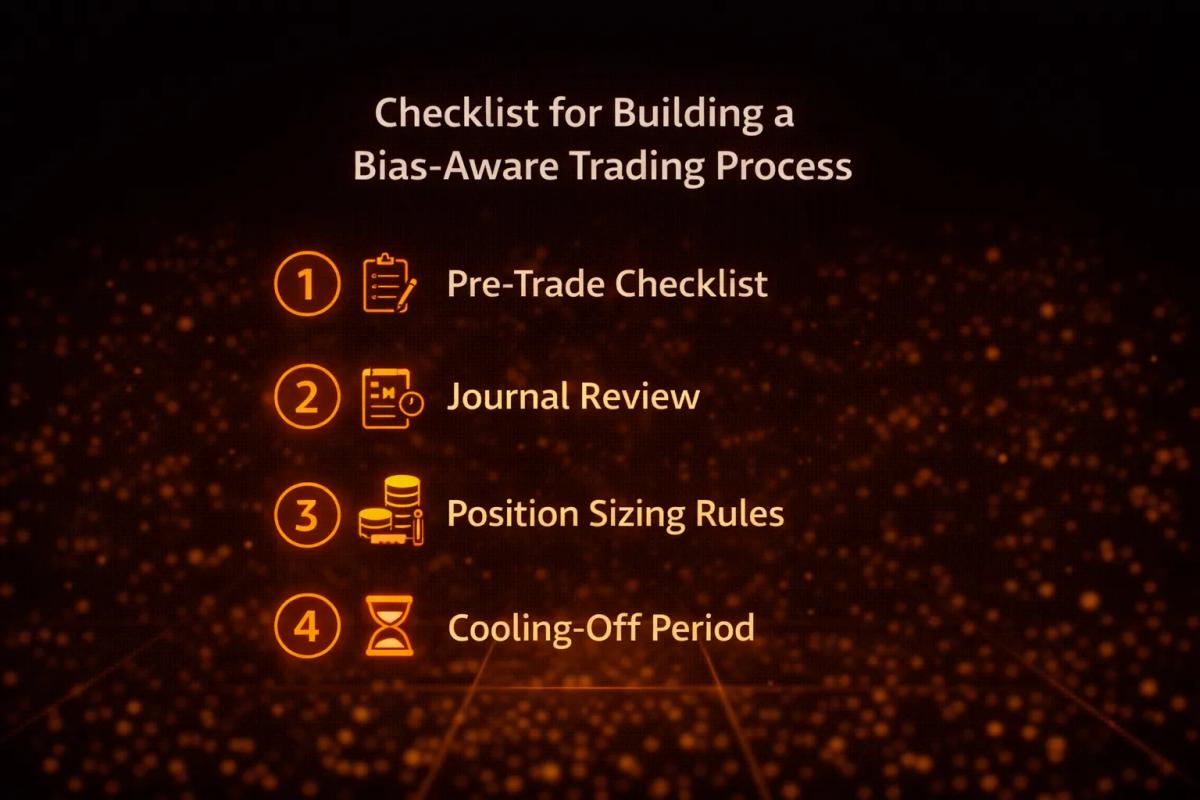
A bias-aware process typically includes:
- Written trading rules. Spell out entry criteria, exit criteria, position sizing, and risk limits. Decisions made ahead of time are harder for bias to hijack.
- Pre-trade checklists. Before every trade, run through a standard list: thesis, risks, what would prove you wrong, and confirmation the trade fits your rules.
- Trade journaling. Record every trade with the reasoning you had at the time. Regular review surfaces patterns invisible in the moment. Hunt specifically for recurring, bias-driven errors.
- Cooling-off periods. After big wins or losses, enforce a waiting window before making major calls. Emotional extremes amplify bias.
- Process audits. Weekly or monthly, compare trades against your rulebook. Did you follow the plan? Where did you stray, and why?
- Consistent position sizing. Size based on predetermined risk parameters, not conviction. This single guardrail defends against multiple biases at once.
Of course, nobody can become a flawlessly rational trader. The aim is to install enough structure that biases get fewer chances to steer decisions. Rules-based and systematic trading approaches exist partly because they strip out discretionary moments where bias can slip in.
Final Thoughts
Cognitive biases are part of being human. Every trader, no matter how seasoned, remains susceptible.
What separates consistently profitable traders from the rest isn’t the absence of bias, but the presence of systems designed to limit its reach. Checklists, journals, written rules, and disciplined routines create guardrails that keep you on course when instinct wants to pull you off it.
Start by pinpointing which biases show up most often in your own trading. Comb through your history with fresh eyes. Look for patterns in your mistakes. Then weave specific countermeasures into your process.
Over time, trimming the damage from cognitive errors compounds into meaningful improvement. Sometimes, the difference between a successful trader and a failing one is simply making fewer bad decisions.

About the authors

Related articles
Common Trading Mistakes and How to Avoid Them
Learn the most common trading mistakes that cost beginners money. Discover how to identify and avoid these errors to protect your capital and improve results.
Hedging Strategies in Trading: How to Protect Positions
Learn how hedging strategies help traders manage risk. Explore options, pairs trading, and diversification techniques with practical guidance.

How to Create a Risk Management Strategy: A Step-by-Step Guide
Learn how to create a risk management strategy step by step. Build a risk plan with clear rules to protect your trading capital.
0 comments